100×worker · job analysis
Will AI Replace Pharmacists, and What Should You Do About It?
Pharmacists working in pharmaceutical manufacturing and drug development, often called industrial pharmacists, spend a large share of their time on documentation: literature reviews, toxicology summaries, batch release paperwork, and regulatory filings. That is exactly the kind of structured, text-heavy work generative AI is good at drafting.
Microsoft Research analyzed 200,000 real Copilot conversations and scored how applicable generative AI is to different occupations. Pharmacists scored 27.8%, meaning roughly a quarter of documented work activities show clear AI applicability. That is a moderate score, well below translators (49%) and well above nurses (12%). Anthropic's Economic Index, which classifies millions of Claude conversations against O*NET task lists, separates AI use into automation-like use (AI does the task) and augmentation-like use (AI assists a human doing the task). For pharmacists, most current use falls into the augmentation category: drafting, summarizing, checking, not deciding.
This article breaks the job into four buckets: tasks to eliminate, tasks to automate, tasks to delegate to AI with human review, and tasks to keep entirely human. The legal responsibility for releasing a drug batch or approving a formulation never moves to software.
A pharmacist in industrial practice develops, tests, and oversees medicines, ensuring every batch complies with legal and safety requirements.
The task split: what AI takes over and what stays yours
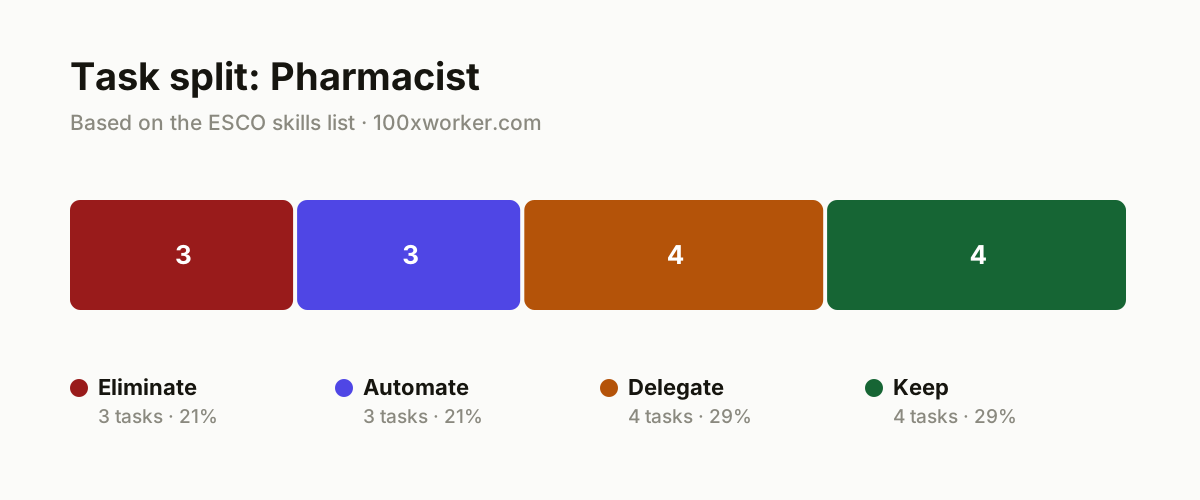
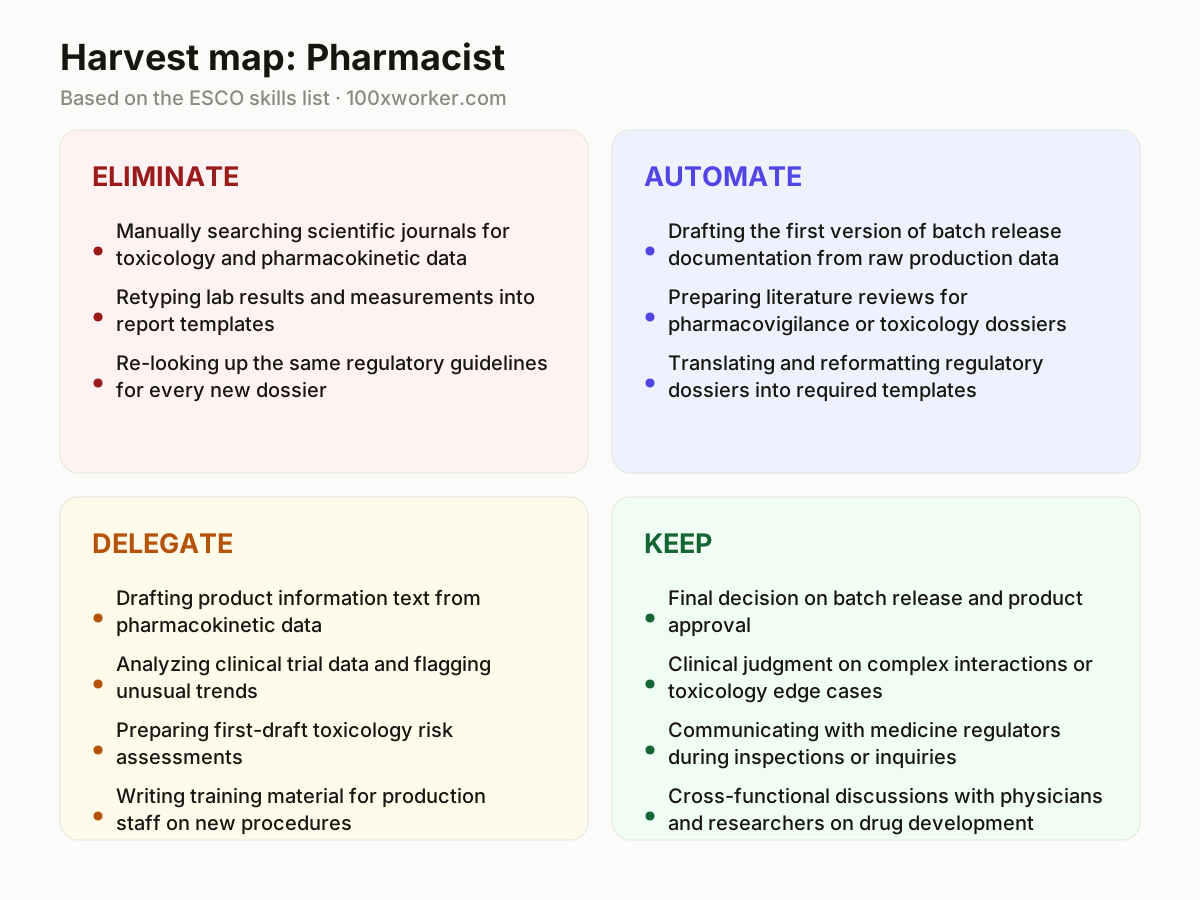
The eliminate/automate/delegate/keep framework sorts pharmacist tasks by how much human judgment they require. Eliminate means the task disappears because a system now does it instantly. Automate means AI produces a usable first output with light oversight. Delegate means AI drafts, but a pharmacist must review and correct before anything ships. Keep means the decision, the liability, or the relationship stays fully human, no exceptions.
| Task | Bucket | Why |
|---|---|---|
| Manually searching scientific journals for toxicology and pharmacokinetic data | eliminate | AI search tools scan and summarize literature far faster than article-by-article manual review. |
| Retyping lab results and measurements into report templates | eliminate | Pure copy work with no judgment involved, safe to automate without any loss of quality. |
| Re-looking up the same regulatory guidelines for every new dossier | eliminate | A searchable knowledge system surfaces the answer instantly, no repeated lookup needed. |
| Drafting the first version of batch release documentation from raw production data | automate | Structured data plus fixed templates are exactly what AI drafting tools handle well. |
| Preparing literature reviews for pharmacovigilance or toxicology dossiers | automate | Repeatable work with a fixed structure, well suited to full automation with review. |
| Translating and reformatting regulatory dossiers into required templates | automate | Translation and formatting are mechanical tasks, the underlying content does not change. |
| Drafting product information text from pharmacokinetic data | delegate | AI produces a strong first draft, the pharmacist corrects medical nuance and accuracy. |
| Analyzing clinical trial data and flagging unusual trends | delegate | AI spots patterns quickly, interpretation and next steps stay with the pharmacist. |
| Preparing first-draft toxicology risk assessments | delegate | AI structures known risks, the pharmacist judges context and edge cases. |
| Writing training material for production staff on new procedures | delegate | AI writes a working draft, the pharmacist checks it against actual floor practice. |
| Final decision on batch release and product approval | keep | This carries legal and personal liability that belongs to the pharmacist, not software. (Your edge: Legal accountability sits with a licensed human, never with a model.) |
| Clinical judgment on complex interactions or toxicology edge cases | keep | Rare exceptions require years of expertise and context that AI systems lack. (Your edge: Experience with rare cases that no training data ever covered.) |
| Communicating with medicine regulators during inspections or inquiries | keep | Building trust and giving account is relational work, not a drafting task. (Your edge: Personal credibility with the regulator, built over years.) |
| Cross-functional discussions with physicians and researchers on drug development direction | keep | Decisions about development priorities weigh competing interests, not just data. (Your edge: Negotiating priorities among people with different goals.) |
Which pharmacist tasks can AI take over?
AI is strongest at the paperwork side of the job: searching literature, summarizing toxicology findings, drafting regulatory dossiers, and formatting documents into required templates. These are structured, repeatable tasks with clear inputs and outputs. Microsoft's applicability score of 27.8% for pharmacists reflects this: a real but limited share of the job. AI is weak at anything involving legal sign-off, rare clinical exceptions, or judgment calls that combine data with professional experience. The practical split is documentation versus decision. AI increasingly handles the first, humans keep the second.
Will AI replace pharmacists?
No. Anthropic's Economic Index shows most current AI use in professional work is augmentation, meaning AI assists a person rather than replacing the role outright. Pharmacists carry legal responsibility for batch release, formulation approval, and safety sign-off, responsibilities that cannot be transferred to software regardless of how good the AI output is. What changes is the task mix inside the job: less manual searching and drafting, more reviewing, correcting, and deciding. The job title stays, the daily task list shifts.
What can you do this month with AI as a pharmacist?
Start small and specific. Pick one recurring document type, such as a toxicology literature summary or a batch release report, and test whether an AI tool can produce a usable first draft from your raw data. Time how long your review and correction takes versus writing it from scratch. If it saves real time, build a template prompt for it. Do not start with your highest-stakes documents. Start with the lower-risk, high-repetition ones, then expand once you trust the output pattern.
How does AI change the role of an industrial pharmacist within pharmaceutical manufacturing?
The role shifts from producing documentation to verifying it. Where a pharmacist once spent hours drafting a toxicology summary or formatting a regulatory dossier, AI now produces a first version in minutes. The pharmacist's value moves toward catching errors, applying context AI cannot access, and making the final call on release. This mirrors what employer research generally describes: AI changes the task list inside a job more than it changes the job title itself. The core professional identity, ensuring safe, compliant medicines, stays intact.
AI changes not your job, but your task list.
UWV (Dutch employers' insurance agency), based on a survey of 2,300 employers
Become the AI person on your team
Build a personal prompt library for recurring documents
Save working prompts for literature reviews, risk assessment drafts, and dossier reformatting. Reuse and refine them instead of starting from scratch each time.
Set a hard review checklist before anything ships
Because AI drafts convincingly even when wrong, keep a short checklist of what you always verify manually: units, regulatory citations, and toxicology thresholds.
Track time saved, not just tasks automated
Log how much review time an AI-assisted draft actually takes versus writing from scratch. Use that to decide where automation is worth the risk and where it is not.
Want this for your actual task list?
The free scan on the homepage builds your personal task map in 30 seconds, based on your role and industry.
Run the free task scanTools for this work
| Tool | For which tasks | The sober take |
|---|---|---|
| Microsoft Copilot | Drafting batch release reports, summarizing production data, reformatting documents | Widely used in enterprise settings, the same tool Microsoft's own applicability research is based on. |
| Claude (Anthropic) | Literature review drafts, toxicology summaries, long-document analysis | Strong for augmentation-style tasks where a human reviews the output closely. |
| ChatGPT Enterprise | First-draft regulatory text, training material for production staff | General-purpose drafting tool, requires a fixed review process to catch errors. |
| Document management systems with AI search | Eliminating repeated lookup of regulatory guidelines and prior dossiers | Search quality depends heavily on how well internal documents are indexed. |
Prompts to try today
Toxicology literature summary draft
Batch release report first draft
Regulatory dossier reformatting
Related jobs
Frequently asked questions
How much of a pharmacist's job can generative AI actually handle?
Microsoft Research scored generative AI applicability at 27.8% for pharmacists, based on analysis of 200,000 real Copilot conversations. That places pharmacists in the middle range: well below translators (49%) but clearly above nurses (12%). This means AI is genuinely useful for roughly a quarter of documented work activities, mostly drafting and summarizing, but the majority of the job still requires human judgment or hands-on decisions.
Is AI use in this field mostly automation or augmentation?
Anthropic's Economic Index, which classifies millions of Claude conversations against O*NET task categories, splits AI use into automation-like (AI completes the task alone) and augmentation-like (AI assists a human). For professional, judgment-heavy fields like pharmaceutical work, augmentation dominates: AI drafts, summarizes, and structures information, while a qualified person reviews and decides.
Should I worry about my job being replaced?
The tasks most at risk are the repetitive, document-heavy ones: literature searches, first-draft summaries, and template formatting. The parts of the job tied to legal sign-off, rare clinical judgment, and regulator relationships are not something current AI systems can take on. Focus on shifting your time toward review, judgment, and communication rather than manual drafting.
Where can I find reliable data on how AI affects specific occupations?
Microsoft Research publishes occupation-level applicability scores openly on GitHub under a CC BY 4.0 license. Anthropic's Economic Index offers similar data classified against O*NET tasks. Eurostat tracks actual adoption rates of generative AI across the EU population. The European Commission's ESCO taxonomy describes 3,039 occupations with associated skills across 28 languages, useful for mapping which specific tasks make up a given job title.
Sources
- Microsoft Research, Working with AI: Measuring the Applicability of Generative AI to Occupations (2025)
- Anthropic Economic Index
- Eurostat, Use of generative artificial intelligence (isoc_ai_iaiu)
- ESCO, European Commission occupational taxonomy
Hendrik De Winne, author of Becoming AI-Savvy, founder of VibeLab. Helps teams redesign their work with AI.
This article was drafted with AI assistance from public data sources and editorially reviewed.