100×worker · job analysis
Will AI Replace Payroll Administrators?
Payroll work runs on rules: contracts, pay scales, tax tables, overtime thresholds. That makes large parts of it a natural fit for generative AI, but not all of it. Microsoft Research analyzed 200,000 real conversations people had with Copilot and built an occupation-level 'AI applicability score.' Payroll and timekeeping clerks, the closest match to payroll administrator, scored 21.8%, meaning roughly one in five work activities shows AI being used in ways that plausibly replace the task rather than just support it.
That number sits in the middle of the scale, well below translators (49%, the highest-scoring occupation in the dataset) and above nurses (12%). It tells you payroll is neither a role AI leaves untouched nor one it can fully take over. Anthropic's Economic Index, which classifies millions of Claude conversations against standardized O*NET task lists, finds the same pattern across office occupations more broadly: most real AI use looks like augmentation, a human working alongside the model, rather than full automation.
The practical question is not whether AI touches payroll work. It already does. The question is which tasks disappear, which get automated end-to-end, which you delegate to AI as a first draft, and which stay firmly yours.
A payroll administrator manages employee time tracking, wage calculation, and pay disbursement, and checks the accuracy of that data.
The task split: what AI takes over and what stays yours
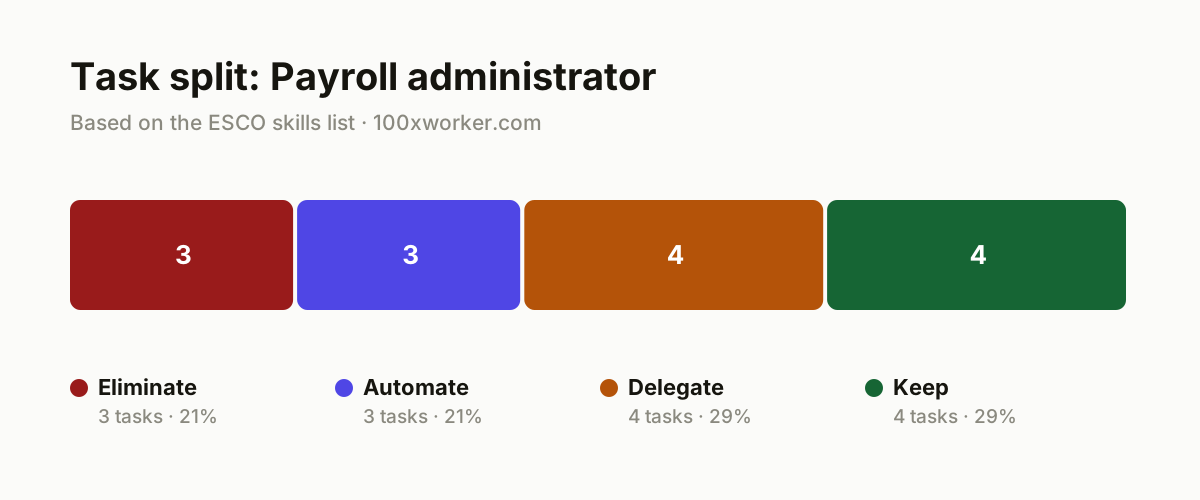
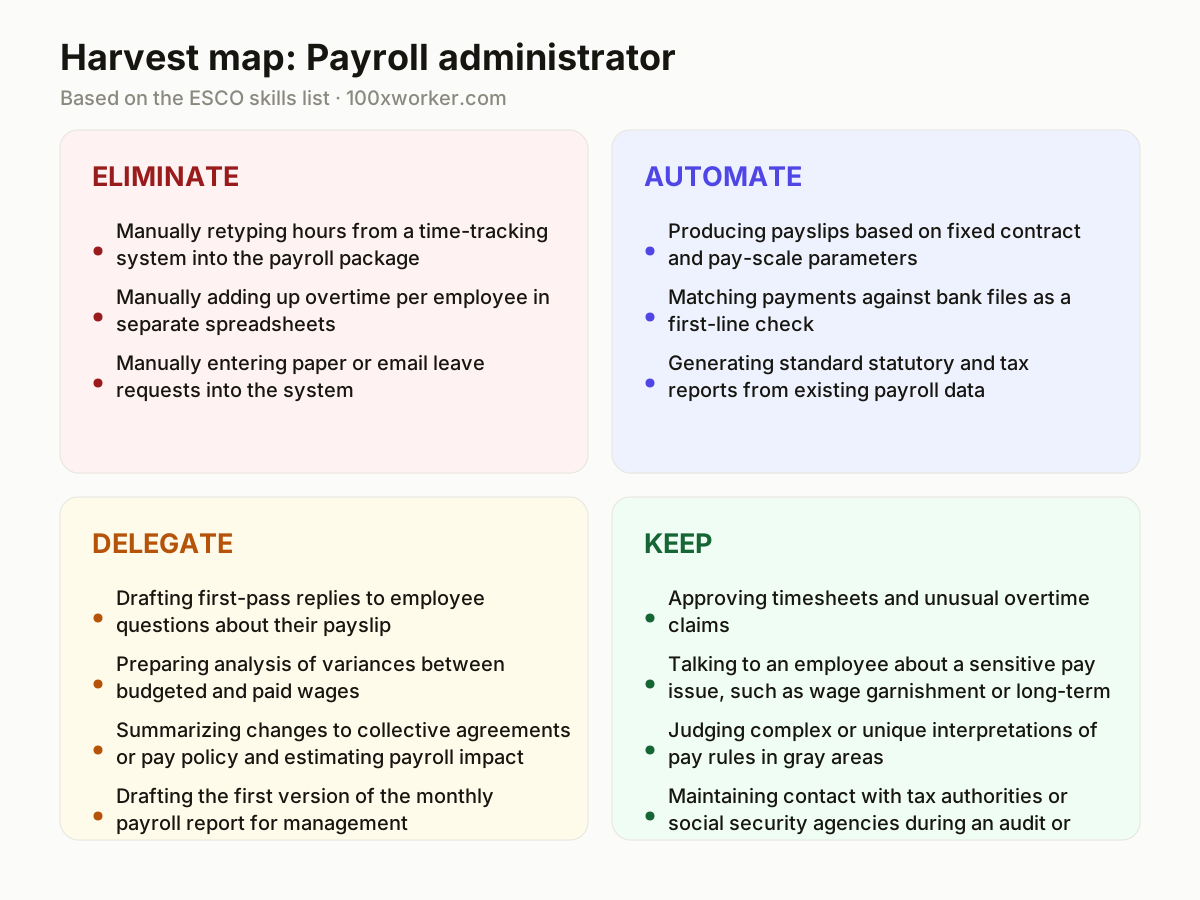
Not every payroll task changes the same way. Some tasks disappear entirely once systems talk to each other directly (eliminate). Some get handled end-to-end by software with no supervision needed per step (automate). Some are best done as an AI-drafted first pass that you review and finalize (delegate). And some require a named, accountable person and stay with you no matter how good the tools get (keep). Sorting your own task list into these four buckets is a more useful exercise than asking whether 'AI will replace payroll.'
| Task | Bucket | Why |
|---|---|---|
| Manually retyping hours from a time-tracking system into the payroll package | eliminate | A direct system integration makes double entry pointless work. |
| Manually adding up overtime per employee in separate spreadsheets | eliminate | Payroll systems calculate this more accurately and without human error. |
| Manually entering paper or email leave requests into the system | eliminate | Employee self-service portals make this manual step unnecessary. |
| Producing payslips based on fixed contract and pay-scale parameters | automate | Repetitive, rule-based work that an AI agent handles faster and error-free. |
| Matching payments against bank files as a first-line check | automate | Pattern recognition in transaction data is exactly what automation does well. |
| Generating standard statutory and tax reports from existing payroll data | automate | Fixed templates with fixed fields, ideal for an agent working without step-by-step supervision. |
| Drafting first-pass replies to employee questions about their payslip | delegate | AI writes the first version, you check accuracy and tone before sending. |
| Preparing analysis of variances between budgeted and paid wages | delegate | AI surfaces the patterns, you decide whether it's an error or a real deviation. |
| Summarizing changes to collective agreements or pay policy and estimating payroll impact | delegate | AI reads and structures the text, you test the interpretation against real cases. |
| Drafting the first version of the monthly payroll report for management | delegate | The numbers and structure are already there, you add context and judgment. |
| Approving timesheets and unusual overtime claims | keep | This is a formal control step that carries personal accountability. (Your edge: final responsibility and liability for errors rest with you) |
| Talking to an employee about a sensitive pay issue, such as wage garnishment or long-term sick leave | keep | Discretion and trust require a human on the other end of the conversation. (Your edge: trust and discretion cannot be automated) |
| Judging complex or unique interpretations of pay rules in gray areas | keep | Every exception requires judgment that goes beyond pattern matching. (Your edge: legal liability sits with the person, not the model) |
| Maintaining contact with tax authorities or social security agencies during an audit or dispute | keep | Institutional relationships and formal accountability need a named, reachable person. (Your edge: you're the accountable contact who answers for the numbers) |
Will AI replace payroll administrators?
Not as a full role replacement, at least not based on current data. Microsoft Research's applicability score for payroll and timekeeping clerks sits at 21.8%, meaning most of the job still requires a human. What changes is the mix of tasks: less manual data entry and reconciliation, more review, judgment, and employee conversations. Anthropic's Economic Index shows the same shift across office work generally, with AI use skewing toward augmenting a person's work rather than replacing the whole job. Expect fewer payroll administrators doing pure data entry and more doing exception handling, approvals, and communication.
Which payroll administrator tasks will AI take over?
AI is already strong at the rule-based parts of payroll: producing payslips from fixed contract data, matching payments against bank files, and generating standard statutory reports. These are high-volume, low-ambiguity tasks with clear inputs and outputs, exactly the profile Microsoft Research's applicability score picks up on. Tasks that involve manual retyping between systems, like copying hours from a time clock into the payroll package, disappear once systems are integrated rather than being 'done by AI' as such. What AI does not take over cleanly are approvals, sensitive conversations, and judgment calls in gray-area cases.
What can I actually do with AI as a payroll administrator this month?
Start small and concrete. Use an AI assistant to draft replies to routine payslip questions, then edit before sending. Ask it to summarize a policy or collective agreement change and flag what it might mean for payroll calculations, then verify against the source document. Feed it (anonymized) budget-versus-actual wage data and ask it to flag unusual variances for you to investigate. None of this requires new software approval in most companies if your organization already has an AI assistant like Copilot or Claude available; it requires changing what you personally hand off first.
How do you become the AI-savvy person on the payroll team?
Map your own task list against the four buckets: eliminate, automate, delegate, keep. Pick the delegate tasks first, since they show the fastest visible time savings with the lowest risk (you still review the output). Document which prompts and workflows actually save time and share them with colleagues. Learn to spot when an AI-drafted variance analysis or policy summary is wrong, since that skill, not prompt-writing, is what makes you the reliable check in the process. Being the person who knows where AI helps and where it fails is more valuable than being the fastest adopter.
Most real-world AI use in professional tasks looks more like augmentation than full automation.
Anthropic Economic Index
Become the AI person on your team
Build a personal prompt library for recurring payslip questions
Collect the questions employees ask most often (tax withholding, garnishment deductions, overtime calculation) and keep tested AI prompts for drafting first-pass answers. Reuse and refine them instead of starting from scratch each time.
Run a monthly AI-assisted variance check before the human review
Feed budgeted versus actual payroll data into an AI assistant and ask it to flag anomalies before you do the manual review. This turns AI into a first filter rather than a replacement for your judgment.
Keep a short log of AI mistakes you catch
Note the specific cases where an AI-drafted summary or analysis was wrong. This becomes both a training resource for colleagues and evidence of why human review still matters in payroll.
Want this for your actual task list?
The free scan on the homepage builds your personal task map in 30 seconds, based on your role and industry.
Run the free task scanTools for this work
| Tool | For which tasks | The sober take |
|---|---|---|
| Microsoft Copilot | Drafting employee replies, summarizing policy changes, first-draft management reports (delegate bucket) | Useful where payroll data is already in Microsoft 365 or Excel workflows. |
| Claude (Anthropic) | Summarizing collective agreements, drafting variance analysis narratives (delegate bucket) | Good for long, dense policy documents that need structured summaries. |
| Payroll platform native automation (e.g., built-in payslip generation and bank reconciliation modules) | Payslip production, payment matching, statutory reporting (automate bucket) | Check what your existing payroll software already automates before adding new AI tools. |
| Employee self-service portals | Leave requests, timesheet submission (eliminate bucket) | Removes manual re-entry rather than 'using AI' in the strict sense. |
Prompts to try today
Draft a payslip explanation reply
Summarize a policy or collective agreement change
Flag payroll variances for review
Related jobs
Frequently asked questions
How many payroll tasks can AI actually do today?
Microsoft Research's applicability score puts payroll and timekeeping clerks at 21.8%, based on analysis of real Copilot conversations. That means roughly one in five work activities shows AI plausibly handling the task, mostly the rule-based parts: payslip generation, payment matching, and standard reporting. The remaining activities, approvals, sensitive conversations, and judgment calls, are not well captured by current AI applicability data and remain human-led.
Is payroll administration a high-risk job for automation?
It depends on which framework you use. Older studies like Frey and Osborne (2013) predate large language models and use a different methodology, so they are not directly comparable to newer AI-specific scores. Microsoft Research's 2025 applicability score of 21.8% for payroll clerks sits in the middle of their occupation ranking, well below high-applicability roles like translators (49%) and above low-applicability roles like nurses (12%).
Do I need to learn to code or use complex AI tools?
No. Most useful AI applications in payroll involve writing clear prompts for tools you likely already have access to, such as Copilot or Claude, not building automations or writing code. The higher-value skill is knowing which tasks to hand to AI as a draft, how to check the output, and which tasks (approvals, sensitive conversations, dispute contact) to keep entirely human-led.
What should I tell my manager about AI and payroll workload?
Frame it around tasks, not job titles. Point out which specific tasks on your list are candidates for elimination (manual re-entry), automation (payslip generation, reporting), delegation (drafting replies and analyses), or must stay human-led (approvals, sensitive conversations, audits). This task-level framing, also used by workforce researchers analyzing employer surveys, gives a manager something concrete to plan around instead of a vague statement about 'AI in payroll.'
Sources
- Microsoft Research, Working with AI: Measuring the Applicability of Generative AI to Occupations (2025)
- Anthropic Economic Index
- Eurostat, Individuals using generative AI (isoc_ai_iaiu)
- ESCO (European Commission occupation and skills taxonomy)
Hendrik De Winne, author of Becoming AI-Savvy, founder of VibeLab. Helps teams redesign their work with AI.
This article was drafted with AI assistance from public data sources and editorially reviewed.