100×worker · job analysis
Will AI Replace Opticians, and What Should You Do About It?
Microsoft Research analyzed 200,000 real Copilot conversations and scored how applicable generative AI is to hundreds of occupations. Dispensing opticians came in at 13.6%, a modest number next to translators at 49% but well above zero. That gap tells you something important: AI reaches the paperwork and communication parts of the job, not the fitting and adjusting parts.
That pattern shows up elsewhere too. Eurostat reports that 32.7% of the EU population aged 16 to 74 used generative AI in the last three months of 2025, and Anthropic's Economic Index shows that most real-world AI use in skilled service jobs is augmentation, people using AI to draft or check something, rather than full automation. Opticians fit that pattern closely.
This article breaks the optician's job into four buckets: tasks AI eliminates outright, tasks it automates end to end, tasks you delegate to AI but still check, and tasks that stay entirely human. The goal is a practical map for reworking your daily task list, not a prediction about job titles.
An optician fits glasses, contact lenses, and other optical aids to a prescription written by an ophthalmologist or optometrist.
The task split: what AI takes over and what stays yours
Not every task in an optician's day carries the same AI risk. Some tasks disappear because software now does them without anyone asking. Some run end to end through automation. Others get a first draft from AI that you then check and adjust. And some stay fully in human hands because they require touch, judgment, or presence. Sorting your week into these four buckets shows you where to spend less time and where to spend more.
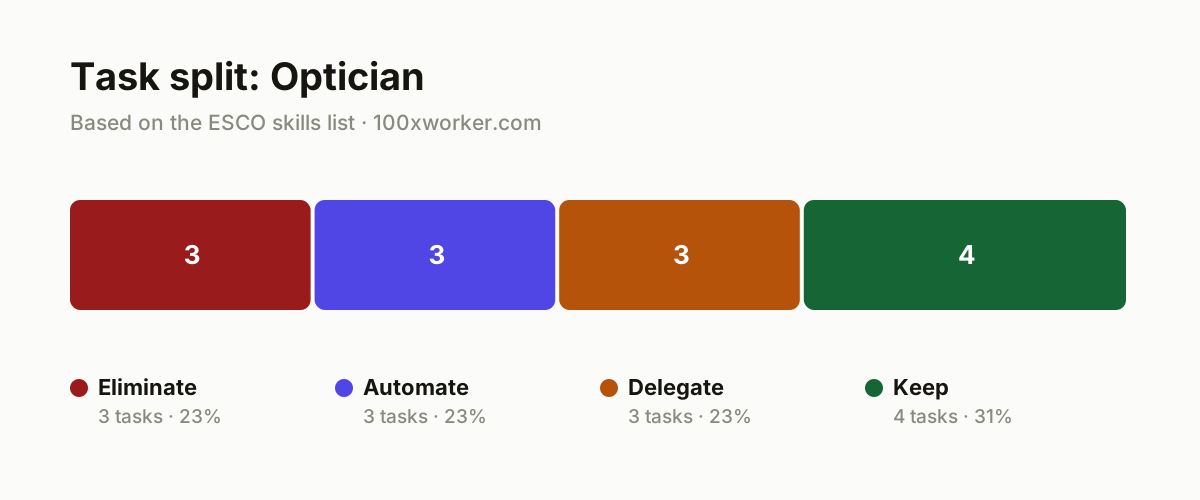
| Task | Bucket | Why |
|---|---|---|
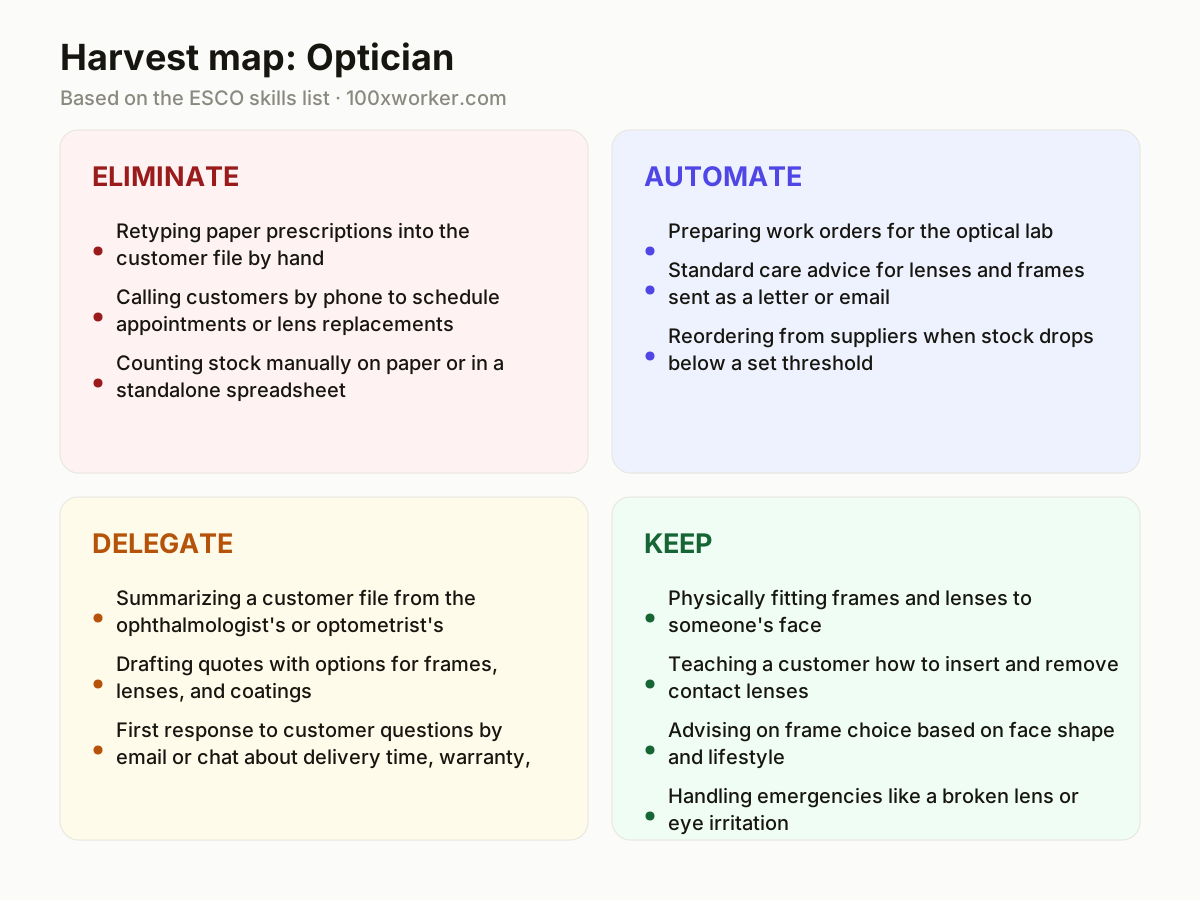
| Retyping paper prescriptions into the customer file by hand | eliminate | Systems now read prescription data directly, so manual retyping adds nothing. |
| Calling customers by phone to schedule appointments or lens replacements | eliminate | Automated calendars and reminders handle this faster and without transcription errors. |
| Counting stock manually on paper or in a standalone spreadsheet | eliminate | Connected point-of-sale and inventory systems count stock in real time. |
| Preparing work orders for the optical lab | automate | Grinding specifications and material choice follow directly from the prescription and frame data. |
| Standard care advice for lenses and frames sent as a letter or email | automate | Fixed text about cleaning and warranty does not need rewriting every time. |
| Reordering from suppliers when stock drops below a set threshold | automate | A link between the point-of-sale system and the supplier turns this into one click. |
| Summarizing a customer file from the ophthalmologist's or optometrist's prescription | delegate | AI turns the prescription into an overview, you confirm it matches what you observe. |
| Drafting quotes with options for frames, lenses, and coatings | delegate | AI generates variants on price and quality, you pick what fits the customer. |
| First response to customer questions by email or chat about delivery time, warranty, and price | delegate | AI answers routine questions, you step in when there is doubt or a complaint. |
| Physically fitting frames and lenses to someone's face | keep | Every face and nose shape is different, and that is something you feel with your hands. (Your edge: Precision work that only touch and sight can deliver.) |
| Teaching a customer how to insert and remove contact lenses | keep | Hands-on guidance prevents irritation and mistakes during first use. (Your edge: Physical coaching with no screen between you and the customer.) |
| Advising on frame choice based on face shape and lifestyle | keep | Taste, style, and comfort come out of a conversation, not a formula. (Your edge: Human judgment about what someone will actually wear.) |
| Handling emergencies like a broken lens or eye irritation | keep | Acting immediately and judging urgency stays work for a person. (Your edge: Immediate physical response to an acute problem.) |
Which optician tasks can AI take over?
AI takes over the paperwork layer around the fitting work. It reads prescriptions and pulls them into a customer file, drafts work orders for the optical lab, writes standard maintenance letters about lens and frame care, and answers routine questions about delivery time or warranty. It also handles the back office: automated reminders replace phone scheduling, and connected inventory systems replace manual stock counts. What it does not do is fit a frame to a face, coach someone through inserting contact lenses, or judge how urgent an eye irritation is. Those stay tasks for a person in the room.
Will AI replace opticians?
No. Microsoft Research's applicability score for dispensing opticians sits at 13.6%, near the low end of the occupations it studied and far below jobs built around drafting text, like translation at 49%. The job of dispensing opticians is built on physical fitting, touch, and in-person judgment calls, tasks generative AI cannot do. What changes is the task list inside the job: less time on prescriptions, quotes, and reminders, more time on fitting, coaching, and advice. The job title stays, the daily mix of tasks shifts.
How do you become the AI-savvy person on the optical team?
Start by mapping your own week against the four buckets above. Pick one delegate task, like drafting quotes or summarizing prescriptions, and run it through an AI tool for two weeks while you check every output against the original. Write down where it gets things wrong, that list becomes your practice's internal guide for using AI safely. Share it with colleagues. Being the AI-savvy person on the team means you know exactly where AI output needs a second look, not that you use AI for everything.
What can you do this month as an optician?
Pick one recurring task from the automate or delegate bucket, for example standard maintenance letters or first-draft quotes, and set up an AI tool to handle the first pass. Keep a short log of edits you make to its output for two weeks. That log tells you whether the task is ready to hand off fully or still needs your review each time. Then move to the next task on the list. Small, checked steps beat a single big rollout.
Generative AI's applicability varies enormously by occupation, from about half of the work activities in translation to roughly one in eight in nursing and dispensing opticians.
Microsoft Research, Working with AI (2025)
Become the AI person on your team
Run a two-week trial on one task
Choose drafting quotes or summarizing prescriptions and let an AI tool produce a first draft for every case for two weeks. Track how often you had to correct it before it went to the customer.
Build a one-page usage guide for the practice
Write down which tasks you trust AI with unsupervised, which need a check, and which stay fully manual. Update it every quarter as tools and your own experience change.
Keep prescription data flowing automatically
If your practice still retypes prescription data by hand anywhere in the process, push to connect that system to your customer file software. This removes a task from the eliminate bucket for good.
Want this for your actual task list?
The free scan on the homepage builds your personal task map in 30 seconds, based on your role and industry.
Run the free task scanTools for this work
| Tool | For which tasks | The sober take |
|---|---|---|
| Microsoft Copilot | Drafting standard maintenance letters, first-response answers to routine customer emails | Useful for text you would otherwise write from a template, still needs a read-through before sending. |
| Claude (Anthropic) | Summarizing prescriptions into a customer file, drafting quote variants | Anthropic's own data shows this kind of drafting and checking work is typical current use, not full automation. |
| Practice management software with connected inventory | Automated stock counts, supplier reordering below a threshold | Check whether your existing point-of-sale system already supports this before adding a new tool. |
| Optical lab ordering systems with prescription integration | Generating lab work orders directly from prescription and frame data | Availability depends on your lab's software, confirm the integration before relying on it. |
Prompts to try today
Draft a lens and frame maintenance letter
Summarize a prescription into a customer file
Generate quote options for a customer
Related jobs
Frequently asked questions
Does AI applicability of 13.6% mean opticians will lose 13.6% of their jobs?
No. The Microsoft Research score measures how much of the work activity mix generative AI can plausibly assist with, based on real Copilot conversations, not how many jobs disappear. A score of 13.6% points to a modest share of tasks, mostly drafting and administrative work, that AI can take on. Fitting frames, coaching customers, and handling emergencies make up most of an optician's actual work and are not captured by this kind of text-based applicability score.
Which parts of the optician's job are safest from AI?
The physical fitting of frames and lenses to a customer's face, hands-on coaching for contact lens insertion, style and comfort advice based on a conversation, and handling emergencies like a broken lens or eye irritation. These all require touch, presence, or immediate in-person judgment, none of which generative AI can provide.
Do I need to learn to code or use complex AI tools?
No. The tools relevant to opticians, chat-based assistants for drafting letters and summarizing prescriptions, work through plain text prompts. The skill worth building is judgment: knowing what to ask for, checking the output against the actual prescription or customer need, and catching mistakes before they reach a customer.
Where can I check how AI applies to other healthcare and retail occupations?
Microsoft Research published its full dataset of applicability scores by occupation on GitHub under a CC BY 4.0 license, covering hundreds of jobs. The European Commission's ESCO taxonomy lists standardized skills and task descriptions for 3,039 occupations across 28 languages, useful for comparing how an optician's skill set overlaps with related roles.
Sources
- Microsoft Research, Working with AI: Measuring the Applicability of Generative AI to Occupations (2025)
- Anthropic Economic Index
- Eurostat, isoc_ai_iaiu (generative AI use, 2025)
- ESCO, European Commission
Hendrik De Winne, author of Becoming AI-Savvy, founder of VibeLab. Helps teams redesign their work with AI.
This article was drafted with AI assistance from public data sources and editorially reviewed.