100×worker · job analysis
Will AI Replace Notaries, and What Should You Do About It?
Generative AI use has moved from early adopters to a mainstream habit. In 2025, 32.7% of the EU population aged 16 to 74 said they had used a generative AI tool in the past three months, according to Eurostat (isoc_ai_iaiu, 2025). For notaries, trying ChatGPT at home is not the point. The real test is whether these tools can touch work built on witnessed signatures, sworn oaths, and legal liability.
Microsoft Research analyzed 200,000 real Copilot conversations and scored how often generative AI shows up in the tasks of different occupations (Working with AI: Measuring the Applicability of Generative AI to Occupations, 2025). Notary work does not map cleanly onto a single occupational code in that dataset, so this article avoids assigning a made-up applicability score. Instead, it breaks the job down task by task, the way the European Commission's ESCO taxonomy does for 3,039 occupations across 28 languages.
This article splits notary work into four buckets: tasks AI eliminates outright, tasks AI can fully automate under supervision, tasks you delegate to AI and then check, and tasks that stay with you because the law, or the client, requires a human.
A notary is the legal professional who drafts, certifies, and guarantees the legal validity of deeds, oaths, and declarations.
The task split: what AI takes over and what stays yours
Not every notary task carries the same weight. Some are pure clerical overhead that no one should still do by hand. Others are template work that AI can produce as a first draft, ready for your review. A third group benefits from an AI first pass that you then check for facts and judgment. A last group must stay entirely human, because the law ties the oath, the seal, and the liability to the person of the notary, not to a system.
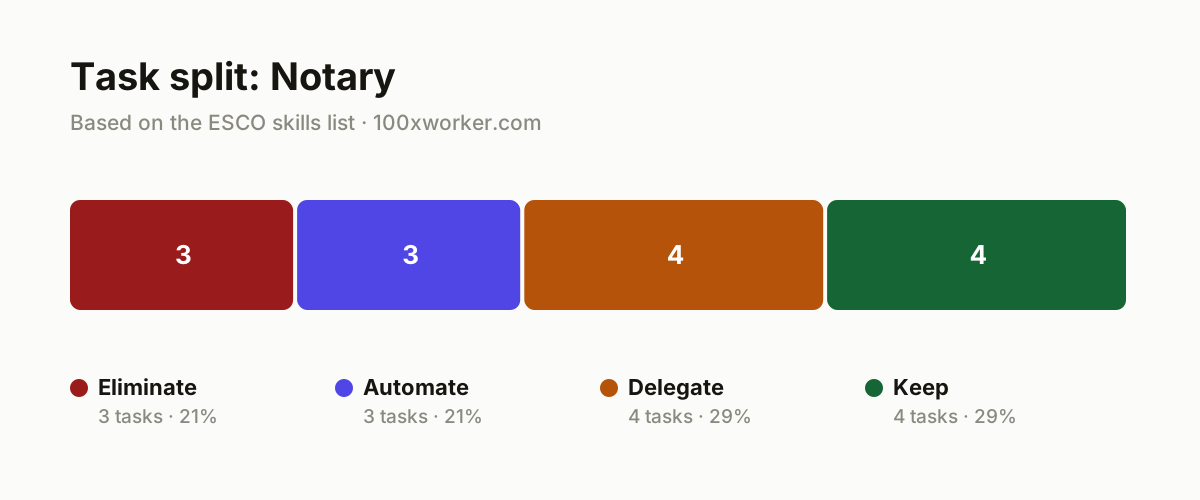
| Task | Bucket | Why |
|---|---|---|
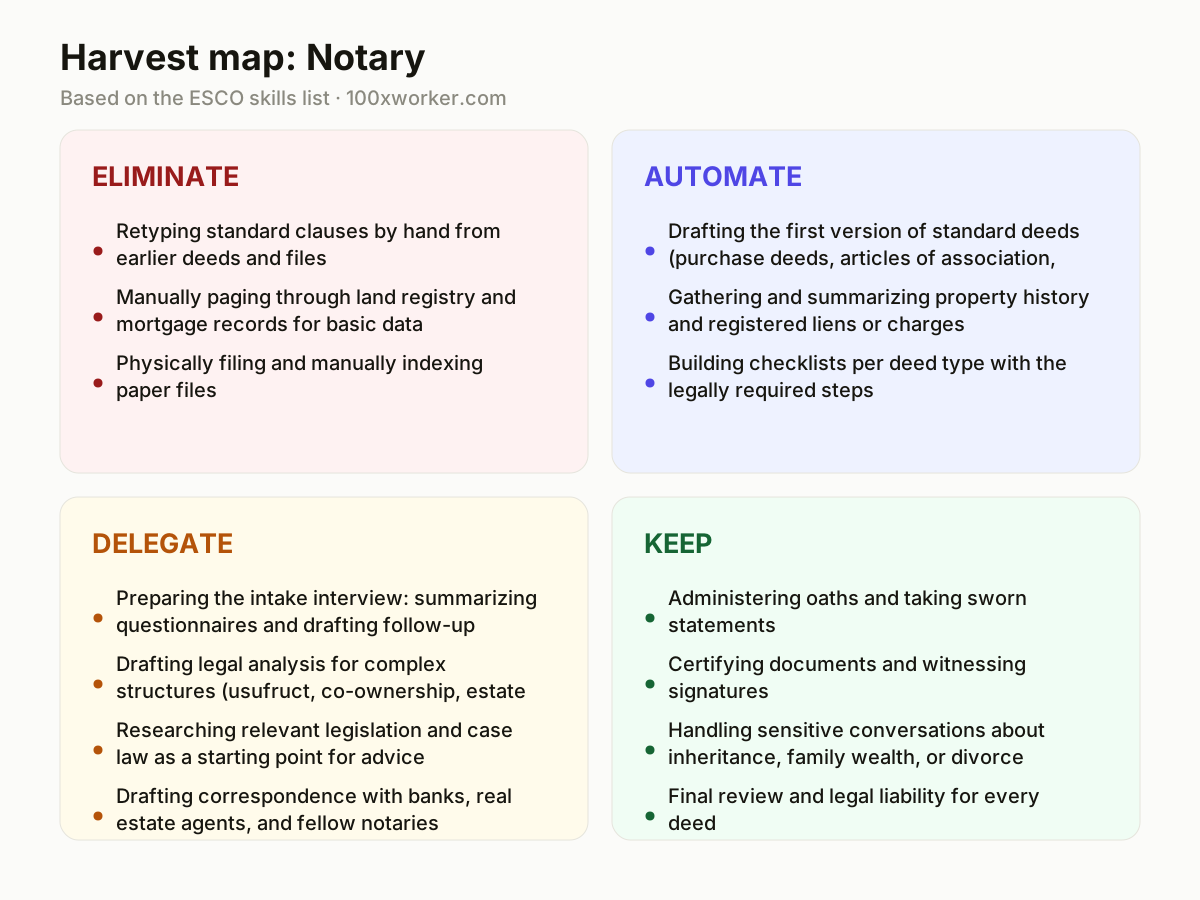
| Retyping standard clauses by hand from earlier deeds and files | eliminate | Copy work with no added value. Templates and text generation do this faster and without errors. |
| Manually paging through land registry and mortgage records for basic data | eliminate | Automated lookups and AI summaries make manual searching unnecessary. |
| Physically filing and manually indexing paper files | eliminate | Digital archiving with a searchable index replaces the filing cabinets entirely. |
| Drafting the first version of standard deeds (purchase deeds, articles of association, marriage contracts) from file data | automate | An AI agent fills the template from intake data, ready for your review. |
| Gathering and summarizing property history and registered liens or charges | automate | AI searches registries and produces a timeline without manual lookup. |
| Building checklists per deed type with the legally required steps | automate | Fixed procedures per deed type can be fully automated and kept current. |
| Preparing the intake interview: summarizing questionnaires and drafting follow-up questions | delegate | AI pulls the thread from the file. You ask the right follow-up questions. |
| Drafting legal analysis for complex structures (usufruct, co-ownership, estate planning) | delegate | AI produces a first analysis with scenarios. The notary weighs and decides. |
| Researching relevant legislation and case law as a starting point for advice | delegate | A faster first source list. Interpretation and application stay your job. |
| Drafting correspondence with banks, real estate agents, and fellow notaries | delegate | AI writes the first version. You check tone, facts, and legal nuance. |
| Administering oaths and taking sworn statements | keep | Reserved by law to the notary and requires personal presence and authority. (Your edge: A legal duty no tool can take over.) |
| Certifying documents and witnessing signatures | keep | The authenticity of a deed depends on the physical notary who witnesses it. (Your edge: Authenticity requires a person with legal mandate.) |
| Handling sensitive conversations about inheritance, family wealth, or divorce | keep | Emotional weight and trust call for personal contact. (Your edge: Trust and nuance cannot be automated.) |
| Final review and legal liability for every deed | keep | Liability for mistakes rests with the notary by law. (Your edge: Liability sits with the notary personally, by statute.) |
Which notary tasks can AI take over?
AI takes over the tasks that are pure clerical overhead first: retyping standard clauses, paging through registries for basic facts, and filing paper documents. It can also produce a full first draft of standard deeds, property history summaries, and per-deed checklists, which a notary then reviews. Beyond that, AI helps prepare intake interviews, draft legal analysis for complex structures, and write correspondence, but a person still checks facts, tone, and legal nuance before anything goes out. The tasks that require an oath, a witnessed signature, or legal liability stay untouched.
Will AI replace notaries?
No. In most jurisdictions, certain acts, administering oaths, witnessing signatures, certifying deeds, are reserved by law to a licensed notary acting in person. AI can draft, search, and summarize, but it cannot hold legal liability or physically witness a signature. Older studies that assign a single automation percentage to a job title, such as the 2013 Oxford analysis by Frey and Osborne, predate large language models and do not reflect how AI actually gets used inside a legal practice today. The realistic outcome is a smaller task list per client file, not an empty office.
How many people already use AI at work?
In 2025, 32.7% of the EU population aged 16 to 74 had used a generative AI tool in the past three months, according to Eurostat. Anthropic's Economic Index, which classifies millions of Claude conversations against the O*NET task taxonomy, finds that AI use splits into automation-like patterns (AI does the task) and augmentation-like patterns (AI supports a person doing the task). For legal and administrative work, augmentation-like use tends to dominate, which matches what the delegate bucket describes for notaries: a first pass by AI, a final check by a person.
What can you do this month as a notary using AI?
Start with one recurring deed type. Feed an AI tool your last five versions of that deed, minus client-identifying details, and ask it to draft a clean template with placeholders. Use that template on your next intake instead of starting from scratch. Separately, set up a checklist per deed type covering the legally required steps, and have AI keep a first draft of correspondence ready for you to edit. Keep every oath, signature, and final sign-off exactly as it is now.
AI use splits into automation-like and augmentation-like patterns, task by task, against the O*NET taxonomy.
Anthropic Economic Index
Become the AI person on your team
Turn your five best deeds into templates
Pick the deed types you draft most often and have an AI tool build a reusable template with placeholders from your past examples. Review the template once for accuracy, then reuse it for every new intake in that category.
Use AI as a research assistant, not a decision-maker
Ask AI to pull a first list of relevant statutes and case law for a complex file, such as a usufruct or estate planning matter. You still interpret, apply, and sign off on the final analysis.
Protect the moments that require your physical presence
Keep oath-taking, signature witnessing, and final certification exactly as scheduled meetings with you present. Use the time AI frees up in drafting and research to spend more time on these client-facing moments.
Want this for your actual task list?
The free scan on the homepage builds your personal task map in 30 seconds, based on your role and industry.
Run the free task scanTools for this work
| Tool | For which tasks | The sober take |
|---|---|---|
| Microsoft Copilot | Drafting first versions of standard deeds and correspondence (automate, delegate) | Useful for a first draft from file data, but every clause still needs a lawyer's read-through. |
| Claude or ChatGPT (enterprise/business tier) | Legal research summaries, intake questionnaire summaries (delegate) | Good for a fast first pass on legislation and case law, not a substitute for interpretation. |
| Document automation platforms (e.g. HotDocs, Clio Draft) | Template-based deed generation, checklist maintenance (automate) | Built for exactly this kind of repeatable, template-driven legal drafting. |
| Legal research platforms with AI search (e.g. Lexis+ AI, Westlaw Edge) | Statute and case law lookup as a starting point (delegate) | Speeds up the first source list; you still verify citations and applicability. |
Prompts to try today
Build a deed template from past examples
Summarize an intake file before a client meeting
First-pass legal analysis for a complex structure
Related jobs
Frequently asked questions
Is the notary profession at risk of disappearing because of AI?
No. Core notarial acts, administering oaths, witnessing signatures, certifying deeds, are reserved by law to a licensed notary in most jurisdictions. AI changes the task mix inside the job by taking over drafting, searching, and filing, but it cannot hold legal liability or physically witness a document. The profession stays, with a smaller manual workload and more time for advisory conversations.
What's the difference between the 'automate' and 'delegate' buckets in this framework?
Automate means AI can complete the task with minimal human input, such as filling a standard deed template from file data. Delegate means AI produces a first draft or first analysis, but a person has to weigh judgment, context, or emotional nuance before finalizing it, such as legal analysis for a complex estate planning case. Both still get a human check, but the depth of that check differs.
Why doesn't this article give a specific AI applicability percentage for notaries?
Microsoft Research's applicability scores, built from 200,000 real Copilot conversations, are tied to specific occupational codes that don't map cleanly onto the notary profession as defined by the ESCO taxonomy. Rather than force a number that isn't backed by the underlying data, this article breaks the job into concrete tasks and applies the same eliminate, automate, delegate, keep logic Microsoft's methodology implies.
Are older studies about job automation risk, like the 2013 Oxford study, still reliable?
Not for large language model era work. The widely cited automation-risk percentages from Frey and Osborne's 2013 Oxford study predate generative AI entirely and were built on a very different technology assumption. Newer, task-level research from Microsoft Research and Anthropic's Economic Index, based on actual AI conversation data, gives a more accurate picture of how AI is used in legal and administrative work today.
Sources
- Microsoft Research, Working with AI: Measuring the Applicability of Generative AI to Occupations (2025)
- Anthropic Economic Index
- Eurostat, isoc_ai_iaiu (2025)
- ESCO taxonomy, European Commission
Hendrik De Winne, author of Becoming AI-Savvy, founder of VibeLab. Helps teams redesign their work with AI.
This article was drafted with AI assistance from public data sources and editorially reviewed.