100×worker · job analysis
Will AI Replace Lawyers, and What Should You Do About It?
Legal work looks like a natural fit for AI: contracts, statutes, and case law are all text. But the numbers tell a more specific story. Microsoft Research analyzed 200,000 real Copilot conversations and gave each occupation an 'AI applicability score', a measure of how much of the job's actual work activities generative AI can plausibly support. Lawyers scored 18 percent, well below translators (49 percent) and closer to the low end of the scale.
Anthropic's Economic Index adds detail by classifying millions of Claude conversations against the O*NET task framework and splitting AI use into automation-like use (AI does the task) versus augmentation-like use (AI supports a human doing the task). For legal work, augmentation use dominates: drafting help, research summaries, and document review support, not autonomous casework. Across the EU, 32.7 percent of people aged 16 to 74 used generative AI in the past three months as of 2025, according to Eurostat, so lawyers are adopting these tools in a workforce that is already broadly AI-literate.
This article breaks the job down using the same eliminate, automate, delegate, keep framework applied across 100xworker.com, mapped to the ESCO occupational description for lawyers (ESCO code 2611.1).
A lawyer advises and represents clients in legal proceedings, interpreting law and building arguments on their behalf.
The task split: what AI takes over and what stays yours
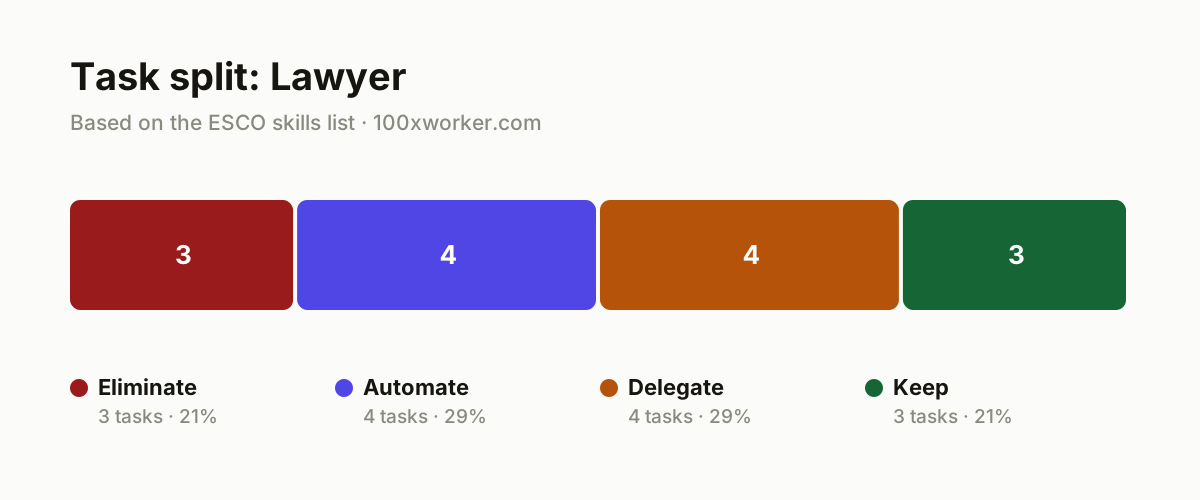
Not every task in a lawyer's day carries the same weight, and AI does not touch them equally. Some tasks can disappear entirely because a tool now does them better. Others get fully automated, run end to end by software with a human sign-off. A third group gets delegated to AI as a first draft that a lawyer then reviews and owns. And a final group stays fully human because it depends on judgment, live persuasion, or professional accountability that no model can carry.
| Task | Bucket | Why |
|---|---|---|
| Manually searching legislation and case law by keyword in unstructured sources | eliminate | AI search tools scan case law databases faster and surface connections keyword search misses. |
| Manually retyping or adjusting boilerplate clauses from old files | eliminate | AI-based clause libraries generate the right clause instantly, so copying from old documents becomes unnecessary. |
| First-line phone or email screening of simple, frequently asked client questions | eliminate | A chatbot answers routine questions about fees and procedure without a lawyer's involvement. |
| Searching and categorizing evidence in a case file (e-discovery) | automate | AI agents scan thousands of documents and flag relevant passages, ready to use in the file. |
| Drafting routine documents such as powers of attorney, standard termination letters, and simple agreements | automate | Based on templates and case data, AI produces a ready-to-use first draft without repetitive manual work. |
| Summarizing lengthy rulings, judgments, and case files into readable briefings | automate | AI compresses hundreds of pages into a usable summary, faster than a lawyer's first read. |
| Linking time tracking to case activity and preparing invoices | automate | Systems log time spent automatically and prepare the invoice ready for review. |
| Legal research and statutory interpretation for a specific case | delegate | AI delivers a first analysis of applicable law and case law, and you verify accuracy and context. |
| Drafting pleadings and legal argumentation | delegate | AI structures arguments and counterarguments, the lawyer chooses the angle and tone for court. |
| Drafting complex, case-specific contracts and writs of summons | delegate | AI writes a first draft tailored to the file, the lawyer refines risk and wording. |
| Preparing negotiation strategy on fees or settlement | delegate | AI generates scenarios and counteroffers, the lawyer decides which strategy serves the client best. |
| Representing clients in the courtroom | keep | Arguing before a judge requires live judgment, persuasion, and adaptability that AI cannot provide. (Your edge: Direct persuasion and adapting to the courtroom in real time) |
| Live negotiation in litigation and settlement talks | keep | Negotiating requires reading the other party and making decisions under time pressure in the moment. (Your edge: Real-time reading of the other side and the moment) |
| Guarding confidentiality and strategically protecting client interests | keep | Attorney-client privilege, ethical judgment, and liability stay with the lawyer who signs the case. (Your edge: Trust, privilege, and personal accountability) |
Which lawyer tasks does AI take over?
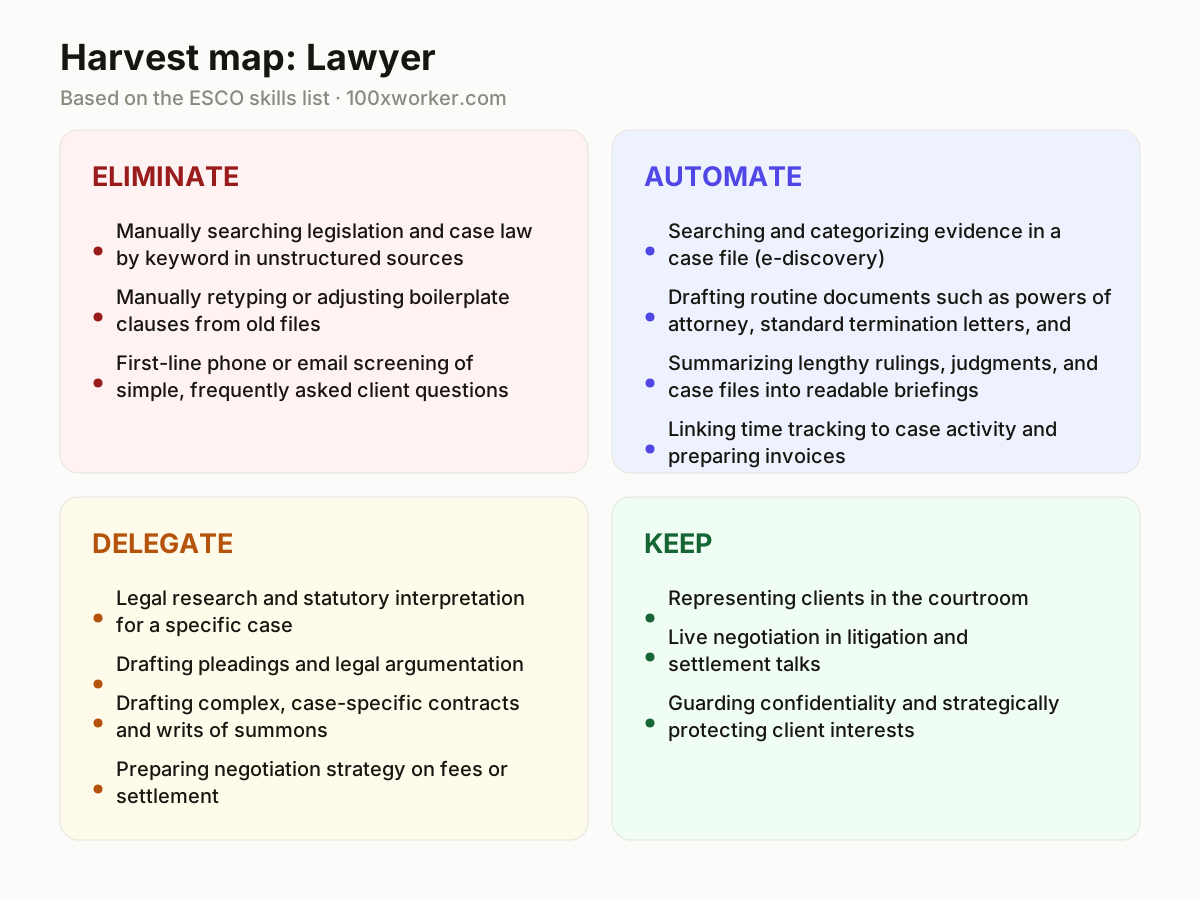
AI takes over the searching, sorting, and first-draft work: keyword searches through case law, retyping boilerplate clauses, and answering routine client questions get eliminated by search tools and chatbots. E-discovery, summarizing long rulings, drafting standard documents, and linking time tracking to billing get automated end to end with a quick human check. Anthropic's Economic Index finds this pattern across legal work generally: AI use skews toward augmentation, meaning it supports a task rather than replacing the person who owns it. The work that stays fully with a lawyer involves judgment calls, courtroom presence, and strategy, not information retrieval.
Will AI replace lawyers?
Not based on current evidence. Microsoft Research's applicability score puts lawyers at 18 percent, meaning AI is a plausible fit for less than a fifth of the actual work activities that make up the job, compared with 49 percent for translators. The tasks AI struggles with, courtroom advocacy, live negotiation, and safeguarding privileged information, sit at the core of what a lawyer is paid and licensed to do. What changes is the mix of tasks inside the job: less time on manual research and drafting, more time reviewing AI output and handling the parts of a case that need a person in the room.
What can you do this month to bring AI into your legal practice?
Start by listing every recurring task in your caseload for one week and marking each one eliminate, automate, delegate, or keep. Pick one automate-bucket task, such as summarizing judgments or drafting standard letters, and test an AI tool on it for two weeks with a mandatory human check before anything goes to a client. Build a clause and template library so drafting starts from AI-generated first drafts instead of blank documents. Set a firm rule that confidential client information never goes into a general-purpose AI tool without a data agreement, and keep that rule visible to junior staff.
How many people already use AI at work?
Across the EU, 32.7 percent of the population aged 16 to 74 used generative AI in the past three months as of 2025, according to Eurostat. Microsoft Research built its applicability scores by analyzing 200,000 real Copilot conversations across occupations, and Anthropic's Economic Index classifies millions of Claude conversations against standardized task lists to see where AI use concentrates. None of these sources report a legal-profession-specific adoption rate, so treat general workforce adoption as context, not a direct measure of how many lawyers use AI daily.
Generative AI is applicable to only about 18 percent of a lawyer's work activities, based on analysis of real usage patterns rather than assumptions about the profession.
Microsoft Research, Working with AI: Measuring the Applicability of Generative AI to Occupations (2025)
Become the AI person on your team
Audit your caseload by task, not by job title
Break one week of work into individual tasks rather than thinking in terms of 'being a lawyer'. Mark each task eliminate, automate, delegate, or keep, and you will usually find that half the week is candidate work for AI support, while the highest-value hours stay untouched.
Build a verification checkpoint into every AI draft
Treat every AI-generated document, summary, or research result as a first draft from a junior associate who has never passed the bar. Require a named person to check citations, verify case law is current, and sign off before anything reaches a client or a court.
Keep confidentiality rules ahead of tool adoption
Decide which categories of client information can never go into a general-purpose AI tool before someone on your team does it by accident. Put this in writing and review it whenever you add a new tool to your workflow.
Want this for your actual task list?
The free scan on the homepage builds your personal task map in 30 seconds, based on your role and industry.
Run the free task scanTools for this work
| Tool | For which tasks | The sober take |
|---|---|---|
| Microsoft Copilot | Summarizing rulings, drafting routine letters, preparing time-tracking notes | Useful for first drafts and summaries, not for final legal opinions without review. |
| Claude (Anthropic) | Legal research summaries, structuring pleadings and argument outlines | Anthropic's own Economic Index shows this kind of use is mostly augmentation, not automation. |
| AI-assisted legal research platforms (e.g., CoCounsel, Lexis+ AI, Harvey) | E-discovery, case law search, contract drafting | Built for legal workflows specifically, but still require a lawyer to verify citations and case status. |
| Clause and template libraries with AI drafting | Standard agreements, powers of attorney, termination letters | Cuts drafting time on routine documents, adds little value on complex or novel matters. |
Prompts to try today
Judgment briefing
First-draft agreement
Counterargument mapping
Related jobs
Frequently asked questions
Which legal tasks are hardest for AI to replace?
Courtroom advocacy, live negotiation, and anything involving attorney-client privilege sit hardest to replace. These tasks depend on reading a room, adapting arguments in real time, and carrying personal legal accountability for what gets said or filed. Microsoft Research's 18 percent applicability score for lawyers reflects exactly this: most of a lawyer's actual work activities, especially the parts tied to judgment and representation, do not map onto what generative AI does well.
Should junior associates worry about AI taking their jobs?
The tasks AI automates well, first-pass research, document summaries, and standard drafting, are often the tasks junior associates traditionally learned on. That changes how junior roles get structured rather than eliminating them outright. Associates who learn to direct and check AI output, rather than only produce first drafts by hand, are positioned to take on delegate-bucket work (research, argument structuring) earlier in their careers.
Is AI legal research reliable enough to use in court filings?
AI research tools can miss or fabricate case citations, so any AI-generated legal research needs verification against primary sources before it goes into a filing. Treat AI output as a draft produced by someone without the ability to guarantee accuracy, not as a finished citation check. The eliminate and automate buckets in this article cover searching and summarizing, not final verification, which stays a delegate or keep task.
What is the ESCO classification for lawyers and why does it matter?
ESCO, the European Commission's occupational taxonomy, lists lawyers under code 2611.1 within the Lawyers ISCO group, describing the role as advising clients and representing them in judicial proceedings. ESCO covers 3,039 occupations with skills in 28 languages, which makes it a consistent reference point for comparing how AI affects a specific job's task list across countries, rather than relying on job titles that vary between employers.
Sources
- Microsoft Research, Working with AI: Measuring the Applicability of Generative AI to Occupations (2025)
- Anthropic Economic Index
- Eurostat, isoc_ai_iaiu (2025)
- ESCO, European Commission
Hendrik De Winne, author of Becoming AI-Savvy, founder of VibeLab. Helps teams redesign their work with AI.
This article was drafted with AI assistance from public data sources and editorially reviewed.