100×worker · job analysis
Will AI Replace Network Engineers?
Network engineers spend a lot of time on tasks that generative AI now handles reasonably well: reading logs, drafting configuration templates, and writing documentation. Microsoft Research analyzed 200,000 real conversations with Copilot and found that generative AI is applicable to about 25.2% of the work activities of computer network architects, a category close to what most people mean by network engineer. That is a moderate score. Translators top the list at 49%, and nurses sit near the bottom at 12% (Microsoft Research, Working with AI, 2025).
That does not mean a quarter of network engineering jobs disappear. It means about a quarter of the tasks inside the job change. The occupation, described in the European Commission's ESCO taxonomy as one of 3,039 occupations covering skills in 28 languages, still requires designing networks, predicting future capacity needs, and applying information security policy. Those tasks stay firmly human for now.
This article breaks the job into four buckets: tasks to eliminate, tasks to automate, tasks to delegate to an AI agent with your oversight, and tasks to keep doing yourself. Think of it as a task-level map for this month, rather than a verdict on whether AI takes over the job.
A network engineer designs, installs, and maintains computer networks, and monitors their security and performance.
The task split: what AI takes over and what stays yours
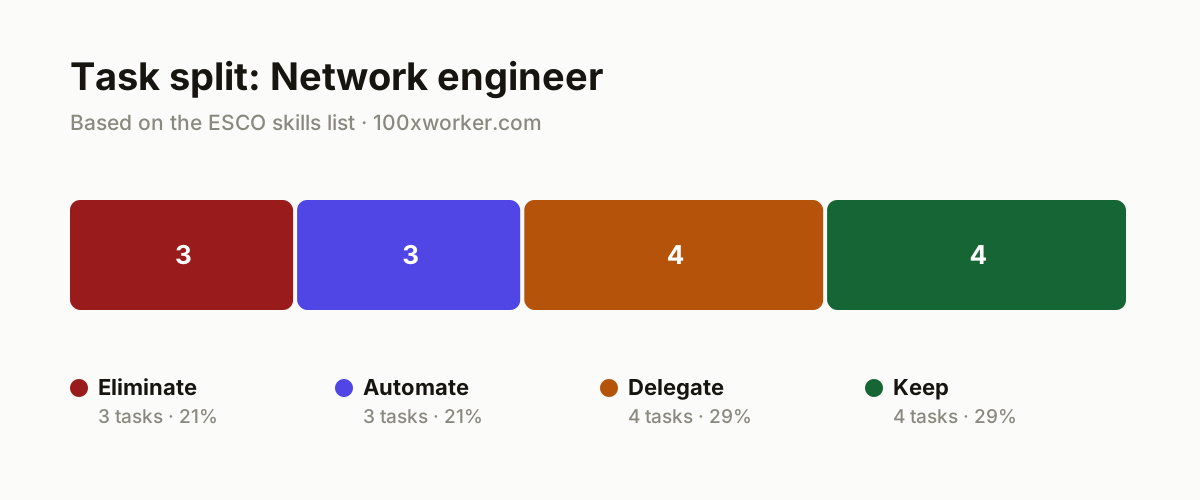
Every network engineering job is really a bundle of tasks, from typing VLAN configs to negotiating budget with stakeholders. Some of those tasks disappear because AI does them without you. Some run inside automated pipelines you supervise. Some are worth handing to an AI agent as a first draft you then correct. And some stay entirely yours because they need judgment, accountability, or a physical body in a server room. Sorting your own week into these four buckets is more useful than asking whether the job category survives.
| Task | Bucket | Why |
|---|---|---|
| Manually scanning log files for error codes and patterns | eliminate | AI-based log analysis spots anomalies faster and more consistently than a person scrolling through text. |
| Drafting network diagrams and documentation from a blank page | eliminate | AI generates a first draft from configuration files and topology data. |
| Typing routine configuration lines (VLANs, basic ACLs) by hand on each device | eliminate | Templates and AI scripts produce this faster and with fewer typos than manual copy-paste. |
| Troubleshooting based on log patterns and monitoring data | automate | Agents correlate events across multiple systems and propose a likely root cause before you dig in. |
| Building performance reports from monitoring tools | automate | Performance analysis runs automatically, including charts and written summaries ready to send to stakeholders. |
| Generating and validating routing configurations against policy | automate | An agent drafts the configuration and checks it against your security policy before you deploy it. |
| Designing a new network (topology proposals) | delegate | AI generates several design options from your requirements, you pick and refine. |
| Forecasting future network needs and capacity planning | delegate | AI extrapolates trends from growth data, you check the result against budget and strategy. |
| Building a migration plan for a move to new infrastructure or the cloud | delegate | AI drafts a step-by-step plan and risk list, you test it and run the critical steps. |
| Analyzing software specifications when buying new network hardware | delegate | AI summarizes specs and flags compatibility risks, you make the purchase decision. |
| Responding to security incidents and applying information security policy | keep | In a real incident, every minute and every judgment call matters. (Your edge: Taking responsibility under time pressure is not something a tool can do.) |
| Collecting customer feedback on applications and translating it into priorities | keep | Feedback is often vague, contradictory, or politically loaded. (Your edge: Sensing what someone actually means takes people skills, not code.) |
| On-site physical installation and troubleshooting | keep | Cables, racks, and hardware remain physical work in a physical room. (Your edge: An AI agent cannot plug a cable into a server rack.) |
| Talks with stakeholders about architecture choices and budget | keep | Decisions about money and risk require trust and negotiation. (Your edge: Persuading people stays a social skill, not a calculation.) |
Which tasks does AI take over from a network engineer?
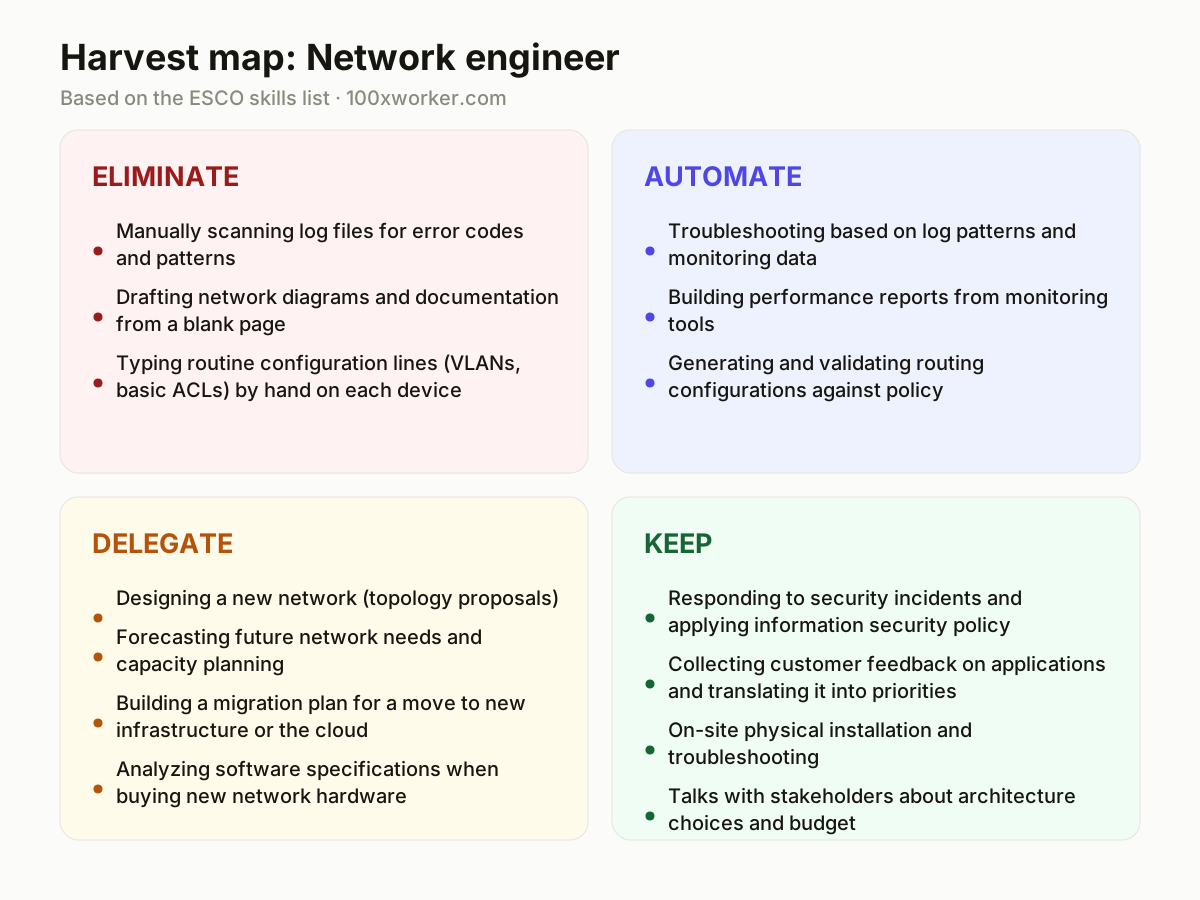
AI takes over the most repetitive parts of network engineering first: scanning logs for anomalies, drafting the first version of network diagrams, and typing routine configuration lines for VLANs or basic access control lists. It also increasingly handles first-pass troubleshooting, correlating events across monitoring tools and suggesting a likely root cause, and it can generate routing configurations that you then check against policy before deployment. Microsoft Research puts the applicable share of tasks for computer network architects at roughly 25%, which lines up with day-to-day monitoring and configuration work rather than design, security judgment, or stakeholder conversations.
Will AI replace network engineers?
No single tool replaces the role, but the role changes shape. Microsoft Research found generative AI applicable to about a quarter of the tasks in this occupation, similar to other technical roles, well below translators (49%) and well above nurses (12%). The tasks that survive are the ones involving accountability: security incident response, architecture decisions, budget negotiation, and physical installation. Anthropic's Economic Index shows AI use across occupations splits between fully automating a task and augmenting a person doing it, and network engineering leans toward augmentation because so much of the work carries real consequences if it goes wrong.
How do you become the AI go-to person on your network team?
Start by using AI tools yourself on your own logs, configs, and documentation, rather than waiting for a company policy. Learn to write prompts that include your topology, your security policy, and your naming conventions, so a first draft is close to usable. Test AI-generated configurations in a lab environment before anyone touches production. Share what works with your team in short, concrete notes rather than vague enthusiasm. Being the person who knows which tasks an agent handles well and which ones it gets wrong is worth more than being the person who used it first.
What can you do this month as a network engineer?
Pick one recurring task, such as weekly performance reporting or log review, and run it through an AI tool for two weeks alongside your normal process. Compare the output for accuracy before you trust it fully. Ask your team which configuration templates could become AI-assisted drafts with a human check before deployment. Write down the tasks where you would never let an agent act without your sign-off, such as security incidents or production changes, and keep that list visible. This turns an abstract debate about AI into a concrete list of what changes in your own week.
Generative AI applies to about a quarter of the tasks in network engineering, well below translation work and well above nursing.
Microsoft Research, Working with AI (2025)
Become the AI person on your team
Run your own logs through an AI tool before your team asks you to
Pick a week of monitoring data and ask an AI tool to summarize anomalies and propose causes. Compare its output against what you already know happened. This gives you a working sense of where it helps and where it misses context.
Build a prompt library for your own network
Save prompts that include your topology, VLAN scheme, and security policy so any draft configuration starts closer to production-ready. Reuse and refine them instead of starting from scratch every time.
Set a hard line for agent-generated changes
Decide which changes an AI agent can draft but never push without your review, such as routing changes or ACL updates. Write that line down so your team knows exactly where automation stops.
Want this for your actual task list?
The free scan on the homepage builds your personal task map in 30 seconds, based on your role and industry.
Run the free task scanTools for this work
| Tool | For which tasks | The sober take |
|---|---|---|
| GitHub Copilot | Drafting configuration scripts, documentation, and troubleshooting notes | Works inside your existing editor and version control, so changes stay reviewable. |
| General LLM chat tools (e.g., Copilot, Claude, ChatGPT) | Summarizing logs, drafting reports, first-draft network diagrams | Useful for a first draft, but check specifics against your own monitoring data. |
| AI-enabled monitoring platforms | Automated anomaly detection and performance reporting | These bake AI into the dashboards you already use, rather than a separate chat tool. |
| AI-assisted config validation tools | Checking generated routing and ACL configurations against policy before deployment | Treat these as a second check, not a replacement for lab testing. |
Prompts to try today
Summarize a week of log data
Draft a migration plan
First-draft network diagram from configs
Related jobs
Frequently asked questions
Will AI take away network engineering jobs entirely?
No. Microsoft Research found generative AI applicable to about 25% of tasks done by computer network architects, a moderate score compared to other occupations. The job changes shape rather than disappears: routine log review, first-draft configs, and documentation shrink, while design, security judgment, and stakeholder negotiation stay with you.
How many people actually use generative AI at work right now?
Adoption varies by region. Eurostat found that 32.7% of the EU population aged 16 to 74 used generative AI in the three months before being surveyed in 2025. A Google/Ipsos survey found 61% of Belgians had used an AI chatbot in 2025. Adoption among technical roles like network engineering tends to run higher because the tools fit troubleshooting and documentation work well.
Is the old 'automation risk' number for network engineers still accurate?
The widely cited automation percentages that circulate for many occupations come from a 2013 Oxford study (Frey and Osborne) written before large language models existed. It measured a different kind of automation risk and does not reflect how generative AI actually gets used in network engineering today. Task-level analyses like Microsoft Research's 2025 applicability score are a better guide.
What AI skill matters most for a network engineer to learn now?
Prompt writing that includes real context, your topology, naming conventions, and security policy, matters more than knowing every AI tool on the market. The ESCO taxonomy already lists skills like applying information security policy and predicting future network needs as core to the role. AI changes how fast you get a first draft on those tasks, not whether you still need the underlying skill.
Sources
- Microsoft Research, Working with AI: Measuring the Applicability of Generative AI to Occupations (2025)
- Anthropic Economic Index
- Eurostat, isoc_ai_iaiu (2025)
- ESCO, European Commission
Hendrik De Winne, author of Becoming AI-Savvy, founder of VibeLab. Helps teams redesign their work with AI.
This article was drafted with AI assistance from public data sources and editorially reviewed.