100×worker · job analysis
Will AI Replace Medical Secretaries, and What Should You Do About It?
Medical secretaries spend a large share of their day converting a physician's spoken dictation into a written, correctly formatted patient record. That single task, transcription itself, is exactly the kind of work generative AI now does well. Microsoft Research analyzed 200,000 real Copilot conversations and built an applicability score per occupation. Medical transcriptionists scored 8.4%, meaning generative AI is demonstrably useful for a small slice of the work activities in this job, far below translators (49%) but on par with many clinical support roles.
That low score is not a reason to relax. It means AI applies unevenly across the job. Raw transcription and template filling can be almost fully automated today. Patient contact, confidentiality, and final clinical review cannot. The Anthropic Economic Index, which classifies millions of real AI conversations against standardized O*NET task lists, finds the same pattern across office occupations: AI use splits between automation of routine steps and augmentation of judgment-heavy steps. For a medical secretary, the practical result is a narrower, more editing-focused job, not a disappearing one.
This article breaks the job into concrete tasks and sorts each one into eliminate, automate, delegate, or keep, based on what generative AI can actually do with dictation, records, and patient communication today.
A medical secretary turns dictated medical information into accurate, filed patient documents under fixed terminology and regulation.
The task split: what AI takes over and what stays yours
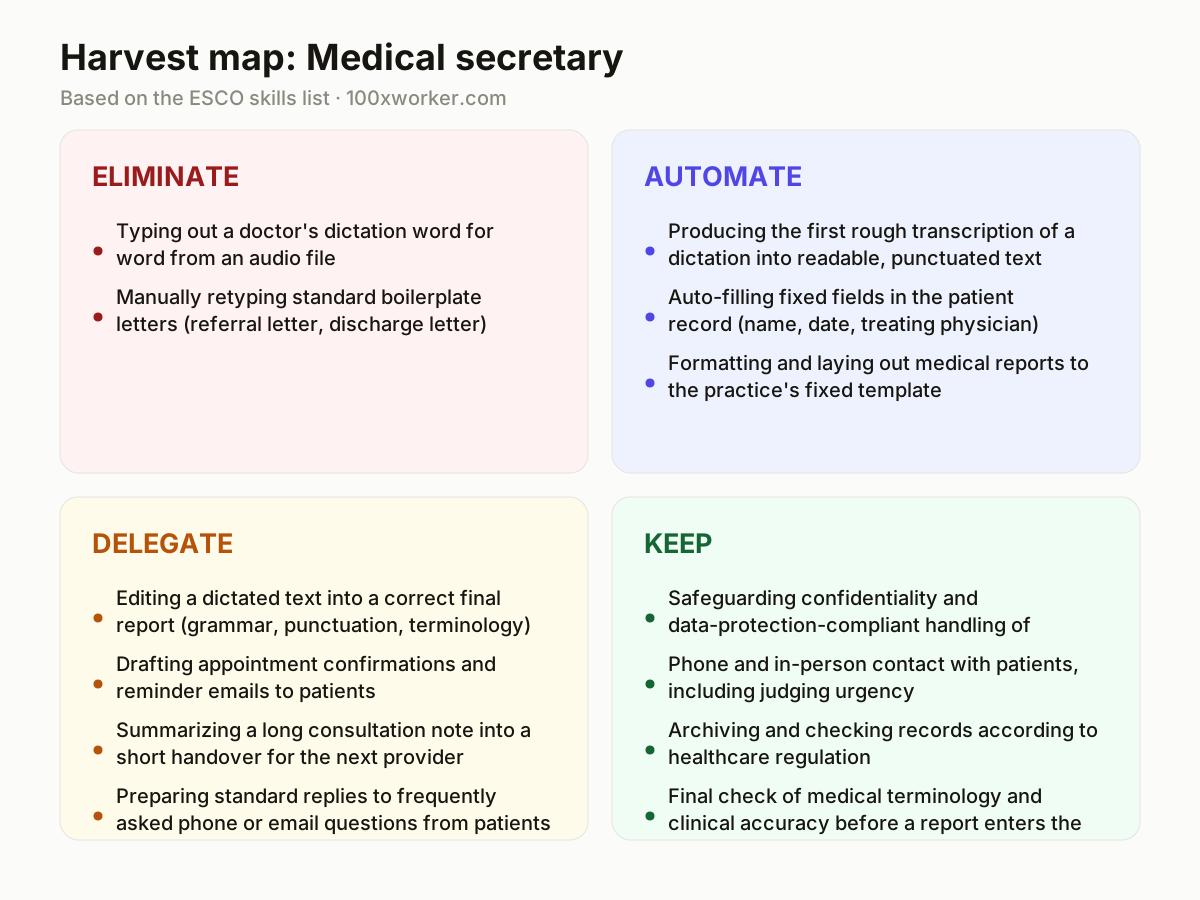
Not every task in a medical secretary's job responds to AI the same way. Some steps, like typing out a dictation word for word, have no reason to exist anymore once speech-to-text handles the conversion directly. Others, like drafting a summary or a reminder email, are worth having AI produce a first version that you then check. And some tasks, confidentiality, patient triage, final clinical accuracy, stay firmly with you because they carry legal or human weight a model cannot carry. Sorting the job this way, task by task, gives a clearer picture than asking whether "the job" will survive.
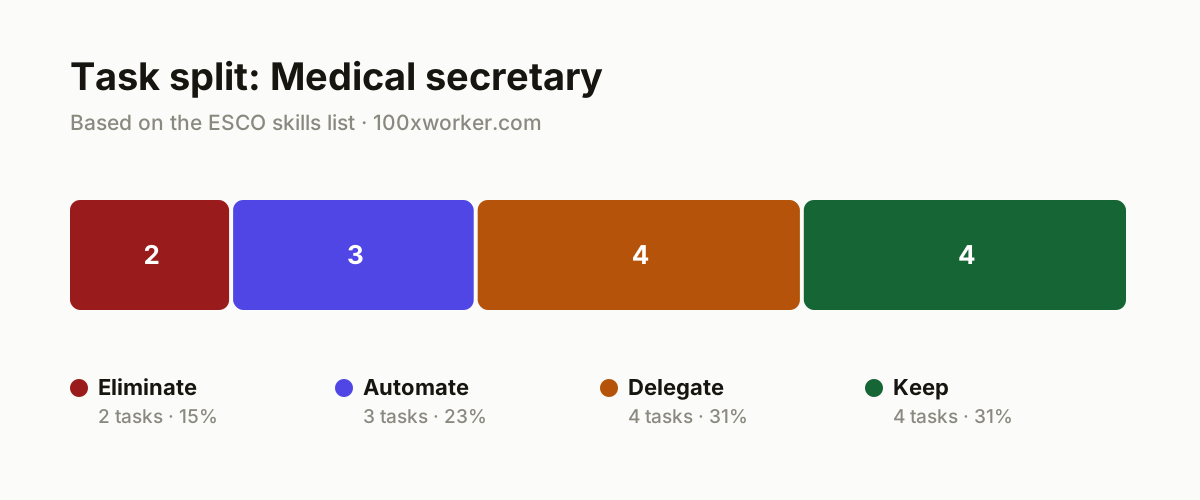
| Task | Bucket | Why |
|---|---|---|
| Typing out a doctor's dictation word for word from an audio file | eliminate | Speech-to-text converts this directly, so the manual typing step itself no longer serves a purpose. |
| Manually retyping standard boilerplate letters (referral letter, discharge letter) from a template | eliminate | A text generator fills in the template itself using the patient's existing data. |
| Producing the first rough transcription of a dictation into readable, punctuated text | automate | Speech recognition delivers a production-ready base text, no manual conversion step needed. |
| Auto-filling fixed fields in the patient record (name, date, treating physician) | automate | This data already sits in the calendar or EHR and can flow in automatically. |
| Formatting and laying out medical reports to the practice's fixed template | automate | A fixed format does not need to be manually rebuilt every single time. |
| Editing a dictated text into a correct final report (grammar, punctuation, terminology) | delegate | AI produces a strong first draft, you check medical terminology and clinical logic. |
| Drafting appointment confirmations and reminder emails to patients | delegate | Tone and content are standard enough for an AI draft, you send it after a quick check. |
| Summarizing a long consultation note into a short handover for the next provider | delegate | A summary speeds up handover, but you still need to check the clinical nuance yourself. |
| Preparing standard replies to frequently asked phone or email questions from patients | delegate | A draft answer saves time, the final tone and content remain your decision. |
| Safeguarding confidentiality and data-protection-compliant handling of patient data | keep | Legal liability and discretion cannot be outsourced to a language model. (Your edge: You carry the legal responsibility, not an algorithm.) |
| Phone and in-person contact with patients, including judging urgency | keep | Emotional tone, worry, and triage require human judgment and empathy. (Your edge: You hear worry in a voice, a chatbot doesn't.) |
| Archiving and checking records according to healthcare regulation | keep | Regulation differs by country and institution, so oversight of it stays human work. (Your edge: You know the local rules of your practice or hospital.) |
| Final check of medical terminology and clinical accuracy before a report enters the record | keep | An error in a medical report has direct impact on a patient, so it needs one last human look. (Your edge: You are the last filter for patient safety.) |
What tasks of a medical secretary does AI take over?
AI takes over the mechanical parts of the job first: converting audio dictation into text, filling standard fields into a patient record, and formatting a report to a fixed template. Microsoft Research's applicability data puts medical transcription tasks at 8.4%, meaning most of the routine typing and formatting work is a strong candidate for automation, while patient-facing and compliance tasks are not. In practice, the transcription step itself increasingly disappears from the workday, while editing, checking, and finalizing that output stays.
Will AI replace medical secretaries?
No single AI applicability score replaces a job, it reshapes its task list. At 8.4%, medical transcription work sits low on Microsoft's applicability scale, well below roles like translation (49%). That means generative AI is useful for specific steps, mainly transcription and formatting, but not for the confidentiality, patient contact, and final clinical review that make up the rest of the role. Practices that adopt AI transcription tools still need someone to check terminology, manage patients, and stay accountable for the record. The job narrows toward editing and oversight rather than disappearing.
How do you become the AI-savvy person in the medical office?
Start by mapping which of your daily tasks are pure transcription or formatting, and test an AI transcription tool on those first. Keep a short log of errors the tool makes with medical terms so you can flag patterns to your team or IT. Offer to draft the practice's guidelines for checking AI-generated notes before they enter the patient record. Being the person who can explain what the tool gets wrong, not just what it saves time on, makes you the reference point colleagues turn to when something looks off.
What can you do this month with AI as a medical secretary?
Pick one recurring task, standard reminder emails or discharge letter drafts are good starting points, and run it through an AI drafting tool for two weeks. Compare the AI draft against your usual final version and note exactly where you still need to correct terminology or tone. Bring that comparison to your supervisor as a concrete case for or against wider use. Do not start with dictation transcription for complex clinical cases, start with the lowest-risk, most repetitive text you write.
AI use in real-world office work splits into automation of routine steps and augmentation of judgment-heavy ones, not a wholesale replacement of the job.
Anthropic Economic Index
Become the AI person on your team
Build a terminology error log
Every time an AI transcription or drafting tool mishandles a medical term, drug name, or abbreviation, write it down with the correct version. After a month, share the list with colleagues so everyone checks for the same recurring mistakes.
Own the review checklist
Draft a short checklist for what must be verified in any AI-assisted report before filing, terminology, dosage, patient identifiers, dates. This turns you into the person who defines quality control, not just the person who types faster.
Pilot before you push
Test one AI tool on one task type for a limited period, then report actual time saved and actual errors caught. Concrete before-and-after numbers convince a practice manager faster than a general recommendation to adopt AI.
Want this for your actual task list?
The free scan on the homepage builds your personal task map in 30 seconds, based on your role and industry.
Run the free task scanTools for this work
| Tool | For which tasks | The sober take |
|---|---|---|
| Dragon Medical One (Nuance/Microsoft) | eliminate: dictation typing; automate: first-draft transcription | Widely used clinical speech recognition, but accuracy on specialist terminology still needs a human check. |
| Microsoft Copilot | delegate: drafting summaries, reminder emails, standard replies | Useful for first drafts of routine text, not for anything touching a diagnosis without review. |
| General AI transcription apps (e.g. Otter.ai-style tools) | automate: converting recorded consultations to text | Fine for general note-taking, medical terminology accuracy varies and needs verification. |
| EHR-integrated note summarization features | delegate: summarizing long consultation notes for handover | Speeds up handover documents, but clinical nuance still needs a human read-through. |
Prompts to try today
Clean up a rough transcription
Draft a patient reminder email
Summarize a consultation note for handover
Related jobs
Frequently asked questions
Will AI replace medical secretarys?
Not the whole job. Microsoft Research's applicability score for medical transcription work is 8.4%, low compared to roles like translation at 49%. AI takes over transcription and formatting steps well, but confidentiality, patient contact, and final clinical checks stay with a person. The realistic outcome is a smaller, more editing-focused task list rather than no job at all.
Which part of the job disappears first?
Word-for-word typing of dictated audio and manual retyping of standard template letters go first. These are mechanical conversion tasks with no judgment involved, so speech-to-text and template-filling tools handle them directly. What stays is checking that the output is correct before it enters the patient record.
Do I need to learn a specific AI tool?
You need enough familiarity with your practice's transcription or drafting tool to spot when it gets medical terminology wrong. You do not need to become a technical expert. Focus on building a habit of checking AI output against source dictation and flagging recurring error patterns to your team.
Is patient data safe if I use an AI transcription tool?
That depends entirely on which tool your practice approves and how it handles data storage and processing. Confidentiality and data-protection compliance remain your responsibility, not the tool's. Before using any AI transcription or drafting tool on patient information, confirm with your practice or IT team that it meets healthcare data-handling requirements.
Sources
- Microsoft Research, Working with AI: Measuring the Applicability of Generative AI to Occupations (2025)
- Anthropic Economic Index
- Eurostat, Use of generative AI (isoc_ai_iaiu)
- ESCO occupation taxonomy, European Commission
Hendrik De Winne, author of Becoming AI-Savvy, founder of VibeLab. Helps teams redesign their work with AI.
This article was drafted with AI assistance from public data sources and editorially reviewed.