100×worker · job analysis
Will AI Replace Insurance Brokers?

Selling insurance still means comparing policies, negotiating with underwriters, and walking a client through a claim after a fire or an accident. AI now handles a growing slice of the paperwork behind those conversations, but the core relationship work has not gone away.
Microsoft Research analyzed 200,000 real conversations between professionals and Copilot and calculated an 'AI applicability score' for each occupation, the share of daily work activities where generative AI is demonstrably useful. For insurance sales agents, the closest US occupational match to a broker role, that score is 22.8%. Translators score highest at 49%, nurses lowest at 12%. Insurance work sits in the middle: enough routine, data-heavy tasks to automate, but with a large core of negotiation and judgment calls that stays human.
This article breaks the insurance broker's task list into four groups: what disappears, what runs on autopilot, what you hand to an AI tool and check, and what stays firmly yours.
An insurance broker is an intermediary who compares policies, sells coverage, and helps clients through claims.
The task split: what AI takes over and what stays yours
Not every task in a broker's day faces the same pressure from AI. Some tasks disappear outright once software does them better. Others get automated end-to-end, with AI producing a finished draft you barely touch. A third group gets delegated, meaning an AI tool does the first pass and you correct it. The last group stays with you because it depends on trust, negotiation, or judgment that no model replicates. Sorting your own task list into these four buckets is the fastest way to see where your time actually goes.
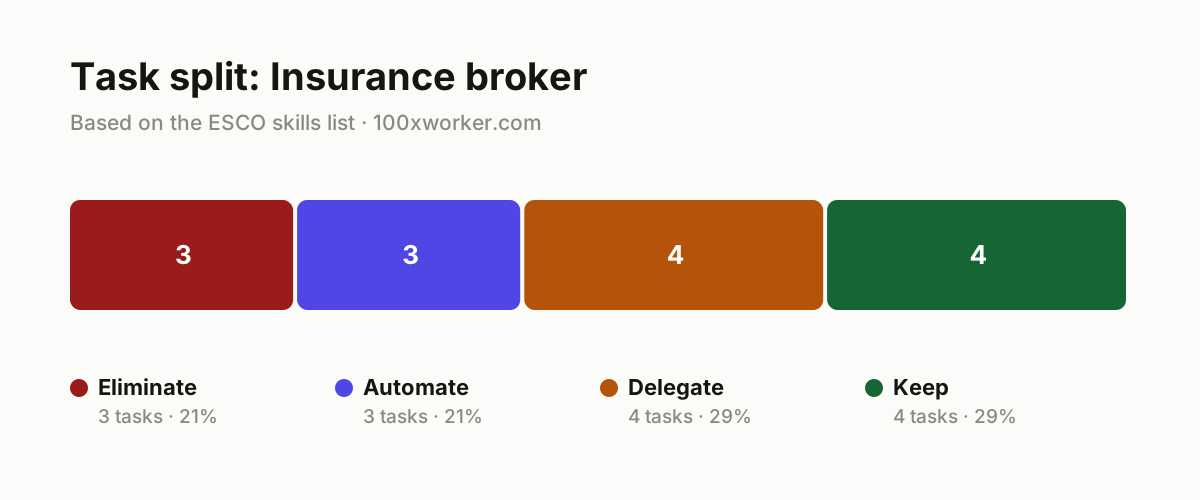
| Task | Bucket | Why |
|---|---|---|
| Manually looking up insurance rates in tariff tables from each insurer | eliminate | Comparison engines and AI tools search rates faster and more accurately than a person cross-checking tables. |
| Retyping policy data by hand between the quoting system, CRM, and insurer portal | eliminate | Connected systems and AI agents fill fields automatically, so manual retyping adds no value. |
| Paper filing and manually searching through old policy files | eliminate | Searchable digital archives with AI search functions make the paper archive unnecessary. |
| Comparing insurance products across insurers for a given client profile | automate | An AI agent searches rates, terms, and coverage and delivers a ready comparison table. |
| Drafting standard quotes for simple policies like auto, home, or family coverage | automate | Based on client data, AI generates a quote that is ready to send immediately. |
| Assembling a first claim file with photos, statement, and relevant policy terms | automate | AI fills in the form and links the right clauses, ready for submission to the insurer. |
| Analyzing a client's insurance needs based on the intake conversation | delegate | AI summarizes the conversation and proposes a first risk profile, you verify and add detail. |
| Drafting policies tailored to a specific client situation | delegate | AI writes a draft policy with likely clauses, you check legal precision and adjust. |
| Drafting client communication: advice letters, follow-up emails, quote explanations | delegate | AI writes the first version in your style, you check tone and factual accuracy. |
| Reaching out to new leads with first contact emails and follow-up | delegate | AI screens leads and drafts personalized first messages, you handle the actual conversation. |
| Negotiating with insurers over specific coverage terms | keep | This depends on relationships, experience, and a feel for what an insurer will actually approve. (Your edge: No AI tool knows the informal understanding you have with an underwriter.) |
| Advising on complex or sensitive cases such as a death, injury claim, or bankruptcy | keep | Empathy and tailored judgment matter more here than processing speed. (Your edge: You do not build trust in a hard conversation with a chatbot.) |
| Defending your client's interests in a disputed claim | keep | This takes negotiation skill and, sometimes, plain persistence against the insurer. (Your edge: You take your client's side, an AI tool stays neutral.) |
| Building a long-term relationship of trust with clients | keep | Clients buy insurance from a person they know, not from an algorithm. (Your edge: Repeat clients choose your name, not a tool.) |
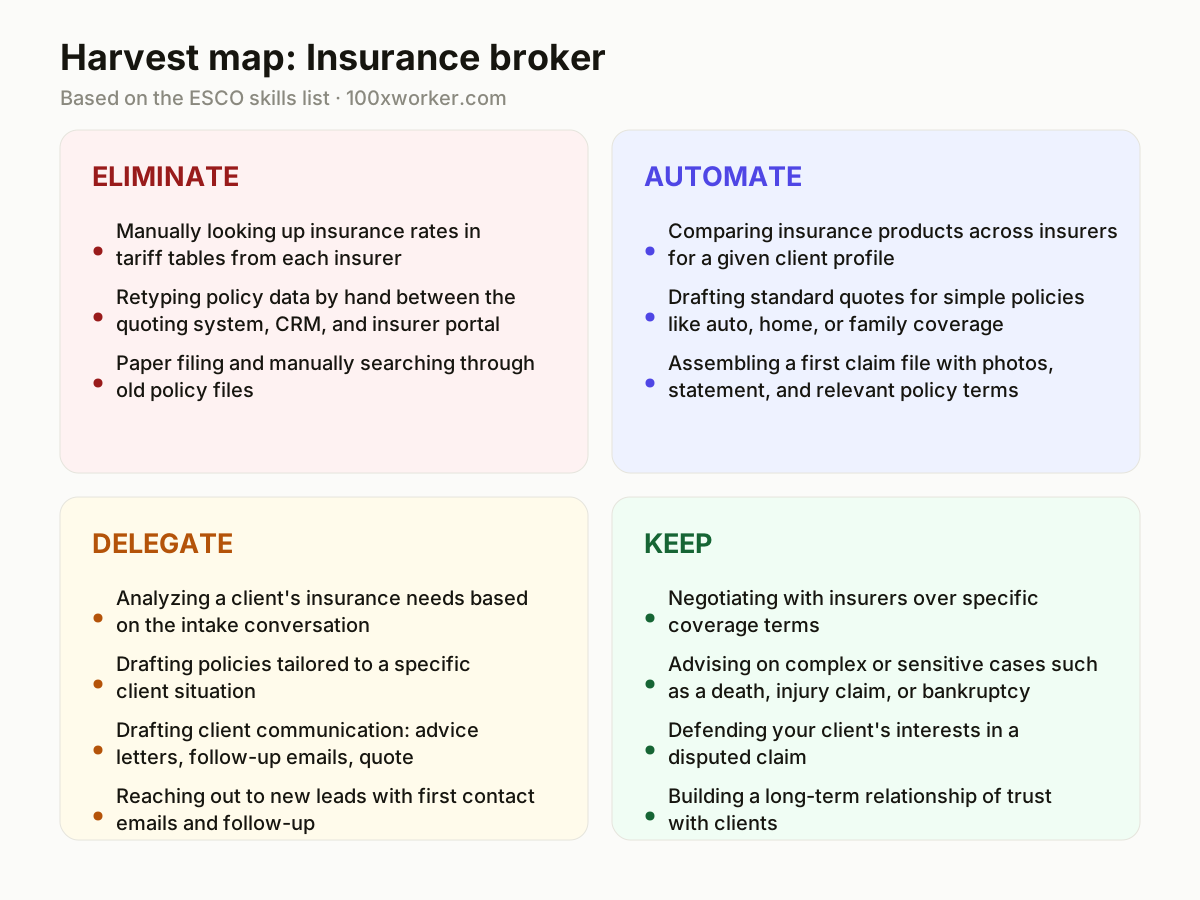
What tasks will AI take over from insurance brokers?
AI removes the tasks that involve looking things up or copying them somewhere else. That means manual rate lookups in insurer tariff tables, retyping policy data between your quoting system, CRM, and insurer portals, and searching paper archives for old files. On top of that, AI now automates comparison work across insurers, drafts standard quotes for simple policies like auto or home insurance, and assembles a first claim file with photos, a client statement, and the relevant policy clauses. None of this needs a broker's judgment call, so it moves to software.
Will AI replace insurance brokers?
No. Microsoft Research's 2025 analysis of 200,000 Copilot conversations puts the AI applicability score for insurance sales roles at 22.8% of daily work activities, meaning most of the job stays outside what current AI tools do well. ESCO's own description of the role centers on negotiating coverage, protecting a client's interests, and advising on financial matters in person, none of which a model can take over. AI reshapes the paperwork and research side of the job. The negotiating, advising, and trust-building side stays with the broker.
How do you become the AI-savvy person at your insurance brokerage?
Start by mapping your own task list against the eliminate, automate, delegate, and keep buckets above. Pick one recurring task, like drafting standard auto quotes or summarizing intake calls, and run it through an AI tool for two weeks. Keep a short log of what it got right, what it missed, and how much time you saved. Share that log with colleagues instead of just the tool itself. Being the person with a working method, not just an early adopter of software, is what makes you the reference point when your office asks who understands this stuff.
What can you do this month to start using AI in your insurance practice?
Pick one task from the automate or delegate bucket, for example drafting a comparison table or a claim follow-up email, and test an AI tool on three real client files this week. Compare the output against what you would have written yourself and note the gaps. Next, build a short prompt for the task that captures what you actually need (client profile, coverage type, tone). Save it somewhere your colleagues can find it. By the end of the month you should have one working prompt and a clear sense of which parts still need your review.
Across 200,000 real conversations, generative AI showed clear applicability to about 23% of an insurance sales agent's daily work activities.
Microsoft Research, Working with AI (2025)
Become the AI person on your team
Run one AI-drafted comparison a week
Pick one client file each week and ask an AI tool to build the policy comparison table you would normally build by hand. Check it against the actual insurer terms, then time how long it took versus your usual method.
Build a prompt library for your office
Collect the prompts that work for quotes, claim summaries, and follow-up emails into a shared document. New colleagues can reuse them instead of starting from a blank page.
Offer to test tools before your agency buys them
Volunteer to pilot a comparison platform or drafting tool for a month and report back on accuracy and time saved. That makes you the reference point when colleagues have questions.
Want this for your actual task list?
The free scan on the homepage builds your personal task map in 30 seconds, based on your role and industry.
Run the free task scanTools for this work
| Tool | For which tasks | The sober take |
|---|---|---|
| Microsoft Copilot or a similar generative AI assistant | Drafting quotes, comparison tables, claim paperwork, and client emails (automate, delegate buckets) | Useful for a fast first draft, but always check figures against the insurer's actual policy documents. |
| AI-powered insurance comparison platforms | Comparing products across insurers for a client profile (automate bucket) | These pull live rate data, so they still need a human check on client-specific exclusions. |
| Speech-to-text and call summarization tools | Turning an intake conversation into a first risk profile (delegate bucket) | Good for a first pass, but nuance from tone of voice gets lost in the summary. |
| Document automation software for policy drafting | Drafting tailored policies with standard clauses (delegate bucket) | Speeds up the paperwork, but a licensed broker still has to verify the legal wording. |
| CRM platforms with generative AI add-ons | Auto-filling client data and drafting lead follow-up messages (eliminate, delegate buckets) | Removes retyping, though lead-scoring suggestions still need a human sanity check. |
Prompts to try today
Draft a policy comparison table
Summarize an intake call into a risk profile
Draft a claim follow-up email
Related jobs
Frequently asked questions
Which insurance broker tasks are most exposed to AI right now?
The tasks most exposed right now are the mechanical ones: looking up rates across insurer tariff tables, retyping policy data between your quoting system, CRM, and insurer portals, and drafting standard quotes for simple products like auto or home insurance. Comparison work across insurers and the first pass of a claim file also move quickly to AI tools. These are high-volume, low-judgment tasks, exactly the kind Microsoft Research's applicability scoring flags as suitable for current generative AI, distinct from negotiation or advice work that stays with the broker.
Is the old 'robotization percentage' for insurance brokers still accurate?
Not really. The robotization percentages you still see cited for many jobs, including sales and brokerage roles, usually trace back to Frey and Osborne's 2013 Oxford study, published before large language models existed. It measured a different kind of automation risk. Microsoft Research's 2025 applicability score, based on real generative AI usage data, is a better current reference: for insurance sales roles it sits at 22.8% of daily tasks, far lower than the automation percentages that circulated a decade ago.
How widely is generative AI already used across Europe, and does that affect insurance sales?
Eurostat reports that 32.7% of the EU population aged 16 to 74 used generative AI in the three months before being surveyed in 2025. That means a growing share of your clients already use AI chatbots to get a first answer about coverage or pricing before they call you. It does not replace the advice or negotiation work you do, but it does change what a first conversation with a client looks like: they often arrive with a rough idea already formed by a chatbot.
Will clients still want to talk to a human broker instead of a chatbot?
Yes, for the parts of the job that involve judgment and trust. ESCO's own description of the broker role centers on protecting a client's interests, negotiating coverage, and advising on financial matters face to face, tasks that depend on relationships and accountability. A chatbot can explain a policy term. It cannot take responsibility for advice, negotiate directly with an underwriter on your behalf, or build the kind of relationship that makes a client call you again after a bad year.
Sources
- Microsoft Research, Working with AI: Measuring the Applicability of Generative AI to Occupations (2025)
- Anthropic Economic Index
- Eurostat, Individuals using generative AI (isoc_ai_iaiu)
- European Commission, ESCO classification
Hendrik De Winne, author of Becoming AI-Savvy, founder of VibeLab. Helps teams redesign their work with AI.
This article was drafted with AI assistance from public data sources and editorially reviewed.