100×worker · job analysis
Will AI Replace Claims Handlers, and What Should You Do About It?
Claims handling looks like a prime target for automation: lots of forms, templates, and numbers. But the data says otherwise. Microsoft Research analyzed 200,000 real Copilot conversations and scored occupations by how applicable generative AI is to their actual work. Claims adjusters, examiners, and investigators, the closest US category to claims handler, scored 20.7%. That is far below translators at 49% and above nurses at 12% (Microsoft Research, Working with AI, 2025). The claims handler job is not disappearing, but a meaningful slice of it is shifting to AI drafting and screening tools.
The ESCO taxonomy, maintained by the European Commission, lists claims handling among 3,039 occupations and breaks the role down into specific skills: evaluating insurance procedures, managing claim files, questioning policyholders, calculating compensation, and detecting fraud. That level of detail matters, because AI does not touch a job title. It touches individual tasks, and which tasks change depends on whether they involve fixed rules or human judgment.
This article sorts the claims handler's task list into four groups: tasks that disappear outright, tasks AI now does end to end, tasks AI drafts while you check the result, and tasks that stay firmly in human hands. Anthropic's Economic Index, which classifies AI conversations against detailed occupational tasks, backs the same pattern: drafting and calculation lean toward automation-style AI use, while judgment calls lean toward augmentation.
A claims handler assesses, calculates, and processes insurance claims on behalf of an insurer.
The task split: what AI takes over and what stays yours
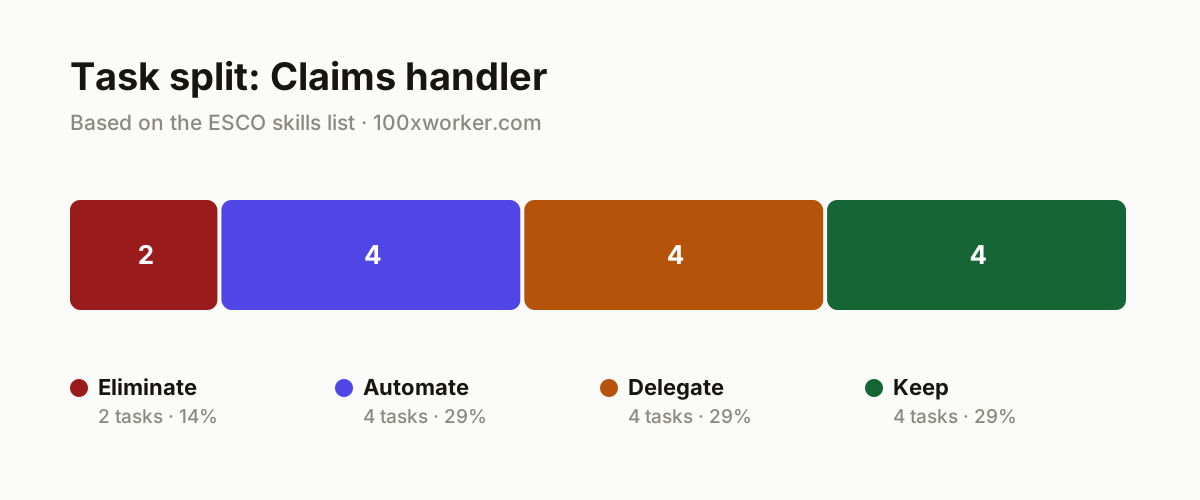
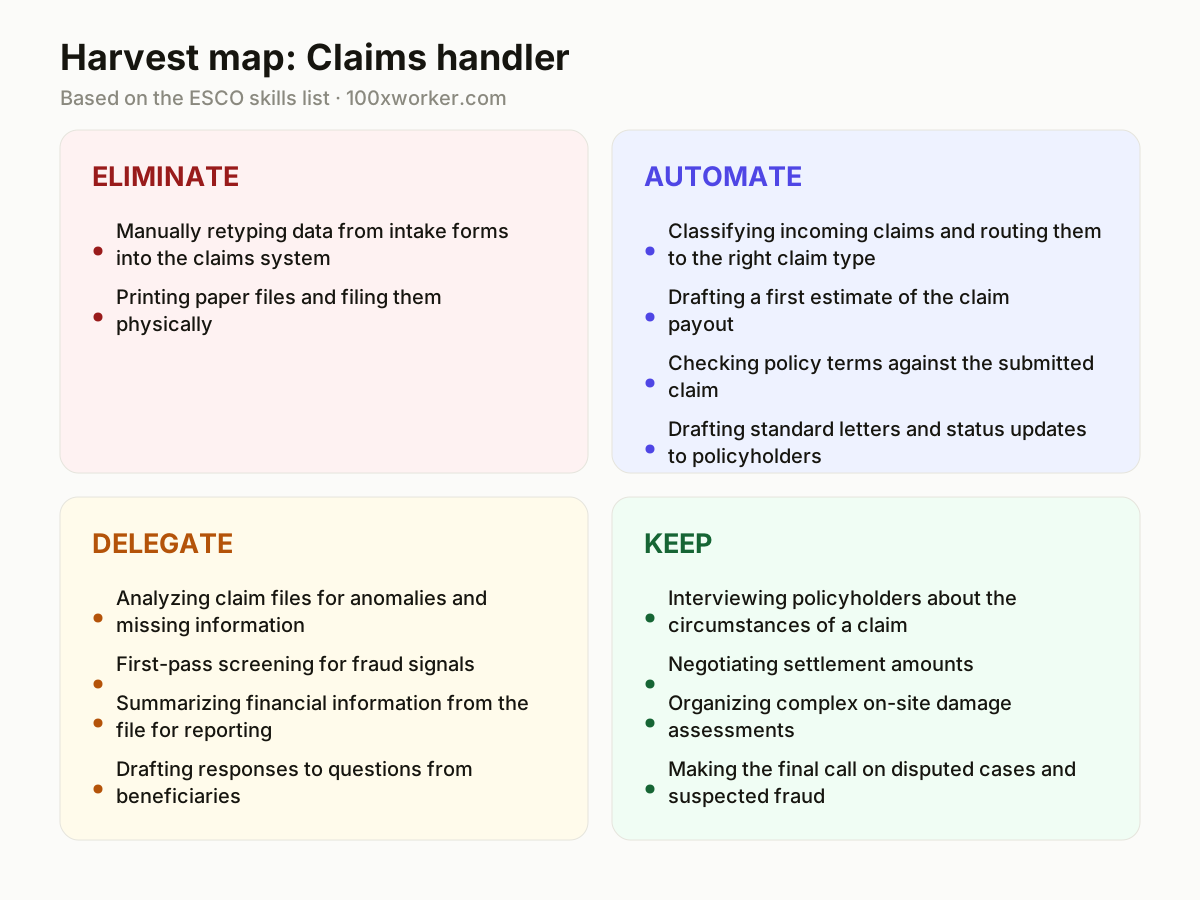
The eliminate/automate/delegate/keep framework sorts a job's tasks by how much AI changes them, not by whether the job title survives. Eliminate tasks disappear because the manual step itself becomes pointless. Automate tasks get done by AI with a person only checking totals or exceptions. Delegate tasks get a first pass from AI, but a person reviews and finishes them before anything goes out. Keep tasks stay with a person because they require judgment, negotiation, or accountability that no model can carry. For claims handlers, this split falls roughly where paperwork ends and conversation begins.
| Task | Bucket | Why |
|---|---|---|
| Manually retyping data from intake forms into the claims system | eliminate | Double data entry disappears once forms connect digitally to the system. |
| Printing paper files and filing them physically | eliminate | Digital case management systems make the paper trail unnecessary. |
| Classifying incoming claims and routing them to the right claim type | automate | An AI agent recognizes claim type and policy coverage from submitted text and documents. |
| Drafting a first estimate of the claim payout | automate | Based on policy terms and historical data, AI produces a starting figure. |
| Checking policy terms against the submitted claim | automate | Text comparison between policy and claim is fast and consistent to automate. |
| Drafting standard letters and status updates to policyholders | automate | Recurring communication follows fixed templates an agent can fill in itself. |
| Analyzing claim files for anomalies and missing information | delegate | AI flags gaps in the file, you decide whether they matter. |
| First-pass screening for fraud signals | delegate | AI produces a risk score, the final fraud judgment stays with you. |
| Summarizing financial information from the file for reporting | delegate | A summary generates quickly, you still check the interpretation. |
| Drafting responses to questions from beneficiaries | delegate | AI writes the first version, you check tone and legal accuracy. |
| Interviewing policyholders about the circumstances of a claim | keep | Building trust and noticing contradictions requires a real conversation. (Your edge: Sensing hesitation and emotion in a live conversation.) |
| Negotiating settlement amounts | keep | Negotiation requires weighing interests that follow no template. (Your edge: Reading what the other party actually wants.) |
| Organizing complex on-site damage assessments | keep | Estimating physical damage and scheduling experts remains situational, hands-on work. (Your edge: Physical inspection and practical coordination on site.) |
| Making the final call on disputed cases and suspected fraud | keep | Legal and financial accountability for the decision rests with a person. (Your edge: Taking responsibility for a decision with real consequences.) |
What tasks does AI take over for claims handlers?
AI already automates several repetitive parts of claims work. It classifies incoming claims by type and coverage, drafts a first estimate of the payout based on policy terms and historical data, checks policy wording against the claim text, and writes standard letters and status updates to policyholders. Anthropic's Economic Index, which classifies large numbers of AI conversations against detailed occupational tasks, finds that this kind of drafting and calculation work leans toward automation-style use rather than augmentation. Other tasks move to a delegate pattern instead: AI flags anomalies in a file, produces a fraud risk score, or drafts a summary, but a person still reviews the output before it goes anywhere near a payout decision.
Will AI replace claims handlers?
No single AI system replaces the claims handler role, but it reshapes what the job involves. Microsoft Research analyzed 200,000 real Copilot conversations and scored occupations by how much of their work AI can plausibly touch. Claims adjusters, examiners, and investigators scored 20.7%, well below translators at 49% but above nurses at 12%. That leaves most of the job, interviewing claimants, negotiating settlements, and deciding disputed or fraud-flagged cases, in human hands. Employers are more likely to redesign the task list around a claims handler than to remove the position, shifting time from paperwork toward judgment calls and direct conversations with policyholders.
What is AI already doing in claims handling today?
Insurers already use AI for claim intake, document extraction, and initial triage, feeding structured data straight into claims systems instead of requiring manual entry. Across the EU, 32.7% of people aged 16 to 74 used generative AI in the three months before the survey (Eurostat, 2025), and many insurers report similar adoption inside claims departments for drafting correspondence and summarizing files. The ESCO taxonomy, which catalogs 3,039 occupations and their skills across 28 languages, still lists claims handling as a task bundle heavy on judgment, interviewing, and fraud detection, which matches where AI adoption inside the role has concentrated so far: drafting and screening, not deciding.
What can you do this month as a claims handler?
Start by listing your recurring tasks and marking which ones are pure data entry, drafting, or checking. Ask your claims system provider whether it already offers AI-assisted intake classification or draft payout calculations, since many platforms have added this without much internal announcement. Practice writing prompts that ask AI to summarize a file or flag missing documents, then compare its output against your own read of the case. Spend the time you save on the conversations and negotiations that still need a person: interviewing claimants, negotiating settlements, and reviewing flagged fraud cases before you sign off.
Claims adjusters, examiners, and investigators show an AI applicability score of 20.7 percent, well below translators at 49 percent and above nurses at 12 percent.
Microsoft Research, Working with AI (2025)
Become the AI person on your team
Shift from drafting to reviewing
Let AI produce the first draft of a payout calculation or a status letter. Your job becomes checking it against policy terms and the specific facts of the case, not writing every line from scratch.
Use AI as a second reader on fraud signals
Feed a claim file into a fraud-screening tool and treat the risk score as a starting point, not a verdict. Cross-check it against your own read of the claimant's story and the documents on file.
Protect time for the conversations that matter
Once routine drafting and classification move to AI, block real time for interviewing claimants and negotiating settlements. Those conversations are where trust and accurate outcomes actually get built.
Track which tasks changed on your desk
Keep a running list of tasks AI now drafts or flags versus tasks you still do end to end. Bring this list to performance reviews, since it shows where your judgment adds value beyond what a tool produces.
Want this for your actual task list?
The free scan on the homepage builds your personal task map in 30 seconds, based on your role and industry.
Run the free task scanTools for this work
| Tool | For which tasks | The sober take |
|---|---|---|
| Claims triage AI agent (built into your claims management system) | Classifying incoming claims and routing them to the right claim type | Most large claims platforms have added a version of this; check your existing system before buying something new. |
| Document extraction / OCR tool | Removing manual retyping from intake forms | Useful mainly when intake still arrives as scanned PDFs or paper. |
| Fraud-risk scoring model | First-pass screening for fraud signals | Treat the score as one input, not the decision itself. |
| AI drafting assistant for correspondence | Drafting standard letters, status updates, and responses to beneficiaries | Still needs a human check for tone and legal accuracy before sending. |
Prompts to try today
Draft a payout estimate
Flag missing information
Summarize for a report
Related jobs
Frequently asked questions
Is the claims handler job at risk of disappearing?
No. Microsoft Research's applicability score for the closest US category, claims adjusters, examiners, and investigators, is 20.7%, meaning most of the work still falls outside what generative AI can reliably do on its own. The tasks most exposed are drafting, classification, and first-pass calculations. Interviewing claimants, negotiating settlements, and deciding disputed or fraud-flagged cases stay with a person, because they require judgment and accountability that a model cannot carry.
How is AI used in claims handling right now?
AI tools already classify incoming claims by type, extract data from intake forms, draft a first payout estimate based on policy terms, and produce standard letters and status updates. Some systems also generate a fraud risk score that a handler reviews before deciding whether to escalate a case. Across the EU, 32.7% of people aged 16 to 74 used generative AI in the three months before being surveyed in 2025 (Eurostat), and insurance departments are part of that broader uptake.
What skills should a claims handler build for the AI era?
Focus less on manual data entry and more on reviewing AI output for accuracy against policy terms and case facts. Sharpen interviewing and negotiation skills, since those stay firmly human. Learn to write clear prompts for drafting and summarizing tasks, and build a habit of checking AI-generated fraud scores and payout estimates against your own read of the file before signing off.
Are old automation-risk statistics about claims handling still accurate?
Be cautious with older robotization-percentage figures still circulating online. Many trace back to Frey and Osborne's 2013 Oxford study, published before large language models existed. That study modeled task automation risk differently and did not account for how generative AI actually gets used inside a job. Newer sources like Microsoft Research's applicability scores and Anthropic's Economic Index, both based on real AI conversation data, give a more current picture.
Sources
- Microsoft Research, Working with AI: Measuring the Applicability of Generative AI to Occupations (2025)
- Anthropic Economic Index
- Eurostat, isoc_ai_iaiu (2025)
- ESCO, European Commission
Hendrik De Winne, author of Becoming AI-Savvy, founder of VibeLab. Helps teams redesign their work with AI.
This article was drafted with AI assistance from public data sources and editorially reviewed.