100×worker · job analysis
Will AI Replace Health and Safety Officers, and What Should You Do About It?
Health and safety officers spend their days walking factory floors, interviewing workers after accidents, and reading dense regulatory text. It is reasonable to wonder how much of that work AI can now do. The clearest answer comes from Microsoft Research, which analyzed 200,000 real Copilot conversations and scored how applicable generative AI is to each occupation's actual work activities. Occupational health and safety specialists scored 14.6%, one of the lowest applicability scores measured, well below translators (49%) but slightly above nurses (12%).
That low score does not mean AI is irrelevant here. It means AI is useful for a specific slice of the job: drafting reports, translating safety instructions, tracking regulatory changes, and summarizing incident data. It is not useful for the parts that define the profession: standing on a factory floor to spot a hazard, sitting across from a worker after an accident to find out what really happened, or deciding whether a violation warrants a fine.
This article breaks the job into four buckets, tasks to eliminate, automate, delegate, and keep, based on what AI can actually do reliably today, not on speculation about future capability.
A health and safety officer inspects workplaces and advises organizations on managing risks to worker health and safety.
The task split: what AI takes over and what stays yours
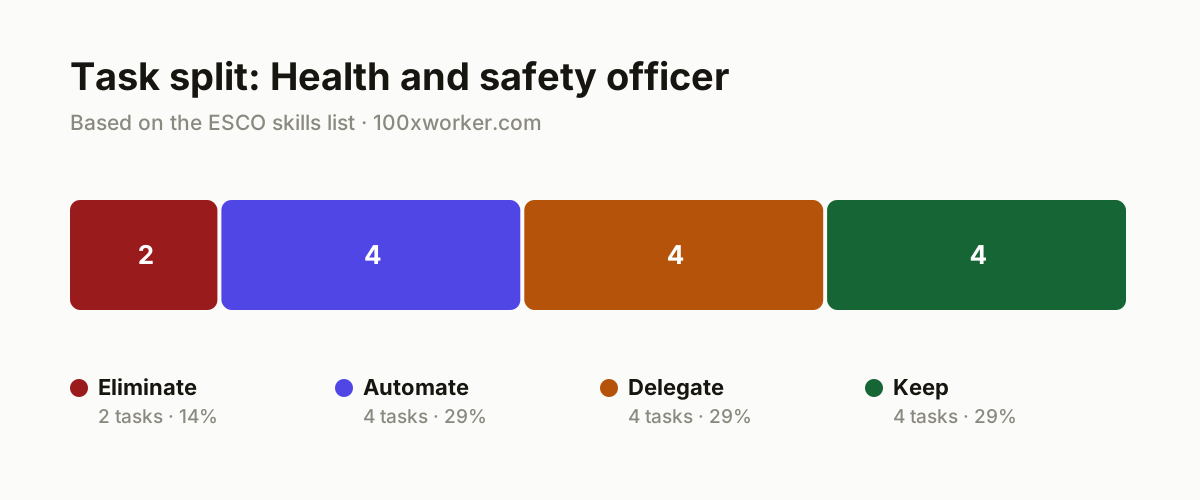
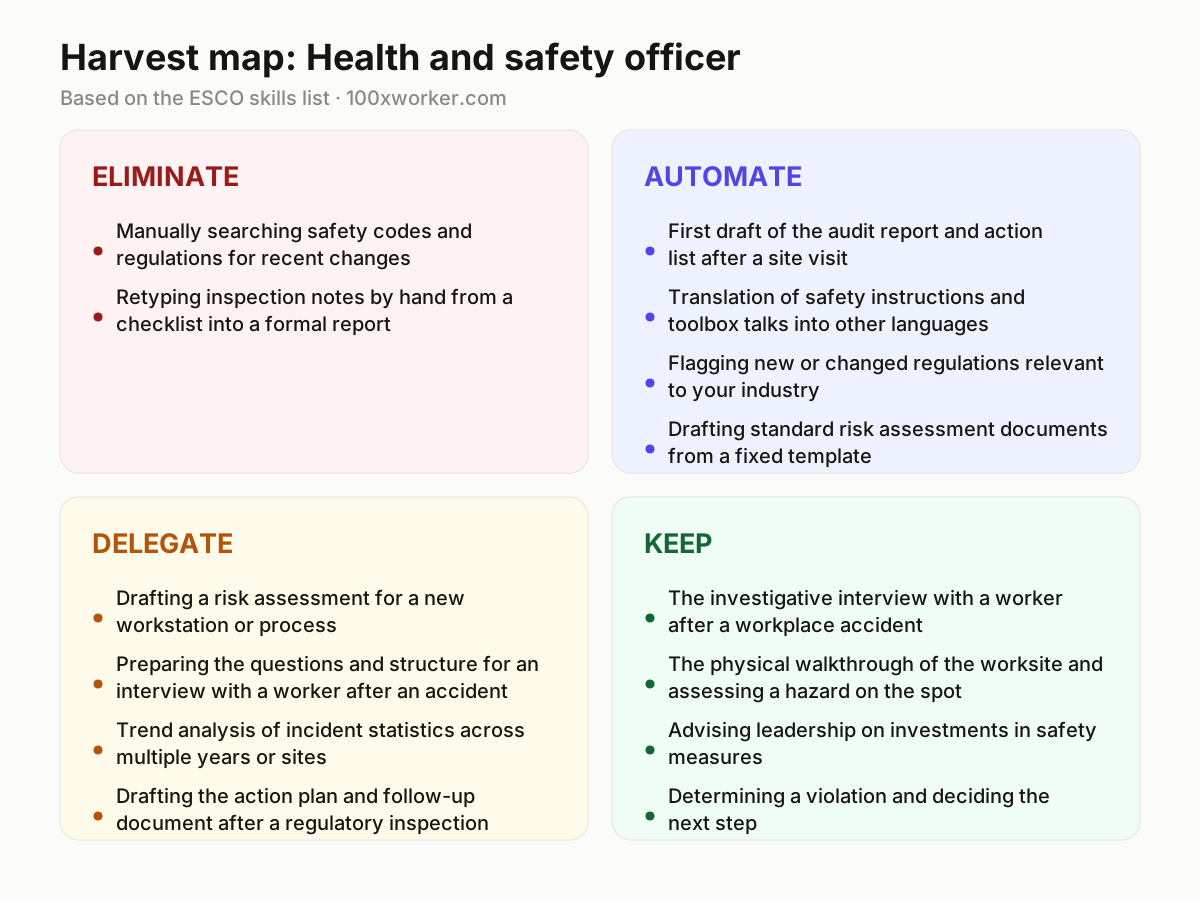
Not every task in a health and safety officer's day carries the same weight, and not every task responds to AI the same way. Splitting the job into four buckets makes this concrete: tasks to eliminate outright because AI does them better, tasks to automate with an agent doing the first pass, tasks to delegate where AI drafts and you decide, and tasks to keep because they depend on physical presence, trust, or legal judgment that no model can supply.
| Task | Bucket | Why |
|---|---|---|
| Manually searching safety codes and regulations for recent changes | eliminate | AI searches regulatory text in seconds and summarizes what changed. |
| Retyping inspection notes by hand from a checklist into a formal report | eliminate | Speech-to-text and document generation make manual transcription unnecessary. |
| First draft of the audit report and action list after a site visit | automate | An agent turns spoken or typed notes into a structured report with action items. |
| Translation of safety instructions and toolbox talks into other languages | automate | On multinational sites this is repetitive work an agent delivers without errors. |
| Flagging new or changed regulations relevant to your industry | automate | An agent monitors regulatory updates and forwards only what applies to your company. |
| Drafting standard risk assessment documents from a fixed template | automate | For a new machine or role, AI fills the template with the right risk categories. |
| Drafting a risk assessment for a new workstation or process | delegate | AI produces a draft based on similar roles, you verify on-site and adjust it. |
| Preparing the questions and structure for an interview with a worker after an accident | delegate | AI drafts an initial question list, you set the tone and ask the real questions. |
| Trend analysis of incident statistics across multiple years or sites | delegate | AI finds patterns in numbers faster, you judge whether a pattern requires action. |
| Drafting the action plan and follow-up document after a regulatory inspection | delegate | AI turns findings into a concrete plan, you negotiate deadlines with management. |
| The investigative interview with a worker after a workplace accident | keep | This is about trust and finding the truth, not just gathering information. (Your edge: Only a human reads doubt, fear, or shame in someone's expression.) |
| The physical walkthrough of the worksite and assessing a hazard on the spot | keep | A smell, a sound, or a gut feeling about a machine doesn't show up in a photo. (Your edge: Physical presence and hands-on experience remain irreplaceable.) |
| Advising leadership on investments in safety measures | keep | This requires persuasion and knowledge of the company's culture and politics. (Your edge: Convincing leadership is relationship work, not report work.) |
| Determining a violation and deciding the next step | keep | This is a legal and human judgment call with consequences for someone's job. (Your edge: Final responsibility and risk stay with the human, not the model.) |
Which tasks of a health and safety officer does AI take over?
AI reliably takes over document-heavy, repetitive work: searching regulatory text for changes, drafting the first version of an audit report from your notes, translating toolbox talks and safety instructions, and monitoring regulatory updates for relevance. These are the eliminate and automate buckets. AI does not take over site inspections, accident interviews, or the decision to cite a violation. Microsoft Research's applicability score of 14.6% for this occupation reflects that split: a real but bounded share of the job responds to generative AI, while the core inspection and judgment work does not.
Will AI replace health and safety officers?
No, not based on current evidence. Health and safety officers scored 14.6% on Microsoft Research's applicability scale, close to the low end of all occupations studied and far below roles like translation (49%). The job depends on physical presence at the worksite, in-person interviews after accidents, and legal judgment about violations, none of which a language model can perform. What changes is the task mix inside the role: less time on paperwork and regulatory searches, more time on inspection quality, interviewing skill, and advising leadership on where to invest in safety.
How many professionals already use AI at work?
Adoption is rising but still uneven. Eurostat reports that 32.7% of the EU population aged 16 to 74 used generative AI in the three months before being surveyed in 2025. Anthropic's Economic Index, which classifies millions of real conversations against standardized occupational task lists, finds that AI use splits between automation-like use (AI does the task) and augmentation-like use (AI supports a human decision). For a role like health and safety officer, augmentation-like use is more common, since much of the job cannot be fully automated.
What can you do this month to become the AI-savvy person on your team?
Pick one recurring report you write by hand, feed a template and your raw inspection notes into an AI tool, and see how close the draft gets to something usable. Do the same for a regulatory summary you already track manually. Set up one automated alert for regulatory changes in your sector instead of checking manually. None of this requires new software approval in most organizations, a general-purpose AI assistant and thirty minutes are enough to find out which of your weekly tasks belong in the automate or delegate bucket.
Distinguishing automation-like use from augmentation-like use shows where AI replaces a step and where it supports a human decision.
Anthropic Economic Index
Become the AI person on your team
Turn your notes into a report template
Take a recent site visit's raw notes and ask an AI tool to structure them into your standard audit format. Compare the output to what you would have written and note where you still had to correct facts or tone.
Set up a regulatory watch
Use an AI tool to summarize weekly updates to safety regulations relevant to your sector, so you spend review time on relevance, not searching. Keep a human check before anything reaches a compliance decision.
Build a risk assessment starting template
Ask AI to draft a first-pass risk assessment for a new workstation or process based on a description you provide, then walk the actual site to verify and correct it in person.
Want this for your actual task list?
The free scan on the homepage builds your personal task map in 30 seconds, based on your role and industry.
Run the free task scanTools for this work
| Tool | For which tasks | The sober take |
|---|---|---|
| Microsoft Copilot | Drafting audit reports and action lists from meeting or inspection notes | Works inside Word and Outlook, which most inspectors already use for documentation. |
| Claude or ChatGPT | Summarizing regulatory text, drafting interview question lists, trend analysis of incident data | General-purpose, useful for delegate-bucket drafting but always needs your review. |
| DeepL or similar translation tools | Translating safety instructions and toolbox talks for multinational sites | Faster and more consistent than manual translation for repetitive safety text. |
| EHS management software with AI features | Automated regulatory monitoring, template-based risk assessments | Check whether your existing safety management platform already has these features before adding a new tool. |
Prompts to try today
Turn inspection notes into a structured report
Summarize a regulatory change
Draft interview questions for an accident investigation
Related jobs
Frequently asked questions
Is health and safety officer a high-risk job for AI automation?
No. Microsoft Research's 2025 applicability study, based on 200,000 real Copilot conversations, scored this occupation at 14.6%, near the low end of all occupations measured. High-scoring occupations like translation reach 49%. The role depends heavily on physical site presence and in-person interviews, tasks generative AI cannot perform, which keeps the applicability score low even as AI adoption grows in adjacent office tasks.
What is the difference between AI automating and AI augmenting this job?
Automation means AI performs the task with minimal human input, like translating a toolbox talk or drafting a report from notes. Augmentation means AI supports a decision a human still makes, like summarizing incident trends before you decide whether action is needed. Anthropic's Economic Index tracks this split across occupations by classifying real conversations against standardized task lists, and augmentation-like use tends to dominate in roles requiring judgment and physical presence.
Should I worry about my job disappearing because of AI?
Based on the available evidence, no. The occupation scores low on AI applicability specifically because its core functions, worksite inspection, accident interviews, and violation decisions, require physical presence and legal judgment. What is more realistic is a shift in your daily task mix: less time on report writing and regulatory searches, more time available for inspection quality and advising leadership, since AI absorbs the paperwork load.
Where does the occupational data for this profession come from?
Task descriptions and required skills for this role come from ESCO, the European Commission's occupational classification covering 3,039 occupations and their associated skills across 28 languages. AI applicability figures come from Microsoft Research's 2025 study of real Copilot usage. Adoption figures come from Eurostat's EU-wide survey and Anthropic's Economic Index, which classifies AI conversations against standardized occupational task frameworks.
Sources
- Microsoft Research, Working with AI: Measuring the Applicability of Generative AI to Occupations (2025)
- Anthropic Economic Index
- Eurostat, Individuals using generative AI (isoc_ai_iaiu)
- ESCO, European Commission occupational classification
Hendrik De Winne, author of Becoming AI-Savvy, founder of VibeLab. Helps teams redesign their work with AI.
This article was drafted with AI assistance from public data sources and editorially reviewed.