100×worker · job analysis
Will AI Replace Fashion Designers, and What Should You Do About It?
Fashion designers create concepts and translate them into sketches, mood boards, material choices, and production instructions for a collection, according to the ESCO occupational taxonomy maintained by the European Commission, which classifies more than 3,000 occupations in 28 languages. That job description covers a wide range of tasks, from trend research to fabric selection to overseeing a fitting. Generative AI does not touch all of these tasks equally.
Microsoft Research analyzed 200,000 real conversations between professionals and Copilot and scored how applicable generative AI is to each occupation's actual work activities. For the closest US occupational match, 'Fashion Designers,' that applicability score comes out to 27.1%. For comparison, translators score highest at 49%, and nurses score low at 12%. That places fashion design in the middle: AI is useful for a meaningful chunk of the job, but far from all of it.
Generative AI use is already widespread among the broader public. In 2025, 32.7% of the EU population aged 16 to 74 had used generative AI in the previous three months, according to Eurostat. For a creative profession built on research, iteration, and communication, the practical question is which tasks to hand over and which to keep, not whether to touch these tools at all.
A fashion designer turns creative concepts into sketches, materials, and production instructions for a collection.
The task split: what AI takes over and what stays yours
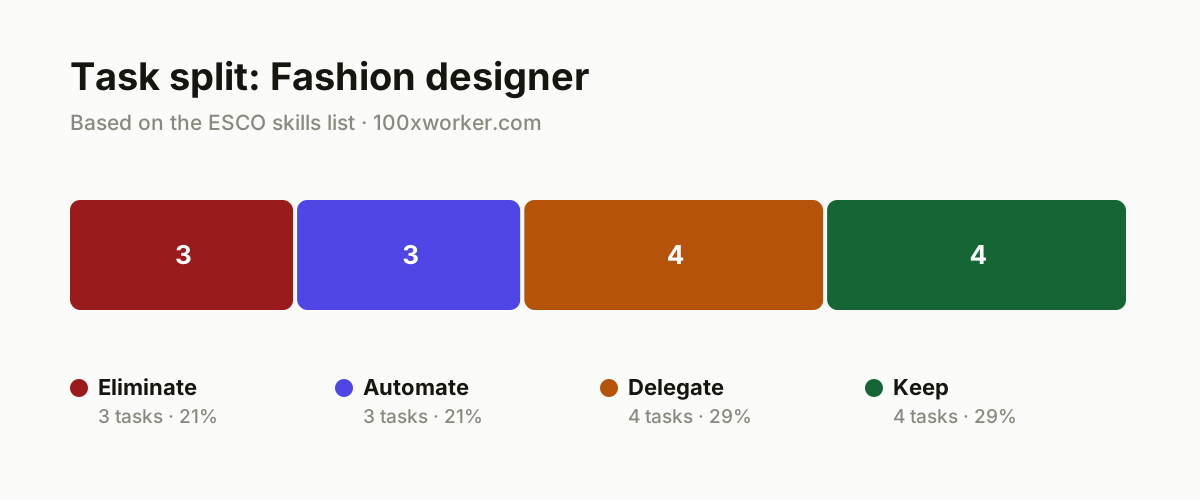
This article sorts fashion design tasks into four buckets: eliminate (tasks that stop making sense once decent AI tools exist), automate (tasks a tool or agent can run with light supervision), delegate (tasks where AI drafts and you edit), and keep (tasks that stay with you because they depend on judgment, touch, or trust). The goal is to give you a practical map of where to spend your time as the tools mature. It has nothing to do with how flashy an AI demo looks and everything to do with which tasks actually change day to day.
| Task | Bucket | Why |
|---|---|---|
| Collecting and cutting out trend images by hand from magazines and catalogs | eliminate | AI scans thousands of sources at once and produces a trend overview faster than a scrapbook ever could. |
| Matching color palettes by hand against physical swatch books each season | eliminate | Software tools generate and test color palettes digitally, cutting out most of the manual matching round. |
| Manually recalculating size charts for each standard sizing system | eliminate | Size conversions that follow fixed tables are calculation rules, not creative work. |
| Generating technical drawings and size charts from a base sketch | automate | An agent turns the sketch into standardized, production-ready technical documentation automatically. |
| Drafting and maintaining production instructions for the manufacturing floor | automate | Managing garment production instructions follows fixed templates, which suits document generation well. |
| Running material and color variations of a base design across a full line | automate | Starting from one silhouette, AI generates every fabric and color variant the collection needs. |
| Working up first sketches and silhouettes from a brief or mood board | delegate | AI produces several design directions quickly, you choose, refine, and set the final line. |
| Summarizing trend forecasts and market research from reports, social media, and sales data | delegate | AI reads and clusters more sources than you could get through alone, you judge what matters. |
| Building mood boards around a theme or collection concept | delegate | A first version appears in minutes, you rework it until it matches the mood and brand DNA. |
| Writing lookbook copy and collection descriptions for the portfolio | delegate | AI writes a solid first draft, you rewrite it into your own voice and brand language. |
| Making the final aesthetic calls and setting the creative signature of a collection | keep | This is where taste, vision, and years of built-up reference make the difference. (Your edge: Taste and vision resist automation.) |
| Handling fabric and judging material properties by hand (drape, weight, texture) | keep | You feel fabric properties directly, a screen shows no drape or weight. (Your edge: Tactile material knowledge stays irreplaceable.) |
| Running fitting sessions and altering garments on a real body | keep | Judging fit and ergonomics on an actual body takes physical presence and experience. (Your edge: No fitting tool checks a real fit.) |
| Maintaining client, brand, and team relationships and defending the creative direction | keep | Building trust and selling a vision to a team or client stays human work. (Your edge: You don't build trust with a chatbot.) |
What tasks will AI take over from fashion designers?
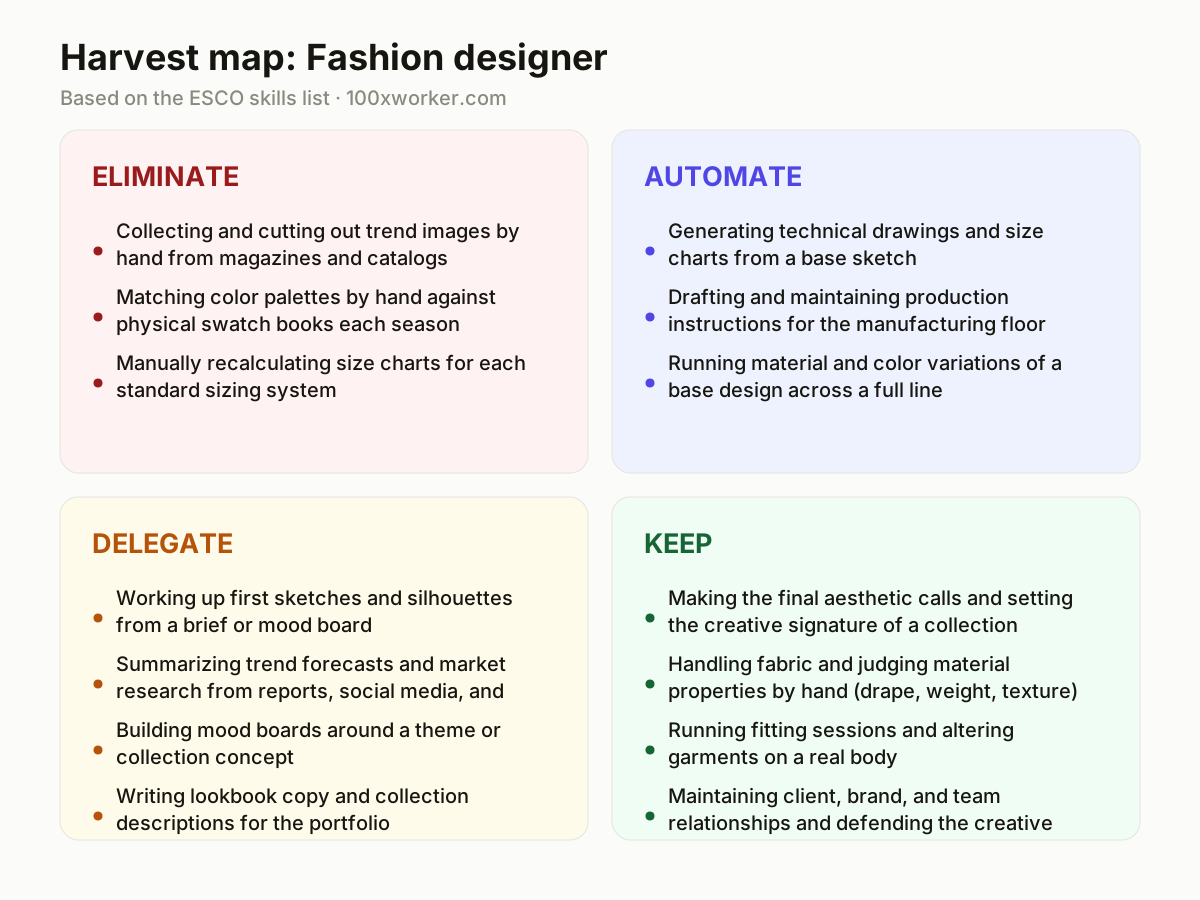
AI is strongest on the parts of fashion design that involve pattern-following and information processing. That includes turning a base sketch into technical drawings and size charts, drafting production instructions for the manufacturing floor, and generating material or color variants across a full line automatically. It also removes some tasks entirely: manually cutting trend images from magazines, matching swatches by hand against a physical color book, and recalculating size charts by hand. Research and drafting tasks like summarizing trend reports, building a first mood board, or writing lookbook copy move into a delegate zone, where AI drafts and you edit. Microsoft Research puts overall applicability at 27.1% of a fashion designer's work activities, concentrated in these areas.
Will AI replace fashion designers?
No single tool replaces the full job. Microsoft Research's applicability score for fashion designers sits at 27.1%, meaning generative AI demonstrably helps with roughly a quarter of the work, well below translators at 49% but above nurses at 12%. The rest of the job depends on things AI cannot do: judging how a fabric drapes on a body, running a fitting, setting the final aesthetic direction of a collection, and keeping a client's trust through a design process. Anthropic's Economic Index shows that across occupations, AI use splits between automating a task outright and augmenting a person's own work. For a hands-on creative role like this one, augmentation (AI drafting, you deciding) is the more realistic pattern than full automation.
What can you do this month as a fashion designer?
Start by listing your actual weekly tasks against the ESCO skill set for this occupation (fabric properties, size systems, garment alteration, mood boards, sketching, production instructions). Mark each task eliminate, automate, delegate, or keep. Pick one delegate task, for example trend research or a first mood board draft, and run it through an AI tool for two weeks, timing how much editing it needs. Keep a short log of what worked and what needed heavy correction. Do not try to change everything at once. A single well-tested workflow, such as tech pack drafting from a base sketch, that actually saves hours beats five half-tried tools nobody on the team ends up using.
How do you become the AI-savvy person on your design team?
Pick one recurring bottleneck (tech pack drafting, trend summaries, or lookbook copy) and become the person who knows the current best tool and prompt for it. Write the prompts down so others can reuse them instead of starting from scratch each time. Set a short review checklist for anything AI drafts, covering correct fabric codes, correct sizing system, and brand voice, so errors get caught before they reach a sample room or client. Share what doesn't work as openly as what does. Being the AI-savvy person on a team is less about knowing the most tools and more about knowing which two or three tools are actually worth the studio's time.
Across the tasks fashion designers actually do, generative AI is demonstrably applicable to about 27 percent of them, based on an analysis of 200,000 real work conversations.
Microsoft Research, Working with AI: Measuring the Applicability of Generative AI to Occupations (2025)
Become the AI person on your team
Build a shared prompt library
Collect the prompts that actually save time on trend summaries, mood boards, and tech pack drafts. Keep them in a shared doc your team can reuse and edit rather than reinventing each time.
Own the tool evaluation
Test two or three AI image and documentation tools against your studio's real briefs. Report back on which one produces usable first drafts and which one just produces noise that needs a full rewrite.
Set the review checklist
Write a short checklist for what a human still needs to check on any AI-drafted tech pack or lookbook text, such as measurements, fabric codes, and brand voice, so mistakes get caught before production.
Teach the team what not to automate
Walk newer team members through which tasks, like fittings, fabric selection, and final aesthetic calls, stay manual, so the team doesn't quietly let AI drift into judgment calls it shouldn't make.
Want this for your actual task list?
The free scan on the homepage builds your personal task map in 30 seconds, based on your role and industry.
Run the free task scanTools for this work
| Tool | For which tasks | The sober take |
|---|---|---|
| ChatGPT or Claude | Trend research summaries, lookbook copy, production instruction drafts (delegate and automate buckets) | Good for text-heavy drafting, weak at judging how a fabric actually behaves. |
| Midjourney, DALL-E, or Adobe Firefly | First sketches, silhouette exploration, mood boards (delegate bucket) | Fast for exploring directions, still needs your eye to pick and refine what's usable. |
| 3D garment simulation software (e.g. CLO or Browzwear) | Technical drawings, size charts, material and color variant runs (automate bucket) | Speeds up tech pack generation but does not replace a physical fit check. |
| AI-enabled PLM or documentation tools | Drafting and updating production instructions for the manufacturing floor (automate bucket) | Keeps instructions organized as specs change, but someone still has to sign off on accuracy. |
Prompts to try today
Trend research summary
Mood board brief to concept
Tech pack draft from sketch description
Related jobs
Frequently asked questions
Which fashion design tasks are safest from AI right now?
Tasks that require physical judgment or trust are the safest: handling fabric to judge drape, weight, and texture, running fitting sessions on a real body, making final aesthetic calls for a collection, and maintaining client and team relationships. These depend on tactile experience, physical presence, and built trust, none of which a chatbot or image generator can replicate. Tasks built on repeatable rules or large amounts of text and image processing, such as trend summaries, size chart math, or first-draft sketches, are far more exposed to change.
Do fashion designers need to learn to code to use AI tools?
No. Most tools relevant to fashion design work through plain-text prompts or a visual interface: image generators for mood boards and sketches, chat tools for trend summaries and copywriting, and specialized software for tech packs and size charts. What matters more than coding is writing clear, specific prompts, including the right sizing system, brand voice, or material details, and knowing how to check the output for errors before it moves further down the production line.
How many people already use generative AI regularly?
Adoption is already broad. In 2025, 32.7% of the EU population aged 16 to 74 had used generative AI in the previous three months, according to Eurostat. That means a large share of the clients, buyers, and colleagues a fashion designer works with are already familiar with these tools, which changes expectations around turnaround time for research, mood boards, and first drafts.
What's the difference between automation and augmentation in AI use?
Automation means AI completes a task with little or no human editing, for example running a size conversion. Augmentation means AI produces a draft or option that a person then reviews, edits, or picks from, for example a first mood board or a trend summary. Anthropic's Economic Index tracks this split across millions of real conversations, classified against standard occupational task lists. For creative, judgment-heavy work like fashion design, augmentation is currently far more common than full automation.
Sources
- Microsoft Research, Working with AI: Measuring the Applicability of Generative AI to Occupations (2025)
- Anthropic Economic Index
- Eurostat, Use of generative AI (isoc_ai_iaiu)
- ESCO (European Commission occupational taxonomy)
Hendrik De Winne, author of Becoming AI-Savvy, founder of VibeLab. Helps teams redesign their work with AI.
This article was drafted with AI assistance from public data sources and editorially reviewed.