100×worker · job analysis
Will AI Replace Facility Managers? What Changes Now
Facility managers keep buildings running: heating, hot water, small repairs, safety checks, and a phone that residents or tenants can call when something breaks. That job is made up of dozens of smaller tasks, and generative AI is already changing how many of them get done. Across the EU, 32.7% of people aged 16 to 74 used generative AI in the three months before the survey (Eurostat, 2025), and the tools behind that adoption are the same ones now showing up in maintenance software, inspection apps, and email inboxes used by property and building teams.
There is no single published AI applicability score for facility management specifically. Microsoft Research analyzed 200,000 real Copilot conversations and scored applicability by occupation (Working with AI, 2025), but building and facility roles do not map cleanly onto that dataset. What the research does show is a consistent pattern: AI is most useful on tasks that involve reading, summarizing, and drafting text from structured input, exactly the kind of work that fills a facility manager's day between inspections and phone calls. This article breaks the job into concrete tasks and sorts them into four groups: what disappears, what gets automated, what you hand off with review, and what stays firmly yours.
A facility manager keeps buildings safe, maintained, and running for the people who use them.
The task split: what AI takes over and what stays yours
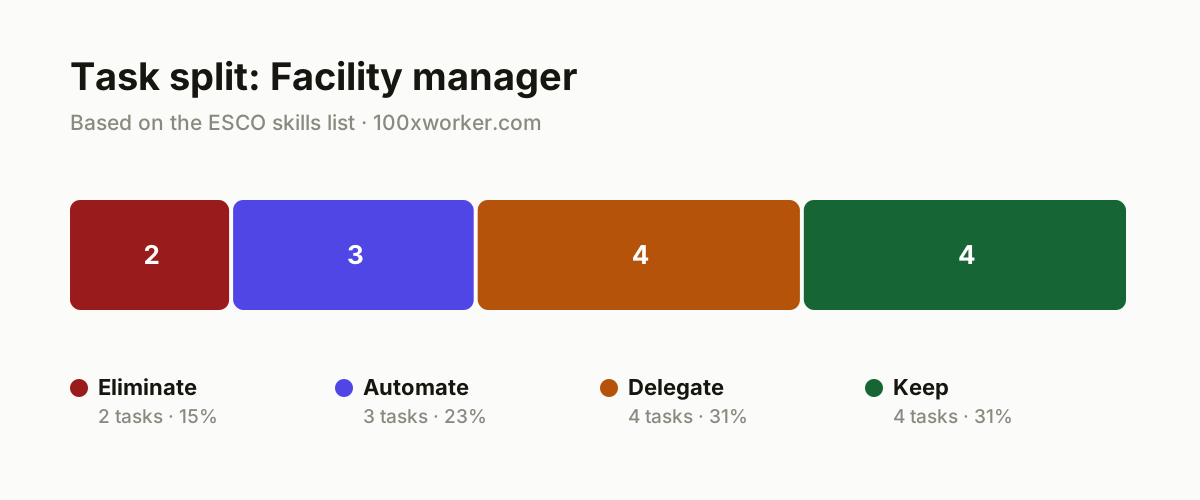
The clearest way to see what AI changes in facility management is to break the job into its actual tasks, the same task-level approach the ESCO taxonomy uses to describe over 3,000 occupations across Europe (European Commission, ESCO). Some tasks disappear because the systems around them made them obsolete. Some get fully automated by software. Some get delegated to AI for a first pass, with you reviewing before it goes out. And some stay with you because they need a physical presence, judgment, or a relationship that AI cannot substitute.
| Task | Bucket | Why |
|---|---|---|
| Keeping paper logbooks of tenant or resident arrival and departure times | eliminate | Access control systems and sensors already log this automatically, so a separate manual log is redundant. |
| Manually updating separate spreadsheet schedules for cleaning rounds per building | eliminate | Scheduling tools generate and update rosters in real time, so the standalone spreadsheet task disappears. |
| Recording and reporting meter readings and energy use per building | automate | Agents pull sensor data and generate consumption reports without anyone retyping numbers. |
| Routing standard maintenance requests to the right contractor | automate | An AI system recognizes the ticket type (leak, elevator, heating) and forwards it automatically. |
| Checking maintenance vendor invoices against contract terms | automate | Agents match invoice line items to contract terms and flag discrepancies without manual comparison. |
| Drafting building inspection reports after a walkthrough | delegate | AI turns photos and voice notes into a structured report, and you check and sign off. |
| Categorizing tenant or resident complaints and drafting a first response | delegate | AI suggests a reply and priority level, and you decide on sensitive or recurring complaints. |
| Compiling compliance checklists for fire safety, elevator inspections, and similar regulations | delegate | AI tracks regulatory updates and drafts a checklist, and you validate it for the specific building. |
| Drafting tender documents and maintenance contract proposals | delegate | AI writes a first version based on past contracts, and you negotiate the actual terms. |
| Having a conversation with a resident or manager about a conflict or serious complaint | keep | Building trust requires a person who listens and adapts in the moment. (Your edge: De-escalation in a face-to-face conversation, on site.) |
| Deciding which building investment gets priority under a limited budget | keep | This trade-off combines risk, budget limits, and the relationship with the owner. (Your edge: Setting priorities with real knowledge of the building and the people.) |
| Inspecting the physical condition of a building and assessing hidden risks | keep | Experience recognizes damage that isn't yet visible in data or photos. (Your edge: Physical presence and hands-on expertise on site.) |
| Negotiating with owners and managers over service levels | keep | This is a relational process where long-term trust matters more than the paperwork. (Your edge: Personal relationship and negotiation skill built over time.) |
Which tasks does AI take over from a facility manager?
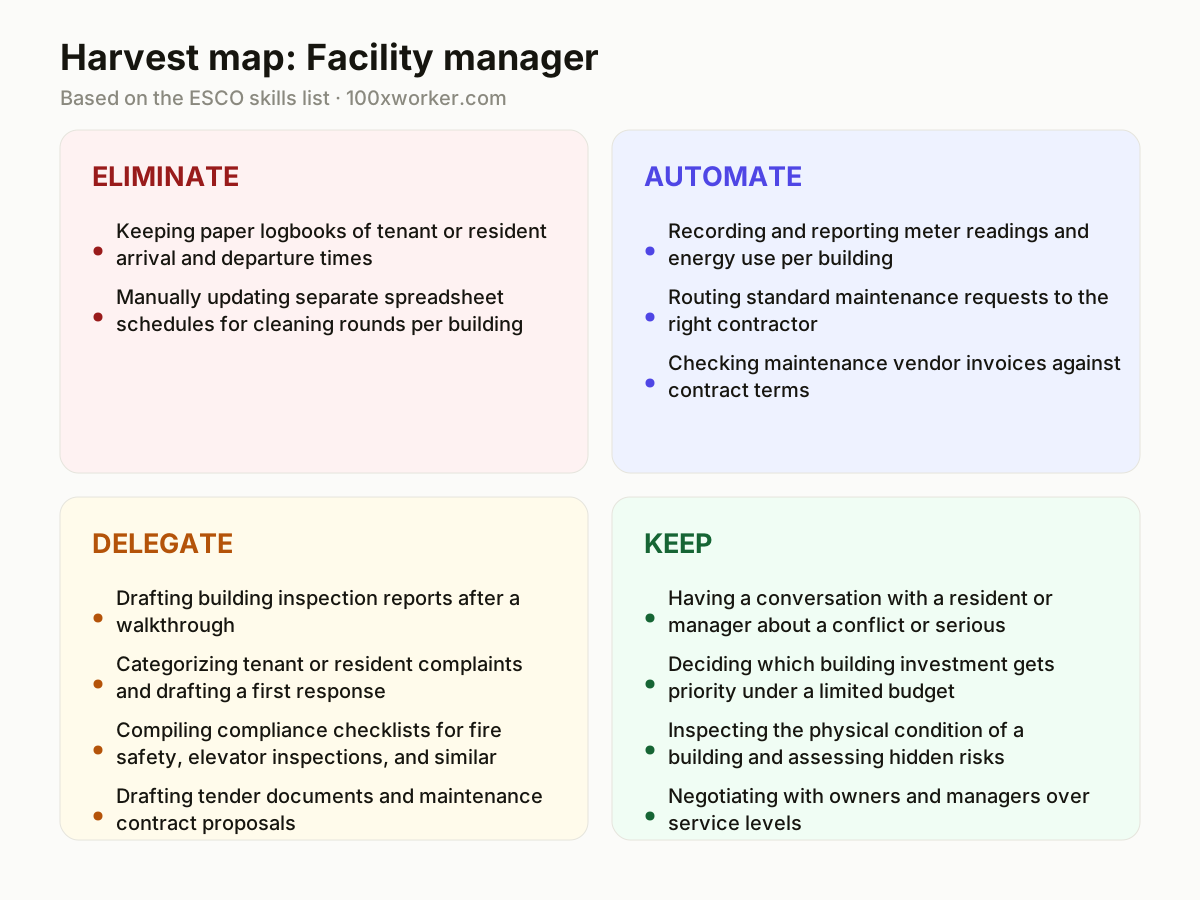
AI takes over the parts of the job that involve repetitive data entry, routing, and first-draft writing. Meter readings, energy reports, invoice checks against contracts, and routing maintenance tickets to the right contractor can run largely on their own once the software is set up. Drafting work such as inspection reports, complaint responses, compliance checklists, and tender documents gets a first pass from AI, but you still review and finalize it. Paper logbooks and manual spreadsheet schedules tend to disappear entirely, replaced by systems that already track the same information automatically.
Will AI replace facility managers?
No single published study scores AI applicability for facility managers specifically, since the role does not map onto one standard occupation code. But the pattern from Microsoft Research's analysis of 200,000 Copilot conversations (2025) is consistent across office-adjacent roles: AI is strong at reading, summarizing, and drafting text, and weak at physical presence, negotiation, and judgment calls under uncertainty. A facility manager's job includes both. AI removes the paperwork layer, not the person who inspects a roof, calms an angry tenant, or decides which repair waits until next quarter. The job changes shape rather than disappearing.
What can you do this month to become the AI person on your team?
Pick one recurring task, such as inspection reports or complaint replies, and run it through an AI tool for two weeks before you touch anything else. Feed it your last five reports as examples of your style, then compare its draft to what you'd normally write. Set up one automation, like invoice matching against a contract template or auto-routing tickets by keyword. Keep a short list of what worked and what needed heavy editing. That list becomes your case for asking management to fund proper tools, instead of guessing what AI can handle.
Do facility managers already use AI at work?
General adoption is already high: 32.7% of people aged 16 to 74 across the EU used generative AI in the last three months of 2025 (Eurostat). Anthropic's Economic Index, which classifies millions of Claude conversations against O*NET task categories, finds that AI use across occupations splits between automation-style use (AI does the task) and augmentation-style use (AI assists while a person decides). Facility and building management work fits the augmentation pattern most often today: AI drafts, checks, and summarizes, while the facility manager still signs off on anything that touches safety, budget, or a resident relationship.
How useful generative AI is for a job depends on the tasks that make it up, not the job title.
Microsoft Research, Working with AI (2025)
Become the AI person on your team
Turn your inspection routine into a template
Record voice notes during your next walkthrough instead of writing on paper. Feed the transcript to an AI tool with a fixed report structure (building, area, issue, severity, recommended action). Reuse that template every time so the output stays consistent and easy to review.
Build a one-page contract cheat sheet for invoice checks
Summarize the key terms of each maintenance contract (rates, response times, penalty clauses) in one page per vendor. Feed that sheet to an AI tool alongside incoming invoices so it can flag mismatches before you approve payment.
Set a rule for what you never delegate
Decide in advance which situations always go to you directly: safety incidents, legal complaints, and anything involving a tenant dispute. Let AI draft and sort everything else, but keep that short list as a hard boundary your team knows about.
Want this for your actual task list?
The free scan on the homepage builds your personal task map in 30 seconds, based on your role and industry.
Run the free task scanTools for this work
| Tool | For which tasks | The sober take |
|---|---|---|
| Microsoft Copilot | Automate and delegate: drafting emails, summarizing inspection notes, first-pass compliance checklists | Works inside Outlook and Teams, which is where most facility managers already handle correspondence. |
| ChatGPT or Claude (general chat interface) | Delegate: drafting inspection reports, tender documents, and complaint responses from your own notes | Useful as a drafting assistant, but you still need to feed it accurate building-specific details. |
| CMMS platforms with AI features (e.g., UpKeep, Fiix, Facilio) | Automate: ticket routing, meter/energy reporting, work order tracking | These systems are built for maintenance workflows specifically, unlike general chat tools. |
| Voice-to-text transcription tools (e.g., Otter.ai) | Delegate: converting spoken walkthrough notes into structured text for reports | Cuts the time between a physical inspection and a written report to almost nothing. |
Prompts to try today
Turn inspection notes into a report
Draft a compliance checklist
Draft a first response to a tenant complaint
Related jobs
Frequently asked questions
Will AI take over facility manager jobs completely?
No. AI handles the paperwork layer of the job well: reports, checklists, invoice checks, and ticket routing. It does not handle physical inspections, on-site judgment calls, or the relational work of managing tenants and owners. The role is likely to keep fewer people doing more oversight and less manual documentation, rather than disappearing outright.
Which facility management tasks are safest from automation?
Tasks that require physical presence, on-the-spot judgment, or a trusted relationship stay hardest to automate. That includes walking a building to spot hidden structural risk, deciding which repair gets priority under a tight budget, and handling a tenant conflict face to face. These tasks depend on experience and context that AI cannot access from a desk.
What's the fastest way to start using AI in this job?
Start with one repetitive task you already do weekly, like writing up inspection notes or replying to routine complaints. Use an AI tool for a two-week trial, compare its drafts to your own writing, and adjust from there. Avoid trying to automate everything at once; a single well-tested workflow gives you a clearer read on where AI actually saves time.
Do I need to learn to code or use complex software to use AI in facility management?
No. Most useful applications for this role involve chat-based tools (ChatGPT, Claude, Copilot) or AI features already built into maintenance software (CMMS platforms). You type or paste in notes, invoices, or building details, and the tool drafts a response, report, or checklist. No programming knowledge is required for these day-to-day uses.
Sources
- Microsoft Research, Working with AI: Measuring the Applicability of Generative AI to Occupations (2025)
- Anthropic Economic Index
- Eurostat, Use of generative AI (isoc_ai_iaiu)
- ESCO (European Skills, Competences, Qualifications and Occupations), European Commission
Hendrik De Winne, author of Becoming AI-Savvy, founder of VibeLab. Helps teams redesign their work with AI.
This article was drafted with AI assistance from public data sources and editorially reviewed.