100×worker · job analysis
Will AI Replace Engineers?
Industrial and production engineers plan manufacturing processes, measure labor time, and control the quality of materials and finished goods. In leather goods and footwear manufacturing specifically, that means analyzing technical specs for a new bag or shoe, sequencing production steps, and calculating how many labor hours a batch needs. The question is not whether AI can write code or generate a report. The question is which parts of this job it already does well enough to change your day-to-day task list.
Microsoft Research analyzed 200,000 real Copilot conversations and scored how applicable generative AI is to each occupation's actual work activities. Industrial engineers land at 25.3%, well below translators (49%, the highest scoring occupation) and above nurses (12%, one of the lowest). That number is not a job-loss forecast. It is a task-level signal: roughly a quarter of what shows up in engineering-related AI conversations maps onto activities AI can meaningfully assist with today.
Anthropic's Economic Index adds a second lens: it splits AI use into automation-like use (AI does the task directly) and augmentation-like use (AI helps a human do the task). For engineers, most current use skews toward augmentation: drafting a first version of a workflow, summarizing a material specification, translating a supplier email. That distinction matters more than a single applicability percentage when you're deciding what to change in your own role.
An industrial engineer plans production, measures labor time, and controls quality across materials and finished goods.
The task split: what AI takes over and what stays yours
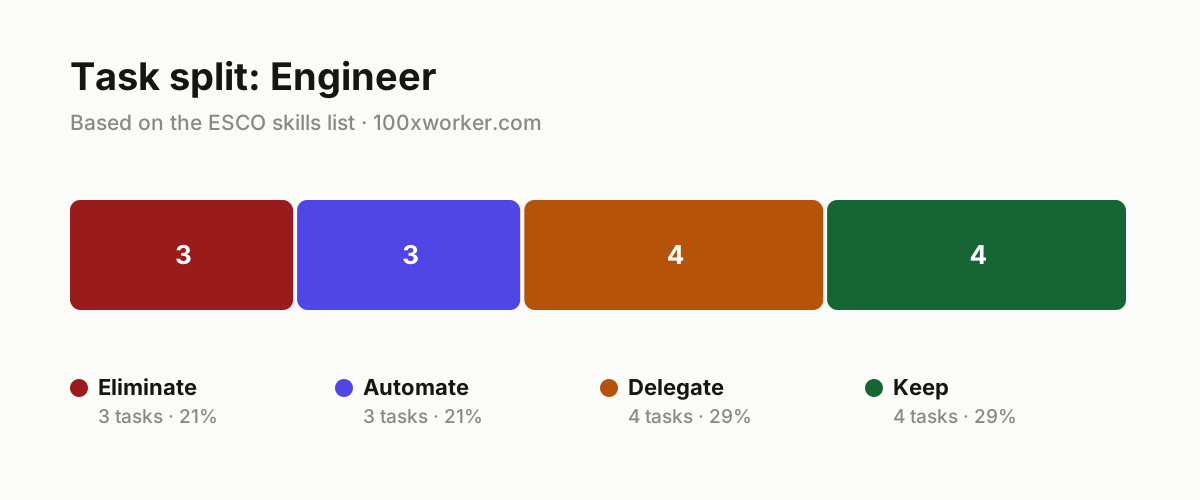
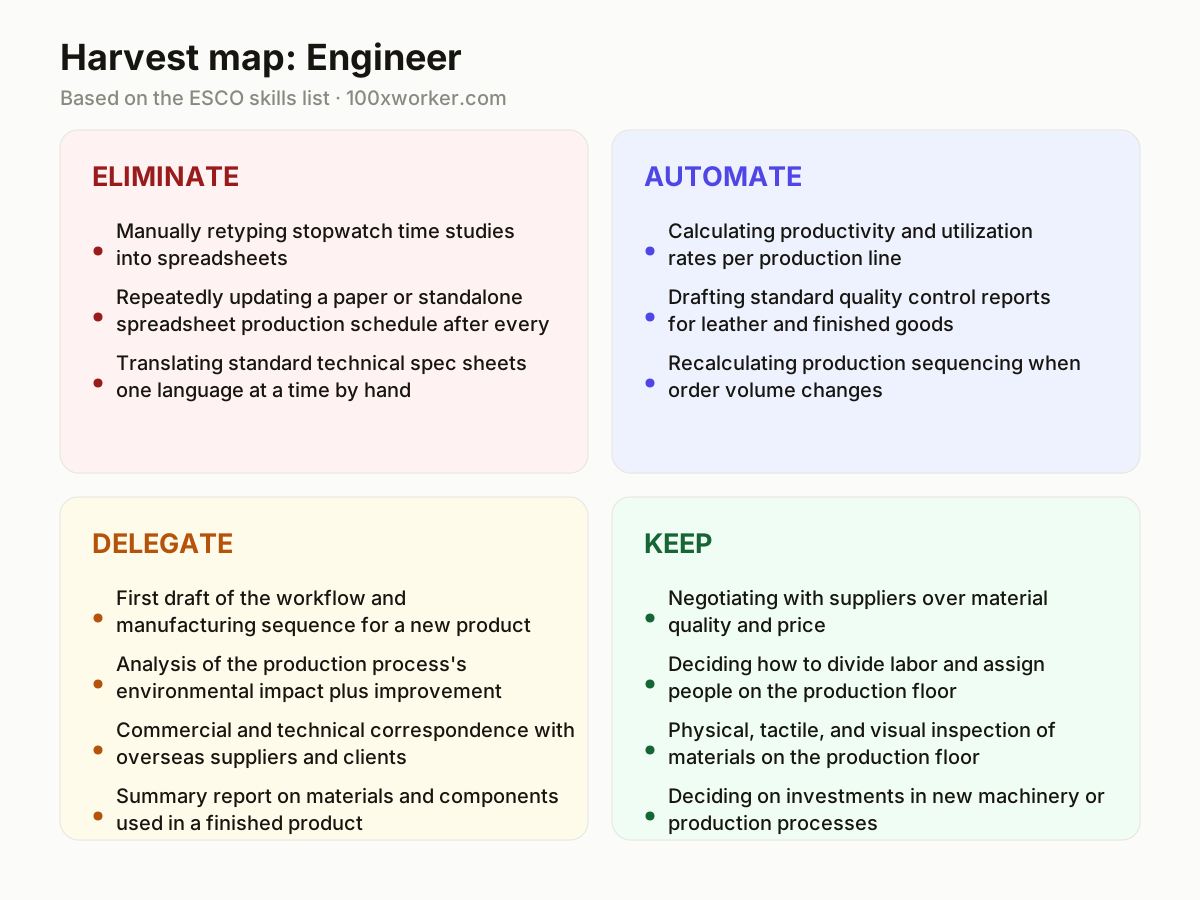
Instead of asking whether AI will replace engineers, break the job into four buckets: tasks that disappear entirely because the underlying manual step is now pointless, tasks an AI agent can run without you touching them, tasks you hand off as a first draft for you to check, and tasks that stay firmly yours because they need judgment, relationships, or accountability AI cannot carry.
| Task | Bucket | Why |
|---|---|---|
| Manually retyping stopwatch time studies into spreadsheets | eliminate | Digital time-tracking systems log and calculate labor hours automatically, so the retyping step has no function left. |
| Repeatedly updating a paper or standalone spreadsheet production schedule after every change | eliminate | A live dashboard recalculates the schedule itself the moment order volumes or staffing shift. |
| Translating standard technical spec sheets one language at a time by hand | eliminate | Translation now happens inline in the workflow, making a separate translation step redundant. |
| Calculating productivity and utilization rates per production line | automate | An agent pulls data straight from the production system and delivers the report without manual input. |
| Drafting standard quality control reports for leather and finished goods | automate | The agent fills the report template with measured quality data, ready to file. |
| Recalculating production sequencing when order volume changes | automate | Staff and machine assignments get recomputed the moment inputs change, with no manual rescheduling needed. |
| First draft of the workflow and manufacturing sequence for a new product line | delegate | AI drafts a version based on comparable products, and you validate and adjust the details. |
| Analysis of the production process's environmental impact plus improvement suggestions | delegate | AI maps material flows and waste, and you decide which measure is realistic and affordable. |
| Commercial and technical correspondence with overseas suppliers and clients | delegate | AI writes the first version in the right language, and you check terminology, tone, and accuracy. |
| Summary report on materials and components used in a finished product | delegate | AI gathers and structures the data, and you judge whether the material choice matches the spec. |
| Negotiating with suppliers over material quality and price | keep | This requires trust, relationship history, and a feel for what a supplier can actually deliver. (Your edge: Relationship management and negotiation instinct don't come from a prompt.) |
| Deciding how to divide labor and assign people on the production floor | keep | Knowledge of individual workers and team dynamics isn't captured in any dataset. (Your edge: You know your people; a model only knows their numbers.) |
| Physical, tactile, and visual inspection of materials on the production floor | keep | Recognizing material quality by sight and touch is skill built over years on the job. (Your edge: Sensory judgment isn't something you can digitize.) |
| Deciding on investments in new machinery or production processes | keep | This is a long-term risk call with financial and strategic consequences. (Your edge: You carry the accountability and the risk, not an AI agent.) |
Will AI replace engineers?
Not as a whole role. Microsoft Research puts generative AI's applicability to industrial engineering work at 25.3% of activities, meaning roughly a quarter of the task mix can already be assisted well, while three-quarters currently cannot. That 25.3% concentrates in reporting, translation, and calculation tasks, not in supplier negotiation, staffing decisions, or hands-on material inspection. Anthropic's Economic Index shows most current AI use in engineering-adjacent work is augmentation (AI helps you do the task) rather than full automation (AI does the task alone). The realistic outlook is a changed task list, not a vacant job title.
Which engineering tasks disappear first?
Manual, repetitive data-handling tasks go first: retyping time-study data into spreadsheets, maintaining a static schedule by hand after every order change, and translating technical documents line by line. These tasks existed because no automated alternative was practical. Now that digital time-tracking, live scheduling dashboards, and inline translation exist inside common workflow tools, the manual version of the task has no remaining purpose. This is the eliminate bucket: not jobs disappearing, but specific steps becoming pointless overhead.
How do you become the AI-savvy person on your engineering team?
Start by mapping your own task list against the four buckets: eliminate, automate, delegate, keep. Pick one recurring report (a quality report, a productivity calculation) and set up an agent-based workflow for it before anyone asks you to. Learn to write clear prompts for drafting technical documents and supplier correspondence, then spend the time you save on the tasks in the keep bucket: floor-level judgment calls, negotiation, and decisions that carry real accountability. Being the AI-savvy person means knowing exactly which tasks to hand off, not knowing every tool that exists.
What can you do this month to start using AI as an engineer?
Pick one delegate-bucket task, such as drafting a first-version manufacturing workflow or a materials summary, and run it through an AI tool for two weeks before deciding whether to keep the habit. Set up one automate-bucket task, like a recurring productivity report, as an agent workflow rather than a manual spreadsheet. Track how much time each change actually saves, since that number, not the technology itself, is what justifies keeping the new workflow.
AI doesn't change your job, it changes your task list.
UWV, based on a survey of 2,300 employers
Become the AI person on your team
Turn one report into a template
Take your most repeated report, such as a monthly quality control summary, and build a prompt template that pulls in the same data fields every time. Test it against three past reports before trusting it on a live one.
Run correspondence through a two-step check
Let AI draft the first version of a supplier email in the target language, then check it yourself for technical terminology and tone before sending. This keeps speed without losing accuracy on specs and pricing.
Log time saved, not tools used
Keep a simple weekly note of which AI-assisted task actually saved you time versus which one took longer to check than to do manually. Drop the ones that don't hold up.
Want this for your actual task list?
The free scan on the homepage builds your personal task map in 30 seconds, based on your role and industry.
Run the free task scanTools for this work
| Tool | For which tasks | The sober take |
|---|---|---|
| Microsoft Copilot | Drafting quality reports, summarizing material specs, first-draft correspondence (delegate, automate) | The applicability data behind this article comes from real Copilot usage logs, not marketing claims. |
| Claude (Anthropic) | Drafting workflow documents, translating technical correspondence, structuring material summaries (delegate) | Anthropic's own usage data shows this kind of work skews toward augmentation, not full automation. |
| Production scheduling dashboards (e.g., MES/ERP-integrated tools) | Recalculating production sequencing and utilization rates (eliminate, automate) | The value is in live recalculation, not in the AI label attached to the software. |
| Inline translation features in office and workflow software | Translating technical spec sheets across languages (eliminate) | Useful for a first pass; still needs a technical check for specialized terminology. |
Prompts to try today
Draft a manufacturing workflow for a new product
Summarize material composition for review
Draft supplier correspondence with a technical ask
Related jobs
Frequently asked questions
Do I need to learn to code to use AI as an engineer?
No. The applicability data from Microsoft Research covers task categories like reporting, translation, and calculation, not software development. Most engineering use cases involve prompting existing tools like Copilot or Claude to draft documents or summarize data, not writing code. Familiarity with your production systems and how to phrase a clear request matters more than programming skill for the tasks currently affected.
Is the 25.3% applicability score the same as a job-loss risk?
No. It measures the share of work activities where generative AI is demonstrably applicable, based on real conversation data, not a prediction of layoffs. Older studies like Frey & Osborne (2013) produced automation-risk percentages, but that research predates large language models and is not the source used here. Applicability tells you where to expect task changes, not whether the role disappears.
Which parts of engineering work will AI never touch?
Tasks involving physical judgment, relationship trust, and financial accountability stay human for the foreseeable future: negotiating with suppliers, deciding staffing assignments based on knowledge of your team, sensory inspection of materials, and investment decisions that carry long-term risk. These require context and accountability that current AI systems don't hold, regardless of applicability scores in reporting or drafting tasks.
How common is AI use among engineers right now?
Exact adoption figures specific to engineers aren't in the verified data here, but broader adoption context exists: 32.7% of the EU population aged 16 to 74 used generative AI in the last three months as of 2025, per Eurostat. Anthropic's Economic Index shows augmentation-style use (AI assisting a task) is currently more common than full automation across most occupations, including engineering-adjacent roles.
Sources
- Microsoft Research, Working with AI: Measuring the Applicability of Generative AI to Occupations (2025)
- Anthropic Economic Index
- Eurostat, isoc_ai_iaiu (2025)
- ESCO, European Commission occupation taxonomy
Hendrik De Winne, author of Becoming AI-Savvy, founder of VibeLab. Helps teams redesign their work with AI.
This article was drafted with AI assistance from public data sources and editorially reviewed.