100×worker · job analysis
Will AI Replace Electrical Engineers?
If you work as an electrical engineer in mining, you have probably already used a chatbot to search a manual or draft a report. That is not an accident. Microsoft Research analyzed 200,000 real Copilot conversations and scored how applicable generative AI is to different occupations. Electrical engineers came out at about 11 percent, far below translators (49%) but on par with other technical, hands-on roles where physical inspection and legal responsibility dominate the job.
That low score does not mean AI is irrelevant. Anthropic's Economic Index, which classifies millions of Claude conversations against O*NET task lists, finds that AI use splits into two patterns: automation, where AI does a task end to end, and augmentation, where a person stays in the loop. For technical engineering roles, augmentation is far more common. Across the EU, 32.7% of people aged 16 to 74 used generative AI in the last three months of 2025, according to Eurostat, so adoption is already mainstream, not experimental.
This article breaks the mine electrical engineer role, as defined by the EU's ESCO occupation taxonomy, into four buckets: tasks AI removes entirely, tasks it runs largely on its own, tasks you delegate to AI but still own, and tasks that stay with you because they require presence, legal accountability, or site-specific judgment.
A mine electrical engineer designs, installs, and maintains electrical systems and machinery for mining operations.
The task split: what AI takes over and what stays yours
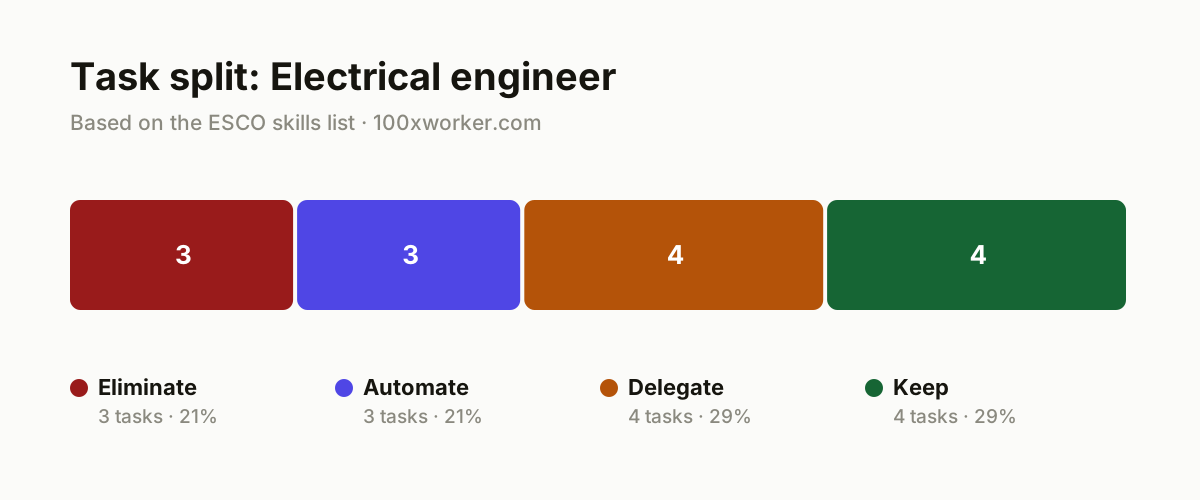
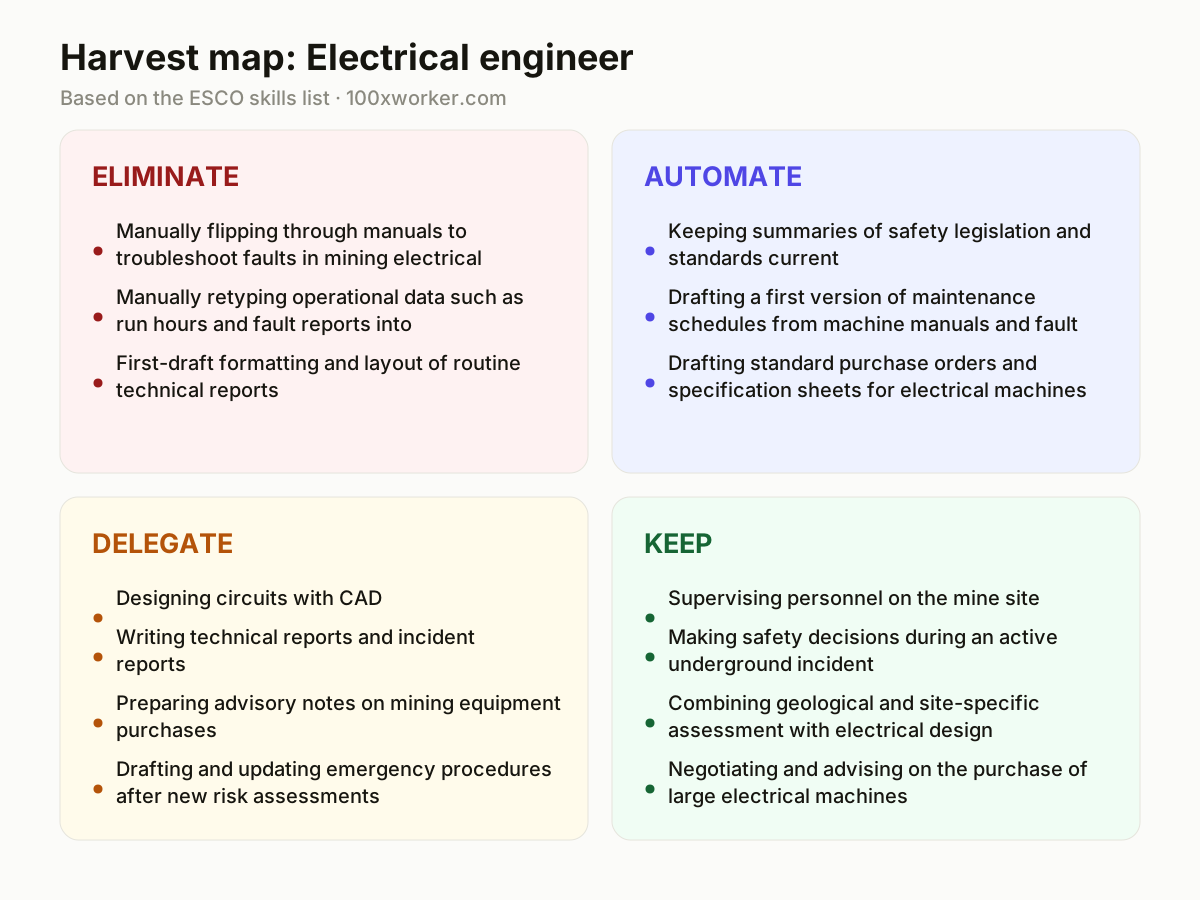
For a mine electrical engineer, tasks split into four groups: work that disappears because AI or sensors already do it better (eliminate), work an AI agent can run start to finish with a quick check (automate), work where AI drafts and you decide (delegate), and work that needs your physical presence, legal accountability, or site knowledge and stays fully human (keep). This is a task-level breakdown, not a verdict on the job title itself.
| Task | Bucket | Why |
|---|---|---|
| Manually flipping through manuals to troubleshoot faults in mining electrical machinery | eliminate | An AI system searches all documentation at once and returns the answer in seconds. |
| Manually retyping operational data such as run hours and fault reports into spreadsheets | eliminate | Sensors and IoT platforms already log this automatically, so retyping it is duplicate work. |
| First-draft formatting and layout of routine technical reports | eliminate | Templates with AI text generation produce this faster than an engineer working by hand. |
| Keeping summaries of safety legislation and standards current | automate | An AI agent monitors regulatory changes and flags what matters for your installations. |
| Drafting a first version of maintenance schedules from machine manuals and fault data | automate | Based on known patterns, AI generates a full schedule ready to use. |
| Drafting standard purchase orders and specification sheets for electrical machines | automate | Templates and historical data let an agent finish these without you stepping in. |
| Designing circuits with CAD | delegate | AI generates first design variants, you optimize them and check them against safety requirements. |
| Writing technical reports and incident reports | delegate | AI drafts from logs and data, you rewrite the critical conclusions. |
| Preparing advisory notes on mining equipment purchases | delegate | AI gathers specifications and market data, you weigh context and risk. |
| Drafting and updating emergency procedures after new risk assessments | delegate | AI produces a first version from earlier procedures, you validate the scenarios. |
| Supervising personnel on the mine site | keep | Leadership needs presence and authority you don't build through a screen. (Your edge: Trust and physical presence are not built with software.) |
| Making safety decisions during an active underground incident | keep | Legal responsibility and on-site context stay with the engineer. (Your edge: Legal liability and time pressure need a human decision-maker.) |
| Combining geological and site-specific assessment with electrical design | keep | Physical inspection and knowledge of a specific mine site can't be replaced. (Your edge: Experience with this one mine, this one seam, this one installation.) |
| Negotiating and advising on the purchase of large electrical machines | keep | Supplier relationships and internal context require human judgment. (Your edge: Knowledge of supplier history and internal priorities.) |
Will AI replace electrical engineers?
No. Microsoft Research scored electrical engineers at about 11 percent applicability for generative AI, one of the lower rates among occupations it studied, well behind roles built around producing text such as translation (49%). Electrical engineering work leans heavily on physical inspection, legal accountability for safety, and judgment specific to one site. AI changes how the paperwork and documentation search get done, but it does not replace the engineer who signs off on a design or decides what happens during an underground incident.
Which tasks does AI take over from electrical engineers?
AI removes the slow, repetitive parts of the job: searching manuals for troubleshooting steps, retyping data that sensors already log, and formatting routine reports. It also runs some tasks almost end to end, such as tracking regulatory updates, drafting maintenance schedules from historical fault data, and generating standard purchase orders. Anthropic's Economic Index shows this augmentation pattern, AI doing the first pass while a person checks it, is far more common in technical roles than full automation. The engineer still approves the final version.
What can you do this month to become the AI person on your team?
Pick one recurring task, such as drafting maintenance schedules or summarizing safety updates, and run it through an AI tool for two weeks before trusting it further. Build a simple document search setup over your machine manuals so faults get diagnosed faster. Share what works with colleagues instead of keeping it to yourself. Being the person who knows which AI shortcuts are reliable and which need double-checking is more valuable right now than being the person who avoids the tools altogether.
How does AI change the role of electrical engineer in mining?
The core of the job, keeping mining electrical systems safe and running, does not change. What changes is where your time goes. Less time gets spent hunting through manuals or retyping logs, more time gets spent reviewing AI-drafted schedules and reports, checking CAD designs an AI system proposed, and making the safety and procurement calls that carry legal weight. The engineer moves from doing every step manually to supervising a mix of automated drafts and human-only decisions.
Generative AI is applicable to only about 11 percent of electrical engineers' work activities, one of the lower shares among all occupations analyzed.
Microsoft Research, Working with AI: Measuring the Applicability of Generative AI to Occupations (2025)
Become the AI person on your team
Turn your manuals into a searchable knowledge base
Feed machine manuals and past fault logs into an AI document search tool so troubleshooting takes minutes instead of an afternoon. Test it on a known past fault first to see if the answer matches what you already know.
Let AI draft, you decide
Use AI to produce first drafts of maintenance schedules, incident reports, and purchase specs. Keep your review step explicit: check numbers against source data before anything goes into a live schedule or an order.
Track regulation changes with an alert, not a manual scan
Set up an AI-based monitor for safety legislation changes relevant to your installations so you get flagged updates instead of scanning bulletins yourself every month.
Want this for your actual task list?
The free scan on the homepage builds your personal task map in 30 seconds, based on your role and industry.
Run the free task scanTools for this work
| Tool | For which tasks | The sober take |
|---|---|---|
| Microsoft Copilot | Eliminate: manual search; Automate: report drafting and regulation summaries | Useful for document search and drafting, but check technical figures against source data. |
| ChatGPT or Claude | Delegate: technical report drafts, advisory notes, emergency procedure drafts | Good for first drafts, weak on site-specific facts it wasn't given directly. |
| CAD software with AI-assisted design features | Delegate: circuit design variants | Generates starting points quickly, but safety compliance checks still need a qualified engineer. |
| Internal document search / retrieval tools built on manuals and logs | Eliminate: manual manual-flipping; Automate: maintenance schedule drafts | Only as reliable as the documents you feed into it, so keep the source library current. |
Prompts to try today
Diagnose a fault from a manual excerpt
Draft a maintenance schedule from historical data
Summarize a regulation update for your installations
Related jobs
Frequently asked questions
Is my job at risk as an electrical engineer?
Not based on current data. Microsoft Research's applicability score for electrical engineers is about 11 percent, far below occupations built mainly around producing text, like translation at 49 percent. The job depends on physical inspection, safety accountability, and site-specific judgment, none of which current AI systems can take over. What is changing is the mix of tasks inside the role, not the existence of the role.
What AI tools should electrical engineers learn first?
Start with a general assistant like Copilot or ChatGPT for drafting reports and summarizing regulations, and a document search tool built on your own manuals and logs for faster troubleshooting. If your CAD software has AI-assisted design features, test those next. You do not need to learn everything at once; pick the tool tied to your most repetitive task first.
Can I trust AI-generated summaries of mining safety regulations?
Use them as a first pass, not a final answer. AI is good at surfacing what changed in a regulation and drafting a plain-language summary, but compliance decisions carry legal weight, so an engineer should verify the summary against the actual regulatory text before acting on it. Treat AI output here as a draft that saves you reading time, not a substitute for sign-off.
How common is AI use among engineers and professionals generally?
Adoption is already widespread. Eurostat reports that 32.7% of the EU population aged 16 to 74 used generative AI in the three months before the survey in 2025. Anthropic's Economic Index, based on millions of real Claude conversations, shows that in technical fields most of that use is augmentation, meaning AI drafts and a person reviews, rather than full automation of a task.
Sources
- Microsoft Research, Working with AI: Measuring the Applicability of Generative AI to Occupations (2025)
- Anthropic Economic Index
- Eurostat, isoc_ai_iaiu
- ESCO, European Commission occupation taxonomy
Hendrik De Winne, author of Becoming AI-Savvy, founder of VibeLab. Helps teams redesign their work with AI.
This article was drafted with AI assistance from public data sources and editorially reviewed.