100×worker · job analysis
Will AI Replace Dentists, and What Should You Do About It?
If you are a dentist wondering whether generative AI is coming for your job, the short answer is no, not for the parts that matter most. Microsoft Research analyzed 200,000 real Copilot conversations and scored occupations on how much of their work generative AI can plausibly touch. Dentistry landed at 4.6%, near the bottom of the scale, well below language-heavy jobs like translation (49%) and even below nursing (12%). Hands-on clinical work does not map well onto a chat interface.
That low score does not mean nothing changes. It means the change concentrates in a narrow band: the administration, documentation, and image review that surround every appointment, rather than the appointment itself. Across the EU, 32.7% of people aged 16 to 74 used generative AI in the last three months of 2025, according to Eurostat, so patients increasingly arrive having already asked a chatbot about their symptoms.
This article breaks your task list into four buckets: tasks to eliminate outright, tasks to automate with software, tasks to delegate to AI with your review, and tasks to keep because they need a human in the room. It is built on the ESCO occupational taxonomy, which lists dentistry (code 2261.1) among 3,039 occupations across the EU, cross-referenced with what generative AI can and cannot plausibly do today.
A dentist diagnoses, treats, and prevents conditions of the teeth, mouth, jaw, and surrounding tissue.
The task split: what AI takes over and what stays yours
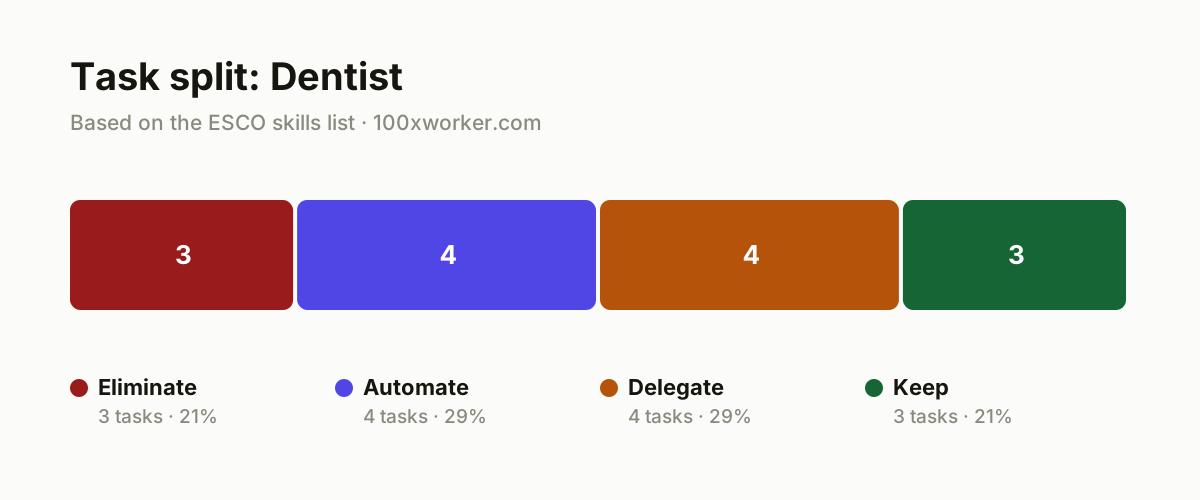
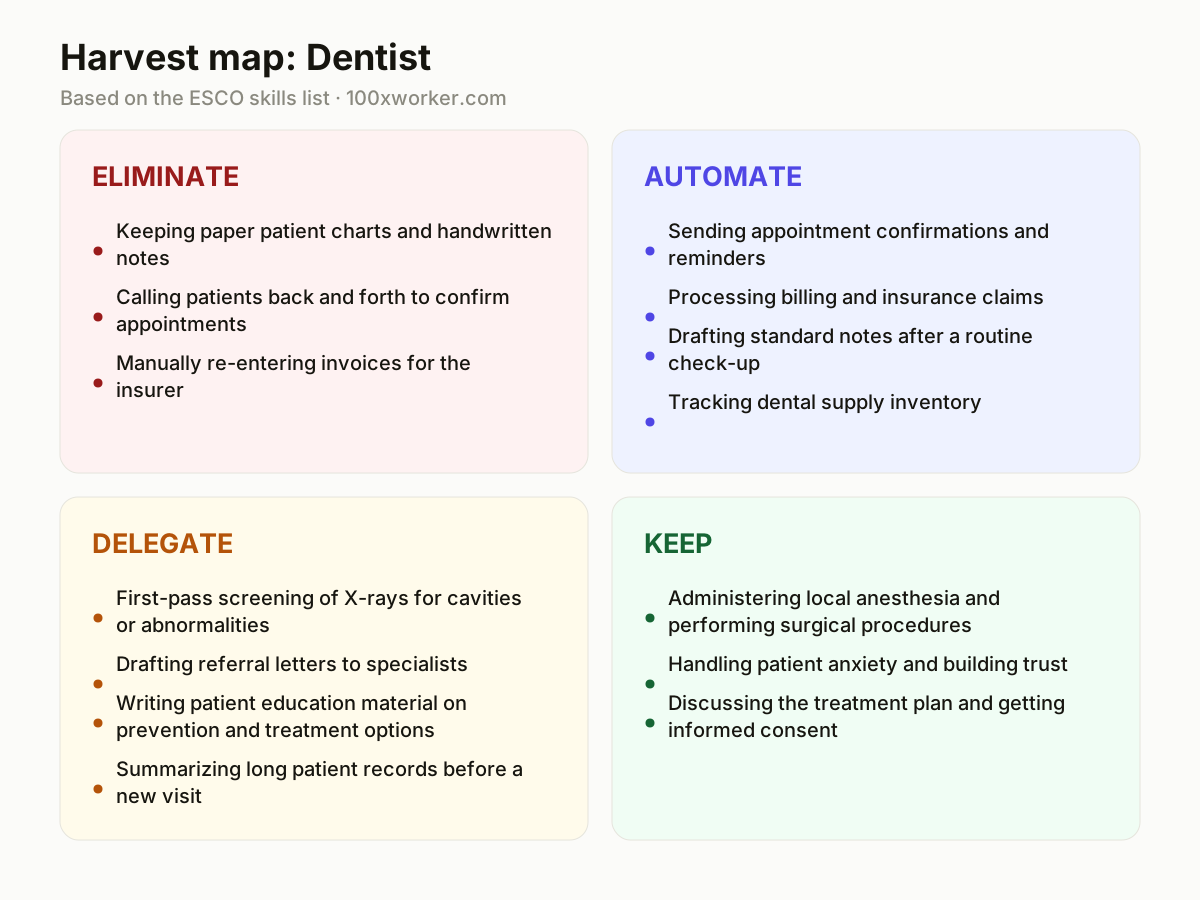
Not every task in a dental practice faces the same pressure from AI. Some tasks should simply disappear because better tools already exist. Others can run on autopilot through software. A third group works best as a draft that AI produces and you correct. The last group needs to stay entirely in your hands because it depends on physical skill, trust, or shared legal responsibility with the patient. Sorting your own task list into these four buckets is the practical starting point.
| Task | Bucket | Why |
|---|---|---|
| Keeping paper patient charts and handwritten notes | eliminate | Digital record systems and speech-to-text make this unnecessary and more error-prone than software. |
| Calling patients back and forth to confirm appointments | eliminate | Automated text and email reminders do this faster, without making patients wait on hold. |
| Manually re-entering invoices for the insurer | eliminate | Practice management software links directly to the insurer's system, so retyping adds nothing. |
| Sending appointment confirmations and reminders | automate | An automated system sends texts or emails at the right time, without front-desk staff doing it by hand. |
| Processing billing and insurance claims | automate | Software generates and submits invoices and links automatically to the insurer's system. |
| Drafting standard notes after a routine check-up | automate | A template fills itself in from your recorded findings, ready for you to sign off. |
| Tracking dental supply inventory | automate | The system reorders automatically based on usage, with no manual counting needed. |
| First-pass screening of X-rays for cavities or abnormalities | delegate | Image recognition flags suspicious areas, you review and confirm the diagnosis. |
| Drafting referral letters to specialists | delegate | AI writes a first version from chart data, you revise and sign it. |
| Writing patient education material on prevention and treatment options | delegate | AI produces a readable base text, you adjust tone and detail for each patient. |
| Summarizing long patient records before a new visit | delegate | AI pulls out relevant history, you check it for completeness and accuracy. |
| Administering local anesthesia and performing surgical procedures | keep | This requires physical precision and split-second adjustment to what is happening in the mouth. (Your edge: Hand skill and real-time judgment of tissue.) |
| Handling patient anxiety and building trust | keep | Reassurance works through voice, posture, and presence, not through a screen. (Your edge: Human presence at a vulnerable moment.) |
| Discussing the treatment plan and getting informed consent | keep | The patient needs a person in front of them who answers questions and shares the decision. (Your edge: Shared legal and emotional responsibility with the patient.) |
What tasks can AI take over from a dentist?
AI is strongest on the tasks around the chair, not in the chair. It can automate appointment reminders, insurance billing, standard post-visit notes, and supply reordering with little oversight. It can also produce useful drafts you still need to check: a first pass at reading an X-ray, a referral letter, patient education material, or a summary of a long chart before a visit. None of this replaces your judgment. It removes the blank-page and repetitive-typing parts of the job so you spend more time actually treating patients.
Will AI replace dentists?
No. Microsoft Research's applicability score for the occupation closest to dentistry sits at 4.6%, near the bottom of all scored occupations, because dental work depends on physical dexterity, direct contact with tissue, and real-time trust with an anxious patient. A chatbot cannot administer anesthesia or hold a drill steady. What AI does is take over the paperwork and first-pass image review around the appointment, which frees time but does not replace the clinician who diagnoses, decides, and operates.
What can you do this month to become the AI-savvy dentist in your practice?
Start by listing every recurring task in your practice for one week, from confirming appointments to writing referral letters. Sort each task into eliminate, automate, delegate, or keep using the buckets above. Then pick one automate task, such as appointment reminders or billing, and move it to software this month. Separately, trial an AI drafting tool for referral letters or patient summaries, but keep final review and sign-off with you. Small, checked changes beat a full system overhaul.
How does AI change administration and X-ray review in a dental practice?
On administration, AI-linked practice management software handles reminders, invoicing, and insurer submissions automatically, cutting the manual retyping that used to fall on front-desk staff. On X-rays, image recognition tools can do a first pass over radiographs and flag areas that look like cavities or bone loss before you look at them yourself. Both changes speed up routine work without changing who makes the diagnosis. You still read the film, confirm the finding, and decide the treatment plan.
Dentistry scores 4.6% on our applicability measure, far below occupations built around language and text such as translation, which tops the list at 49%.
Microsoft Research, Working with AI (2025)
Become the AI person on your team
Audit your own task list first
Before buying any tool, track a week of your practice's tasks and sort them into the four buckets. This tells you which automation actually saves time versus which just adds another app to manage.
Pilot AI X-ray triage on a small scale
Run an image-screening tool alongside your normal reading for a month and compare flags against your own findings. Treat it as a second opinion, not a replacement for your read.
Automate the front desk before anything else
Appointment reminders and billing are the lowest-risk, highest-time-savings automation in a dental practice. Get this running before touching anything closer to clinical judgment.
Want this for your actual task list?
The free scan on the homepage builds your personal task map in 30 seconds, based on your role and industry.
Run the free task scanTools for this work
| Tool | For which tasks | The sober take |
|---|---|---|
| Practice management software with insurer integration | eliminate: manual invoice retyping; automate: billing and insurance claims | Most established dental software already does this; the gain is switching it on fully, not buying something new. |
| AI-assisted radiograph screening software | delegate: first-pass X-ray screening | Useful as a second set of eyes, but the diagnosis and sign-off stay with the dentist. |
| Ambient dictation or scribe software | automate: standard post-visit notes | Turns spoken findings into a structured note template you edit and approve. |
| Automated patient messaging systems | automate: appointment confirmations and reminders; delegate: draft patient education text | Reduces front-desk phone time, but tone still needs a human check for sensitive messages. |
Prompts to try today
Draft a referral letter
Summarize a long chart before a visit
Explain a procedure to a nervous patient
Related jobs
Frequently asked questions
Will AI take over dental diagnoses?
No, not on its own. AI tools can flag suspicious areas on an X-ray or summarize a patient's history, but the diagnosis and treatment decision stay with the dentist. Microsoft Research's applicability score of 4.6% for dentistry reflects how much of the job resists automation because it depends on physical exams, direct patient contact, and clinical judgment that a model cannot exercise.
Can AI read dental X-rays better than a dentist?
AI image-screening tools are useful for a fast first pass, catching patterns a tired eye might miss late in the day. They are not a replacement for a trained reader. The safest use is as a second check alongside your own review, not instead of it, with you making the final call on diagnosis and treatment.
How many people already use AI tools that could touch healthcare tasks?
Across the EU, 32.7% of people aged 16 to 74 used generative AI in the three months before being surveyed in 2025, according to Eurostat. That means a growing share of your patients have likely already asked a chatbot about a symptom or a treatment option before they sit in your chair.
Is the old 'robotization percentage' for dentists still accurate?
Probably not. The widely cited robotization percentages that circulate for many occupations trace back to Frey and Osborne's 2013 Oxford study, published before large language models existed. It measured automation risk from a different generation of technology. Newer data, like Microsoft Research's 2025 applicability score, is a better reference point for what generative AI specifically can do.
Sources
- Microsoft Research, Working with AI: Measuring the Applicability of Generative AI to Occupations (2025)
- Anthropic Economic Index
- Eurostat, isoc_ai_iaiu dataset
- ESCO occupational taxonomy, European Commission
Hendrik De Winne, author of Becoming AI-Savvy, founder of VibeLab. Helps teams redesign their work with AI.
This article was drafted with AI assistance from public data sources and editorially reviewed.