100×worker · job analysis
Will AI Replace Childcare Workers, and What Should You Do About It?

If you work in childcare, you have probably heard that AI is coming for every job. The data tells a different story for this one. Microsoft Research studied 200,000 real conversations between people and its Copilot assistant, then scored how applicable generative AI is to the tasks of each occupation. Childcare work landed at 16%, near the bottom of the scale. Translators topped the list at 49%. Nurses, another hands-on caregiving job, scored similarly low at 12%.
That does not mean AI has nothing to offer you. Across the wider workforce, adoption is climbing fast: Eurostat found that 32.7% of the EU population aged 16 to 74 used generative AI in the three months before being surveyed in 2025. Many of those users are teachers, administrators, and parents you deal with daily, and some of them already expect AI-assisted communication, like a well-written newsletter or a quick answer to a scheduling question.
The European Commission's ESCO taxonomy breaks the childcare worker role down into specific skills: meeting children's basic physical needs, playing with them, supervising them, and communicating with parents. That task-level view is exactly how this article approaches your job. Some tasks disappear, some get automated in the background, some get delegated to AI with your review, and some stay fully yours.
A childcare worker cares for children when parents are unavailable, meeting their basic needs and supporting their development.
The task split: what AI takes over and what stays yours
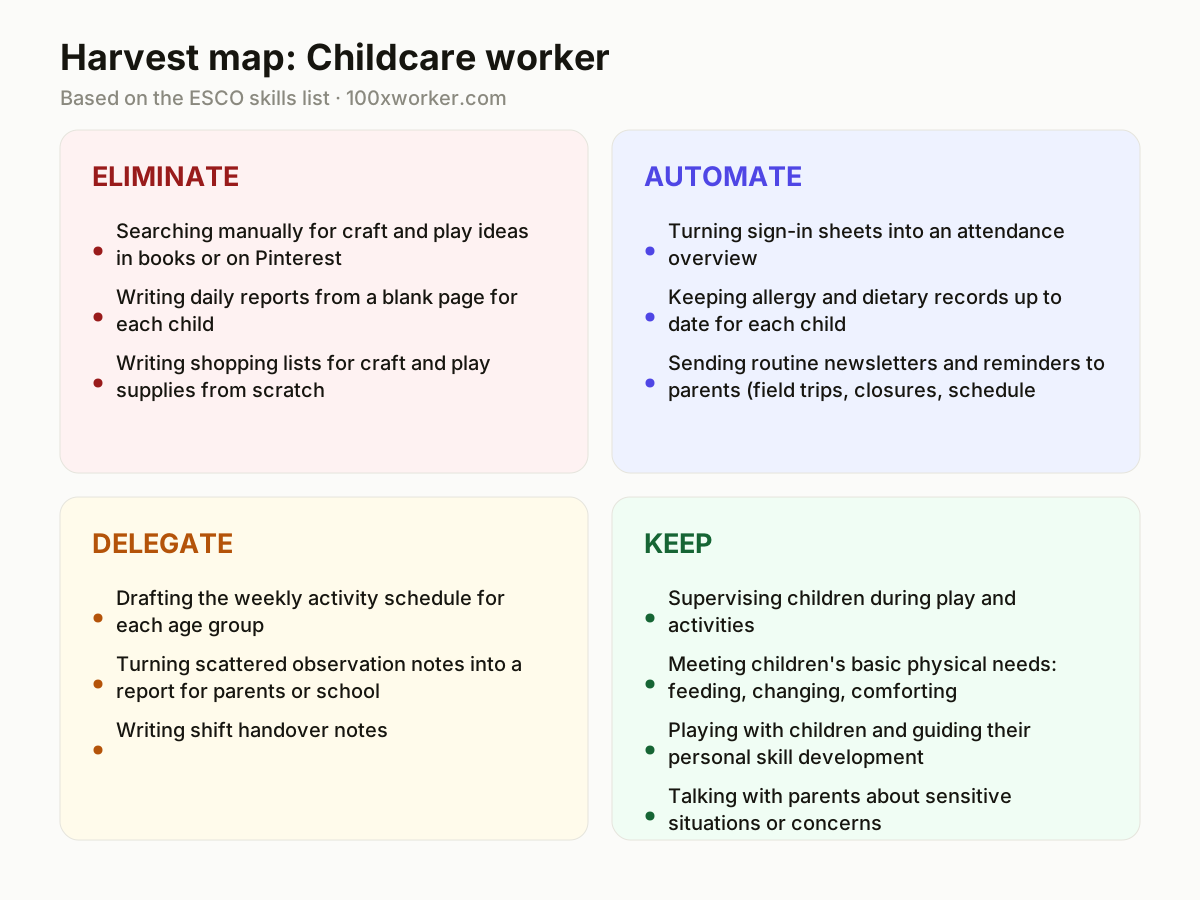
Instead of asking whether AI will take your job, it helps to look at your actual task list and sort each task into one of four buckets: tasks that disappear because AI does them so easily you stop doing them by hand, tasks a system now runs automatically in the background, tasks AI can draft for you to review and approve, and tasks that stay entirely with you because they depend on physical presence, touch, or trust. Sorting your week this way shows you where to actually save time.
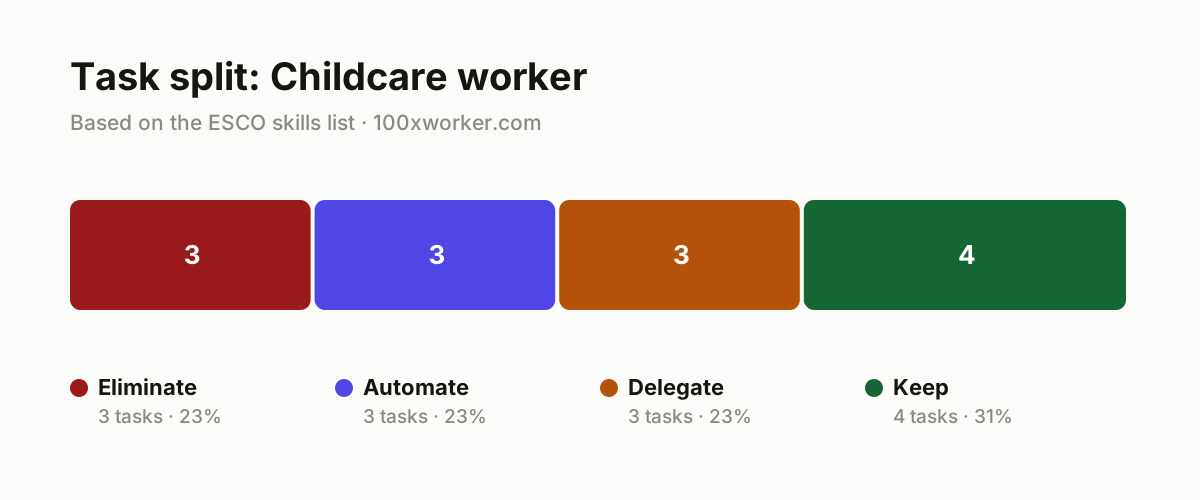
| Task | Bucket | Why |
|---|---|---|
| Searching manually for craft and play ideas in books or on Pinterest | eliminate | A chatbot generates age-appropriate ideas on request, faster and matched to your theme. |
| Writing daily reports from a blank page for each child | eliminate | A first draft is ready based on your rough notes, you only review and adjust it. |
| Writing shopping lists for craft and play supplies from scratch | eliminate | A system compiles the list automatically based on the week's planned activities. |
| Turning sign-in sheets into an attendance overview | automate | Check-in and check-out times are totaled and reported automatically, no manual tallying. |
| Keeping allergy and dietary records up to date for each child | automate | Structured data that a system keeps current and flags automatically when something changes. |
| Sending routine newsletters and reminders to parents (field trips, closures, schedule changes) | automate | A template fills itself in and only goes out after you approve it. |
| Drafting the weekly activity schedule for each age group | delegate | AI proposes a base plan, you adjust it to the group dynamics you know firsthand. |
| Turning scattered observation notes into a report for parents or school | delegate | AI turns notes into readable text, you check it for accuracy and tone. |
| Writing shift handover notes | delegate | AI summarizes the day's findings, the colleague taking over reviews and adds to it. |
| Supervising children during play and activities | keep | Safety requires someone who can step in immediately, not a system that reads reports afterward. (Your edge: Physical presence and instant intervention cannot be replaced by AI.) |
| Meeting children's basic physical needs: feeding, changing, comforting | keep | This is the core of the job and happens through touch and closeness. (Your edge: Touch and physical closeness are irreplaceable with young children.) |
| Playing with children and guiding their personal skill development | keep | Attachment and learning by doing only happen through real, repeated contact. (Your edge: Attachment and patience only develop through live human contact.) |
| Talking with parents about sensitive situations or concerns | keep | Trust and nuance in a difficult conversation require a person who listens. (Your edge: Trust is built only through a real, personal conversation.) |
What tasks can AI take over from a childcare worker?
AI handles the paperwork and planning around your job well. It can draft daily reports from your notes, generate age-appropriate activity ideas, compile shopping lists from a weekly schedule, and write routine newsletters or reminders to parents. Attendance tracking and allergy or dietary records can run automatically once entered into a system. None of this touches the actual caregiving. What AI takes over is writing, organizing, and repeating information, the administrative layer that sits around your direct contact with children.
Will AI replace childcare workers?
No single number proves a job is safe, but the evidence points away from replacement. Microsoft Research's applicability score for childcare work is 16%, near the bottom of every occupation studied, similar to nursing at 12%. Both jobs depend on physical presence, direct supervision, and touch, things a chatbot cannot provide. What AI does change is the paperwork around the job: reports, schedules, and newsletters. The caregiving itself, watching children, feeding them, comforting them, and talking with parents about real concerns, stays human work.
What can you do with AI as a childcare worker this month?
Start small. Use a chatbot like ChatGPT or Claude to generate five activity ideas for your age group's current theme, then pick and adapt one. Feed it your rough end-of-day notes and ask for a first draft of a parent report, then edit it yourself before sending. Try drafting one newsletter through a template instead of from scratch. None of this requires new software approval or training; it just needs fifteen minutes and a willingness to edit whatever the AI produces before anyone else sees it.
How does AI change a childcare worker's task list?
Microsoft Research's approach looks at occupations task by task rather than job by job, and childcare fits that pattern well. The role does not disappear, but individual tasks shift. Writing and repetitive record-keeping move toward AI assistance or full automation. Planning tasks get a draft you refine. Supervision, physical care, and parent conversations stay exactly as they were. The practical result: your task list gets shorter on paperwork and stays the same on the parts that actually require you in the room.
AI use in real conversations splits into automation-like and augmentation-like patterns rather than one single type of replacement.
Anthropic Economic Index
Become the AI person on your team
Draft first, review always
Let AI produce the first version of a daily report or newsletter, then read it against what actually happened before sending. This cuts writing time without letting an error about a child's day go out unchecked.
Keep a running notes file
Jot quick, messy notes on your phone throughout the day (what a child ate, a fall, a milestone). Feed those notes to an AI tool at the end of your shift to turn them into a structured report instead of starting from a blank page.
Reserve AI for planning, not for people
Use AI to generate activity ideas or draft a weekly schedule, but keep every conversation with a parent about a sensitive issue, a concern, or a conflict entirely in your own hands.
Want this for your actual task list?
The free scan on the homepage builds your personal task map in 30 seconds, based on your role and industry.
Run the free task scanTools for this work
| Tool | For which tasks | The sober take |
|---|---|---|
| ChatGPT or Claude | Generating activity ideas, drafting daily reports from notes, drafting newsletters | General-purpose chatbots, useful for drafts but every output needs your review before it reaches parents. |
| Brightwheel | Attendance tracking, parent messaging, sign-in and sign-out logging | Childcare-specific management software already used in many daycare centers; check what your employer already has before adding a new tool. |
| Procare Solutions | Attendance overviews, billing, allergy and dietary record keeping | Another established daycare management platform; overlaps with Brightwheel, pick whichever your center already licenses. |
| Canva | Newsletter templates, printable activity sheets | Free tier covers most basic newsletter and flyer needs without a design background. |
Prompts to try today
Generate age-appropriate activity ideas
Turn rough notes into a daily report
Draft a parent newsletter
Related jobs
Frequently asked questions
Is childcare a job AI can automate?
Not in any meaningful sense. Microsoft Research's applicability score for childcare work is 16%, one of the lowest scores among the occupations it studied, well below jobs like translation at 49%. The core of the job, physically caring for and supervising children, cannot run through a chatbot or automated system. AI can take over some of the writing and planning tasks that surround the job, but the caregiving itself stays a human task.
How does childcare compare to other jobs on AI applicability?
Childcare work scores 16% on Microsoft Research's applicability scale, close to nursing at 12%, another hands-on caregiving job. Both sit far below occupations built around text and language, like translation at 49%. The pattern is consistent: jobs centered on physical presence and direct human contact show low AI applicability, while jobs centered on producing or processing text show high applicability.
Do I need to learn AI tools as a childcare worker?
You do not need deep technical skills, but basic comfort with a chatbot saves time on paperwork. Learning to turn rough end-of-day notes into a report draft, or to generate activity ideas for a theme, takes minutes to pick up and can free up time for the parts of the job that actually need you present with children.
Which parts of childcare will AI never do?
Physical supervision during play, feeding and comforting children, and difficult conversations with parents about their child's wellbeing all require a person physically present who can respond immediately. These tasks depend on touch, judgment in the moment, and trust built over repeated real contact, none of which a chatbot or automated system can provide.
Sources
- Microsoft Research, Working with AI: Measuring the Applicability of Generative AI to Occupations (2025)
- Anthropic Economic Index
- Eurostat, isoc_ai_iaiu
- ESCO, European Commission
Hendrik De Winne, author of Becoming AI-Savvy, founder of VibeLab. Helps teams redesign their work with AI.
This article was drafted with AI assistance from public data sources and editorially reviewed.