100×worker · job analysis
Will AI Replace Radiologists? What Actually Changes in the Job
Radiologists diagnose disease using CT scans, MRI, X-rays and ultrasound. For years, headlines have predicted that computer vision would replace the specialty entirely. The evidence points to something narrower: image analysis software is very good at specific, bounded tasks, and much less capable of the surrounding clinical judgment that fills a radiologist's day.
Microsoft Research analyzed 200,000 real Copilot conversations and calculated an AI applicability score for hundreds of occupations, based on which work activities generative AI can demonstrably support. Radiologists, measured under the closest matching US occupation category, scored 14.2%. Translators topped the list at 49%. Nurses scored 12%, close to radiologists. That gap matters: radiology work is dominated by procedural skill, physical exams, and conversations with patients and colleagues, not the kind of pure language processing where large language models perform best.
Anthropic's Economic Index, which classifies millions of Claude conversations against the O*NET task taxonomy, draws a similar distinction between tasks AI fully automates and tasks where AI augments a person's work. For radiology, most current AI use falls into the augmentation category: drafting, summarizing, and flagging, with a human doing the final read and signing the report.
A radiologist is a medical specialist who detects disease through imaging such as CT, MRI, and X-ray.
The task split: what AI takes over and what stays yours
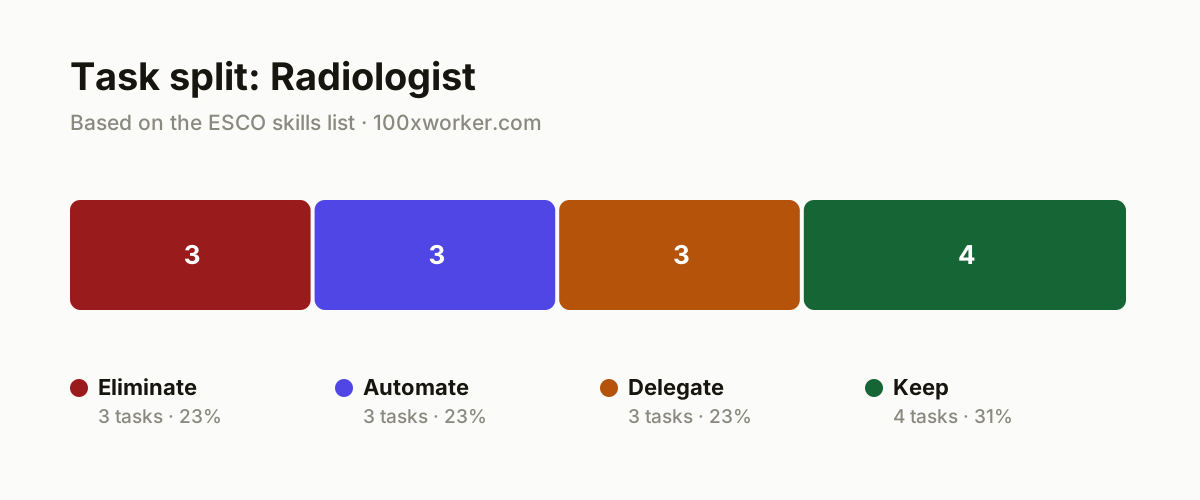
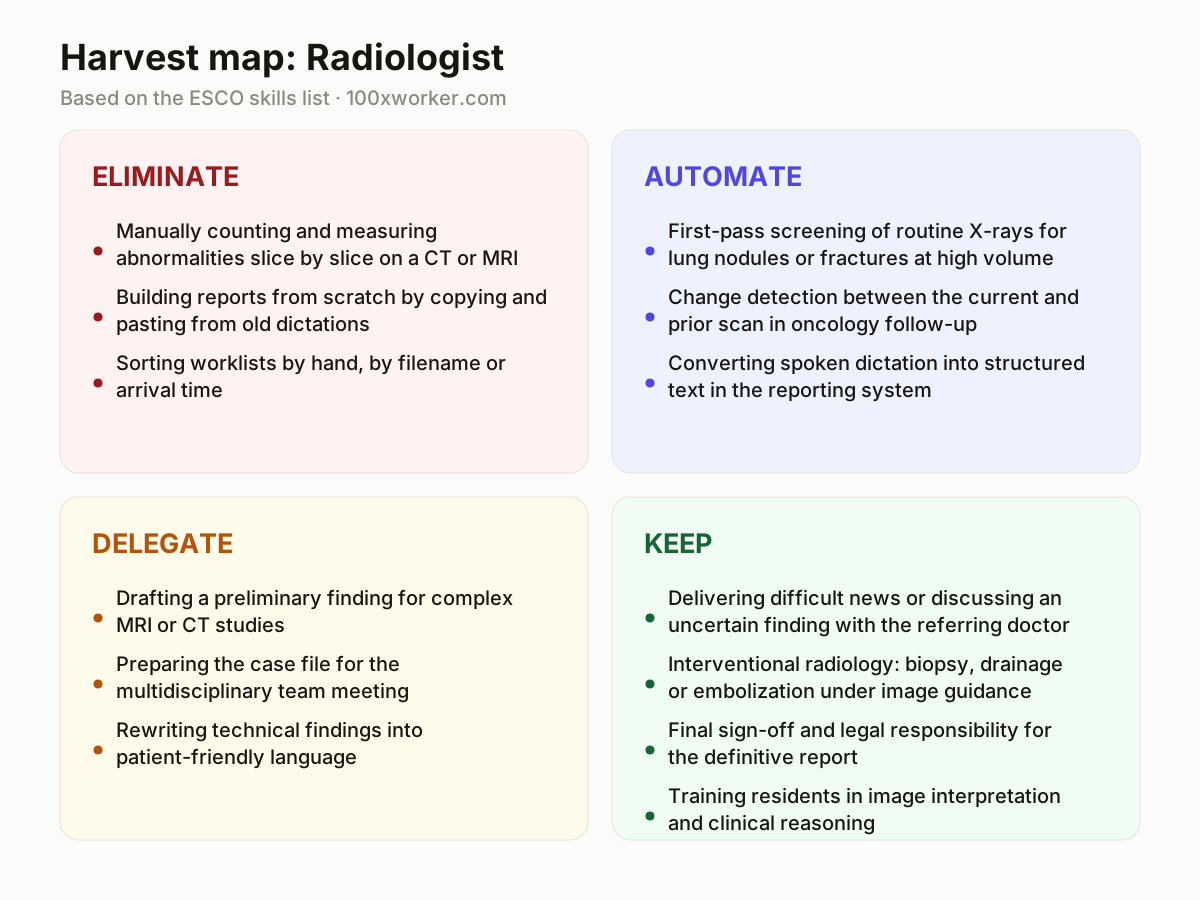
A radiologist's job splits into four buckets: tasks AI eliminates outright, tasks it automates with a human check still attached, tasks you delegate to AI and then verify, and tasks that stay firmly human because they require a body, a signature, or a face-to-face conversation. Sorting the job this way, task by task, gives a clearer picture than any single headline claiming AI will replace doctors.
| Task | Bucket | Why |
|---|---|---|
| Manually counting and measuring abnormalities slice by slice on a CT or MRI stack | eliminate | Segmentation software measures volume faster and more consistently than eyeballing with a mouse. |
| Building reports from scratch by copying and pasting from old dictations | eliminate | Structured reporting templates auto-fill the standard sections for you. |
| Sorting worklists by hand, by filename or arrival time | eliminate | Triage algorithms rank studies by clinical urgency, not by order of arrival. |
| First-pass screening of routine X-rays for lung nodules or fractures at high volume | automate | Detection software flags abnormalities before you open the image, as a safety net. |
| Change detection between the current and prior scan in oncology follow-up | automate | Software overlays images automatically and calculates the volume difference itself. |
| Converting spoken dictation into structured text in the reporting system | automate | Speech-to-text with a template produces a readable draft without manual typing. |
| Drafting a preliminary finding for complex MRI or CT studies | delegate | AI generates a first read, you re-review the full image and correct it. |
| Preparing the case file for the multidisciplinary team meeting | delegate | AI summarizes imaging and history, you check the clinical relevance. |
| Rewriting technical findings into patient-friendly language | delegate | AI rewrites the jargon, you check tone, accuracy and completeness. |
| Delivering difficult news or discussing an uncertain finding with the referring doctor | keep | Transferring trust and responsibility to another person is not something a model can do. (Your edge: Empathy and taking responsibility in an uncertain conversation) |
| Interventional radiology: biopsy, drainage or embolization under image guidance | keep | Guiding a needle inside a living body is a physical act, not text. (Your edge: Physical precision with direct clinical consequences) |
| Final sign-off and legal responsibility for the definitive report | keep | Legal and medical liability sits with the physician, not the system. (Your edge: Legal and ethical final accountability) |
| Training residents in image interpretation and clinical reasoning | keep | Passing on doubt, experience and clinical judgment requires one person facing another. (Your edge: Transferring doubt and clinical judgment to the next generation) |
What tasks can AI take over from a radiologist?
AI takes over the parts of the job that are mechanical and repetitive: measuring lesion size, counting nodules across dozens of slices, comparing a current scan to a prior one pixel by pixel, and turning dictated speech into a structured draft report. These are the eliminate and automate buckets. Detection software also does first-pass screening on high-volume routine studies like chest X-rays, catching obvious findings before the radiologist opens the image. None of this replaces the diagnostic decision itself. It removes the manual labor around that decision, so more of the radiologist's time goes to the images and cases that actually need judgment.
Will AI replace radiologists?
No, not as a profession. Microsoft Research's applicability score puts radiologists at 14.2%, meaning generative AI is demonstrably useful for a small slice of the job's total work activities, well below language-heavy occupations like translation (49%). What AI replaces is specific tasks: routine screening, volumetric measurement, dictation formatting. What stays with the radiologist is everything that requires physical procedure, legal accountability, or a direct conversation with a patient or colleague. The realistic outcome is fewer radiologists doing the mechanical parts of the job and more time spent on complex reads, procedures, and communication.
How does AI change a radiologist's task list, according to research?
Two independent research efforts point the same direction. Microsoft Research's applicability score (14.2% for radiologists) shows generative AI fits a narrow slice of the job compared with language-centric occupations. Anthropic's Economic Index, which maps millions of real AI conversations onto the O*NET task list, finds that most current AI use in medical and technical fields is augmentation (a person checking and finishing AI output), not full automation. Broader adoption data adds context: Eurostat reports that 32.7% of the EU population aged 16-74 used generative AI in the past three months in 2025, showing the tools are now mainstream even outside specialist workflows.
What can you do this month as a radiologist with AI?
Start with the tasks in the eliminate and automate buckets, since they carry the least risk. Turn on speech-to-text dictation with a structured template if your reporting system supports it. Ask your department whether the PACS already has change-detection or measurement tools switched off by default. Try drafting the MDO case summary with AI and compare it against your own notes before your next meeting. Do not start with diagnosis itself. Start with the paperwork and measurement around it, and use the time saved for the reads that actually need your judgment.
Radiologists show one of the lowest AI applicability scores among the occupations analyzed, well below professions built primarily on language and translation tasks.
Microsoft Research, Working with AI: Measuring the Applicability of Generative AI to Occupations (2025)
Become the AI person on your team
Let templates write the boilerplate
Set up structured reporting templates so the standard sections (technique, comparison, clinical history) fill themselves in. Spend your editing time on the findings and impression, not on retyping the same boilerplate for every study.
Treat AI drafts as a first read, not a final one
When AI flags a nodule or drafts a preliminary finding, re-review the full image yourself before signing. Track how often you agree or disagree with the flag, so you build a sense of where the tool is reliable for your case mix.
Reclaim time for procedures and conversations
Every routine task you hand to software (measurement, dictation cleanup, worklist sorting) is time you can put back into interventional cases, complex reads, and the difficult conversations that still require you in the room.
Want this for your actual task list?
The free scan on the homepage builds your personal task map in 30 seconds, based on your role and industry.
Run the free task scanTools for this work
| Tool | For which tasks | The sober take |
|---|---|---|
| Computer-aided detection (CAD) software integrated into PACS | First-pass screening of routine X-rays, chest studies, and mammography | Works as a second reader, not a replacement for your read. |
| Structured reporting templates in the radiology information system (RIS) | Eliminating manual report building and copy-paste dictation | Saves the most time on the highest-volume, lowest-complexity studies. |
| Speech-to-text dictation with clinical vocabulary support | Converting spoken findings into structured draft text | Cuts transcription turnaround but still needs a proofread. |
| Image registration and change-detection software | Comparing current and prior oncology follow-up scans | Automates the overlay math, not the clinical interpretation of change. |
| General-purpose AI assistants (Copilot, Claude) for text tasks | Summarizing case histories for MDO prep, rewriting findings for patients | Useful for language tasks around imaging, not for reading the images. |
Prompts to try today
MDO case summary draft
Patient-friendly rewrite of a technical finding
Structured report skeleton from dictation
Related jobs
Frequently asked questions
Will AI make radiologists redundant in the next few years?
Unlikely in the near term. Microsoft Research's 14.2% applicability score for radiologists shows generative AI fits a narrow slice of the job's total activities. The tasks it handles well (measurement, screening, dictation) are real but bounded. The tasks that remain (procedures, final accountability, patient conversations, training the next generation) make up most of a radiologist's actual working day and are not language-processing problems that current AI is built to solve.
Which part of a radiologist's job is safest from AI?
Interventional procedures and final sign-off. Guiding a needle for a biopsy or drainage is a physical act with direct clinical consequences, not something a model can perform. Signing the definitive report also carries legal and medical liability that sits with the physician by design, not with any software that assisted in drafting it.
Should radiologists resist using AI tools?
No. The research points the other way: AI use in medicine is mostly augmentation, meaning a person checks and finishes the output rather than accepting it blindly. Radiologists who use detection software, structured templates, and dictation tools free up time for the complex reads and procedures that need their judgment. Resisting the tools mostly means doing more manual, low-value work yourself.
How reliable are AI detection tools for screening?
They work best as a safety net on high-volume, routine studies, catching obvious findings a radiologist might rush past under time pressure. They are not a substitute for the full read on complex or ambiguous cases. The available data (Microsoft's applicability score, Anthropic's automation-versus-augmentation split) shows current AI use in this field is concentrated in augmentation, meaning a human is still expected to verify the result before it goes in the final report.
Sources
- Microsoft Research, Working with AI: Measuring the Applicability of Generative AI to Occupations (2025)
- Anthropic Economic Index
- Eurostat, isoc_ai_iaiu (generative AI use, EU population 16-74)
- ESCO, European Commission occupation taxonomy
Hendrik De Winne, author of Becoming AI-Savvy, founder of VibeLab. Helps teams redesign their work with AI.
This article was drafted with AI assistance from public data sources and editorially reviewed.